

Dexterous hands are becoming more compact and more capable.As their size decreases, sensing and transmission design become much harder.The MCP joint is especially challenging because it requires precise angle feedback in a very small space.
In many designs, hall sensors are used for MCP angle sensing.They are compact and suitable for magnetic angle measurement.However, real engineering conditions introduce problems such as magnetic contamination, material shielding, and sealing constraints.
This application note discusses an alternative design approach.Instead of relying on direct MCP joint angle sensing, it evaluates motor-end feedback under a high reduction ratio.It also introduces a whole-hand backlash elimination method to improve reliability and simplify the mechanical design.
MCP Sensor Challenges
In the design of micro dexterous hands, the space for metacarpophalangeal (MCP) joints is extremely limited. To achieve high-precision angle measurement in such a small space, magnetic Hall sensors are almost the only solution in the industry. However, in practical engineering applications, this solution faces severe physical limitations:
1.External Magnetic Contamination Risk:
If a magnet is installed directly on the motor output shaft, the exposed magnetic field easily attracts metal debris and particles in the working environment. This causes serious interference with the sensor signal.
2.Material Shielding and Sealing:
To solve contamination issues, we tried embedding the magnet inside the reducer output shaft and implementing full sealing. However, high-strength reducers usually use stainless steel, which strongly blocks and shields magnetic lines.
This effectively lowers magnetic permeability. It also prevents the external magnetic sensor from sensing effectively. This material property still lacks a perfect direct solution in current miniaturized packaging.
Accuracy Analysis
Facing these challenges, we re-evaluated the system’s overall accuracy requirements. In fact, relying solely on motor-end feedback already meets the dexterous hand’s grasping needs. No complex secondary measurement at the MCP joint is needed.
We evaluated two solutions:
Solution A: High-Resolution Encoder + High Reduction
We used an industry-leading in-house configuration. A 16-bit absolute encoder is mounted on the motor rear end. The transmission system uses a planetary gearbox (28:1) and a worm gear reducer (20:1) in series.
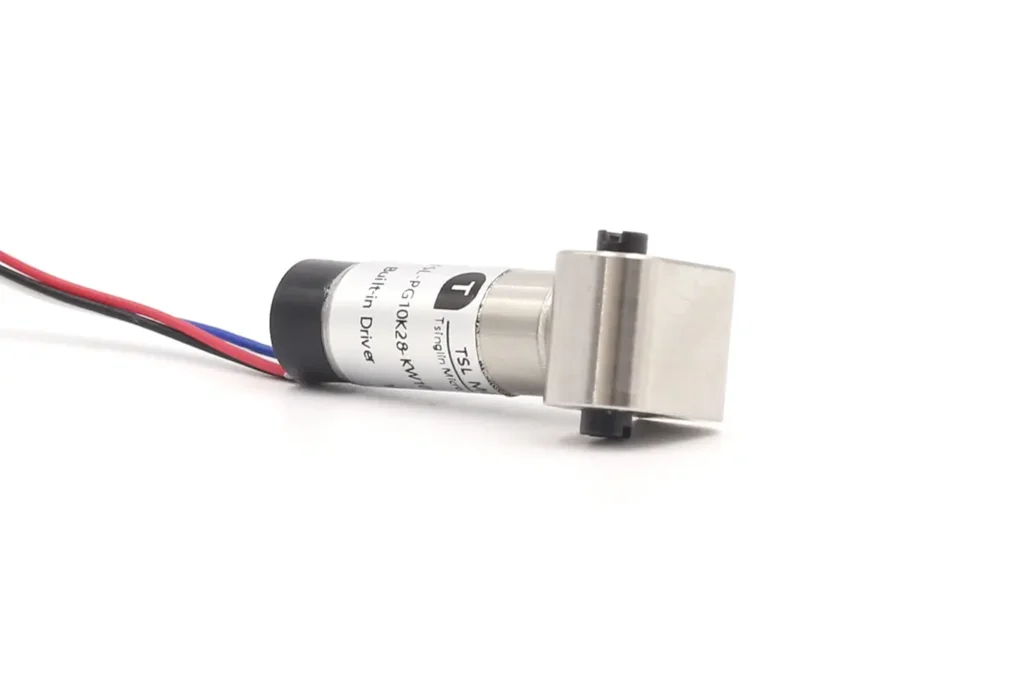
The total reduction ratio reaches 560:1. At this ratio, tiny motor resolution is amplified hundreds of times. From the whole-hand perspective, the end positioning accuracy has a large margin and fully supports high-precision operations.
Solution B: Low-Cost Hall Element
Experiments show that even without an expensive absolute encoder, directly attaching a standard Hall element to the motor rear end for commutation counting, combined with 560:1 reduction ratio, fully meets the output-end angle resolution requirements.
Whole-Hand Backlash Solution
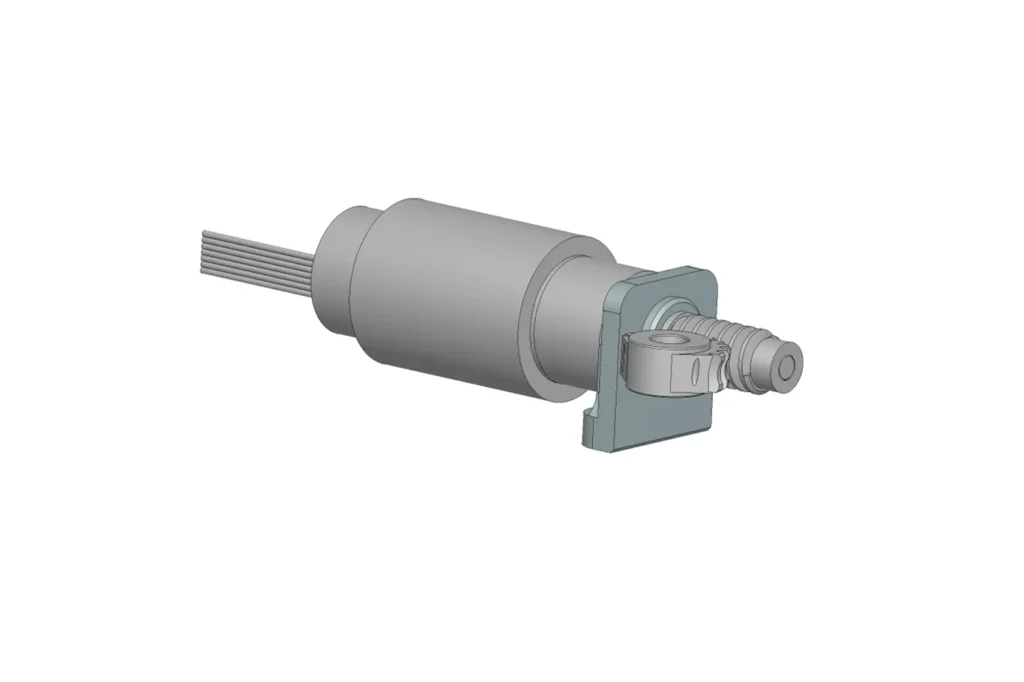
After solving accuracy and sensor selection issues, the transmission chain backlash becomes a key factor affecting performance. Although worm gears have self-locking advantages, inherent backlash and wear are unavoidable.
Initially, we tried local backlash elimination at the MCP joint. In practice, even if zero backlash is achieved at the MCP joint, the PIP and DIP joints still develop mechanical play over long-term operation.
Our experience shows that instead of complex local elimination inside each micro joint, which increases mechanical complexity and failure rate, it is better to adopt a “whole-hand system-level backlash elimination” solution.
By adding a tension spring in the linked finger mechanism, the mechanical preload simultaneously eliminates backlash across MCP, PIP, and DIP. This “simplify to control complexity” system-level design not only greatly reduces single-joint machining and assembly difficulty, but also significantly improves the dexterous hand’s overall lifespan and robustness.