
In high-end medical devices, thermal management directly affects safety and regulatory compliance for small, high-power motors. Devices such as surgical robot actuators and precision therapy terminals often come into direct or indirect contact with the human body. International medical safety standards (e.g., IEC 60601-1) impose very strict limits on surface temperature rise.
Under these high standards, commonly used coreless motors lack continuous metal paths for heat conduction. Under high load, they easily overheat, failing to meet intensive cooling requirements.
Therefore, slotted torque motors (Frameless/Housed Torque Motor) are a better choice. To address the temperature rise bottleneck under small size and high-power conditions, precise thermal management must consider three core dimensions: motor housing, winding, and iron core.
Optimizing Housing and Interface Thermal Resistance
In micro high-power motors, internally generated heat must be conducted via the shortest path to external cooling media.
High thermal conductivity material selection:
The motor housing must use aluminum with high thermal conductivity. Compared to stainless steel or plastic, aluminum can rapidly transfer internal heat with minimal thermal resistance.
Interface thermal resistance (TIM) and tight contact:
During system assembly, the motor’s external mounting surface must tightly attach to the device’s aluminum base (equivalent to a system-level heat sink) with high precision and pressure. Maximizing contact area reduces interface thermal resistance and achieves efficient “housing-base” integrated cooling.
Improving Winding and Insulation System
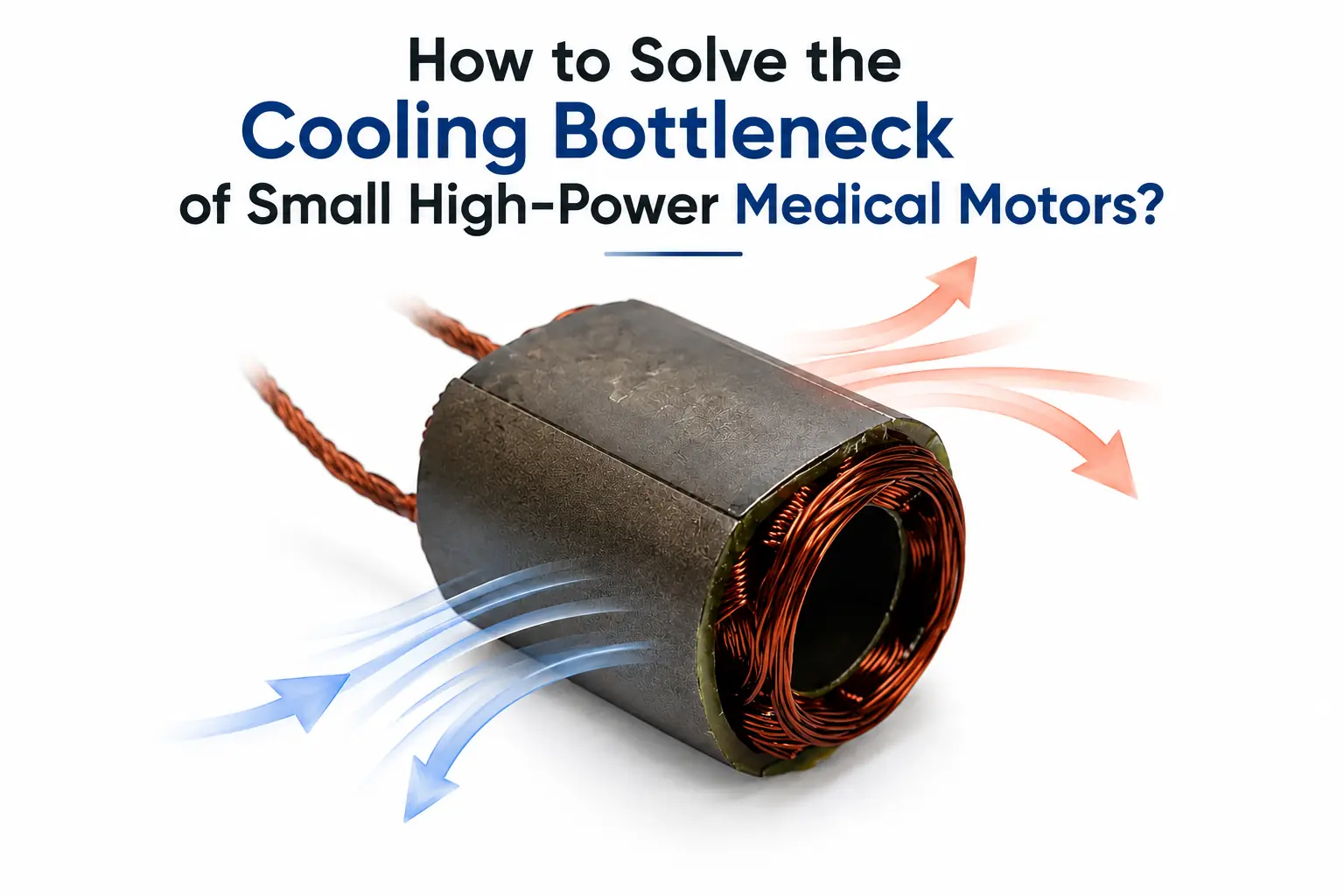
Winding: The motor winding is the primary heat source (copper loss). In small, high-power designs, both the thermal limit and heat dissipation efficiency of the winding must be enhanced.
High-temperature enamel wire: Windings must use high-temperature enamel wire to ensure that insulation does not degrade under transient high current overload.
Vacuum potting and encapsulation: After winding, vacuum impregnation, potting, and high-thermal-conductivity insulation materials must be applied. Traditional air gaps are poor thermal conductors. Using high-conductivity epoxy to fill gaps inside the coils not only improves electrical insulation and mechanical rigidity but also establishes an efficient solid heat conduction path between the winding and stator core.
Stator Core Material Innovation
Besides copper loss, stator iron losses under high-frequency alternating magnetic fields (hysteresis and eddy current loss) are major causes of heat in small high-power motors.
Use of amorphous alloy iron cores: To suppress heat generation from the source, stator cores should break away from traditional silicon steel laminations and use amorphous materials.