
At a Glance
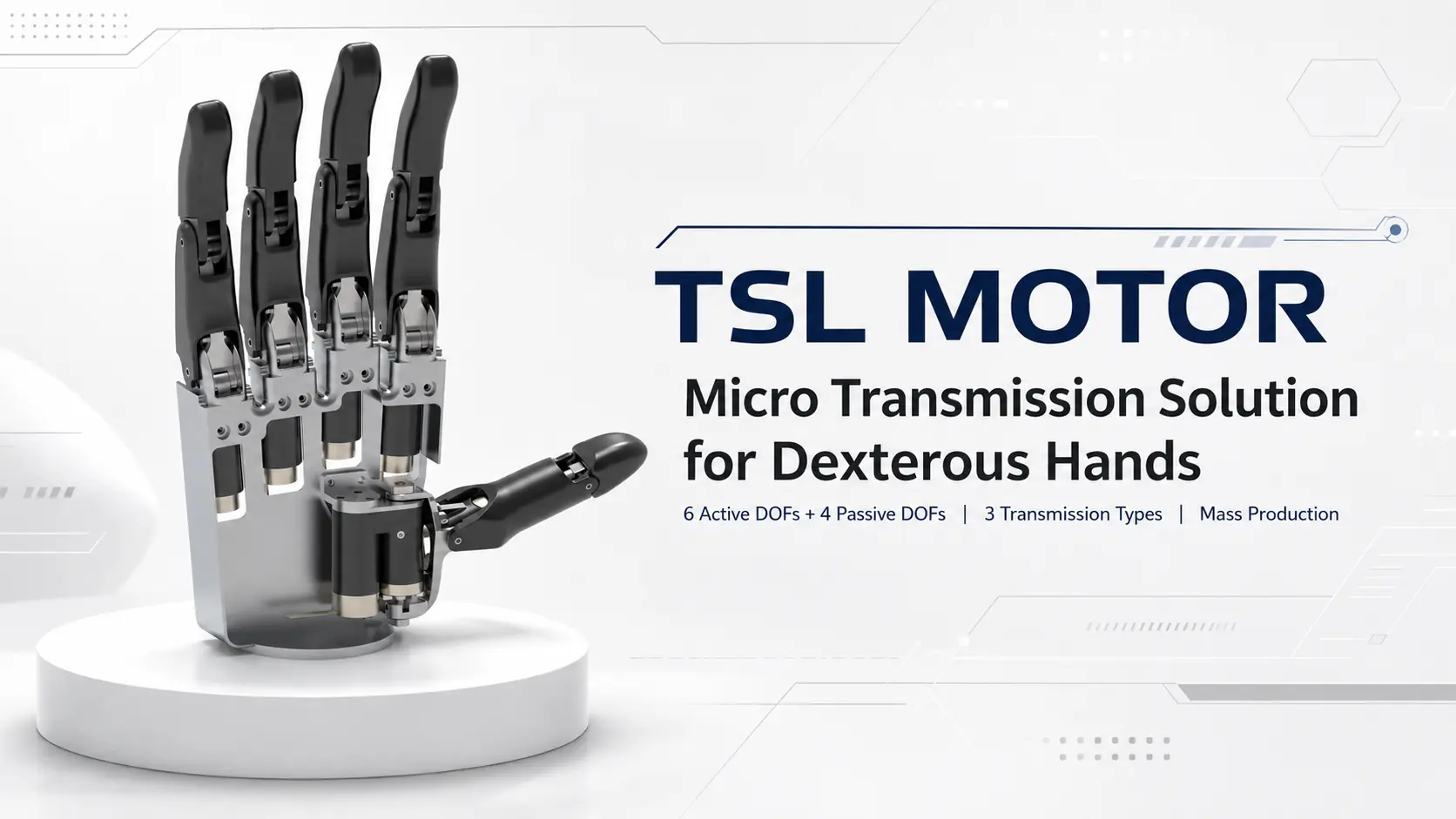
This 10-DOF dexterous hand uses 6 active and 4 passive DOFs, driven by six micro actuator modules in a 4+1+1 configuration. Three transmission types are combined to achieve compact integration, flexible motion, and reliable performance, with the solution now in mass production.
With the rapid development of humanoid robots, service robots, and precision manipulation equipment, dexterous hands are gradually moving beyond laboratory research and into practical applications.
In this case, the customer was developing a dexterous hand with a reduced number of active degrees of freedom. The hand has 10 mechanical degrees of freedom in total, including 6 active DOFs and 4 passive DOFs. Six micro actuator modules are used to independently drive the four fingers, as well as the thumb abduction/adduction and flexion movements.
Considering the differences among the joints in terms of installation space, torque requirements, motion type, and feedback control, TSL MOTOR did not use one identical standard geared motor for all joints. Instead, three different types of micro actuator modules were selected and adapted around the overall mechanical architecture of the hand.
The final solution consists of four MCP joint drive modules, one thumb abduction/adduction module, and one thumb IP joint drive module, forming a complete actuation and transmission system for the dexterous hand.
Solemn statement: The design solution in this case has been officially approved by the customer for public release. We always fully respect our customers’ brand privacy and core technology NDAs. The motor structure and drive design are independently developed patented products of our company.
Key Challenges in Dexterous Hand Transmission Design
Designing actuators for a dexterous hand is not simply a matter of selecting several small geared motors.
First, space inside the palm is extremely limited. Four MCP actuators must be installed within the palm at the same time. If the motor diameter, gearbox length, or output direction is unsuitable, the actuators can easily interfere with the palm frame, linkages, or other mechanisms.
Second, different joints have very different transmission requirements. The four MCP joints place greater emphasis on output torque and low-speed stability. The thumb IP joint requires motion transmission through a lead screw and linkage mechanism, while the thumb abduction/adduction joint places greater emphasis on compact installation and position feedback.
For this reason, TSL MOTOR designed the system from the perspective of the complete hand architecture and divided the six actuators into three categories, respectively matching the MCP joints, thumb IP joint, and thumb abduction/adduction joint.
Four-Finger MCP Joints
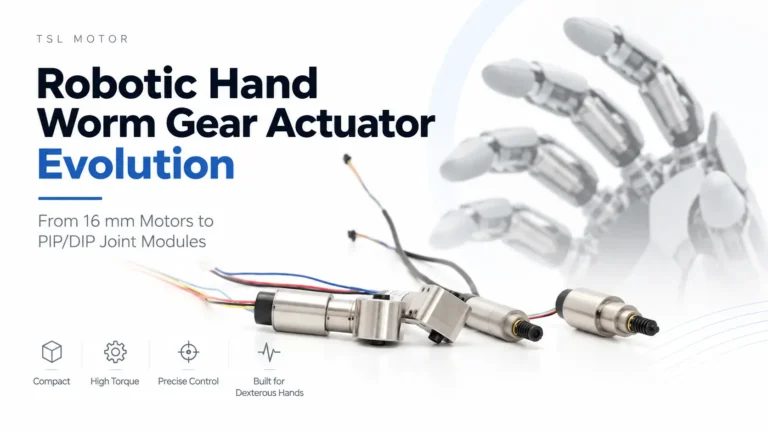
The MCP joints of the index, middle, ring, and little fingers each use one PG10K28-KW1317+LG04M20Z actuator module, for a total of four units.
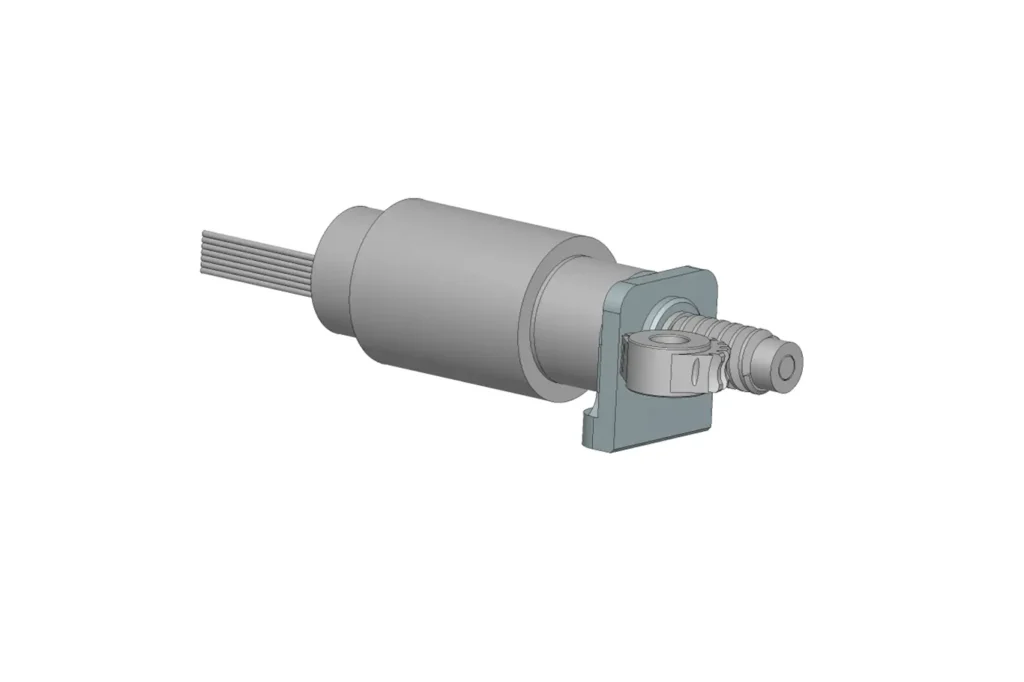
The module combines a 13 mm coreless brushless DC motor, a 10 mm planetary gearbox, and a worm gear mechanism. The total reduction ratio is 1:560, the rated output speed is 30 ±10% RPM, and the rated torque is no less than 2500 g·cm.
Because the MCP joints carry the main gripping loads, output torque and low-speed stability are more important than high rotational speed. The module therefore adopts a multi-stage transmission system combining a planetary gearbox with a worm gear mechanism. This provides speed reduction and torque multiplication while also changing the output direction by 90°.
This right-angle transmission layout allows the motors to be arranged compactly along the palm, while the output shafts can be aligned more closely with the finger joint axes. As a result, the four active MCP joints can be independently driven while reducing space consumption in the palm thickness direction.
Thumb IP Joint
The thumb IP joint uses the PG13K25-KW1317-SG04+MA1024 actuator module.
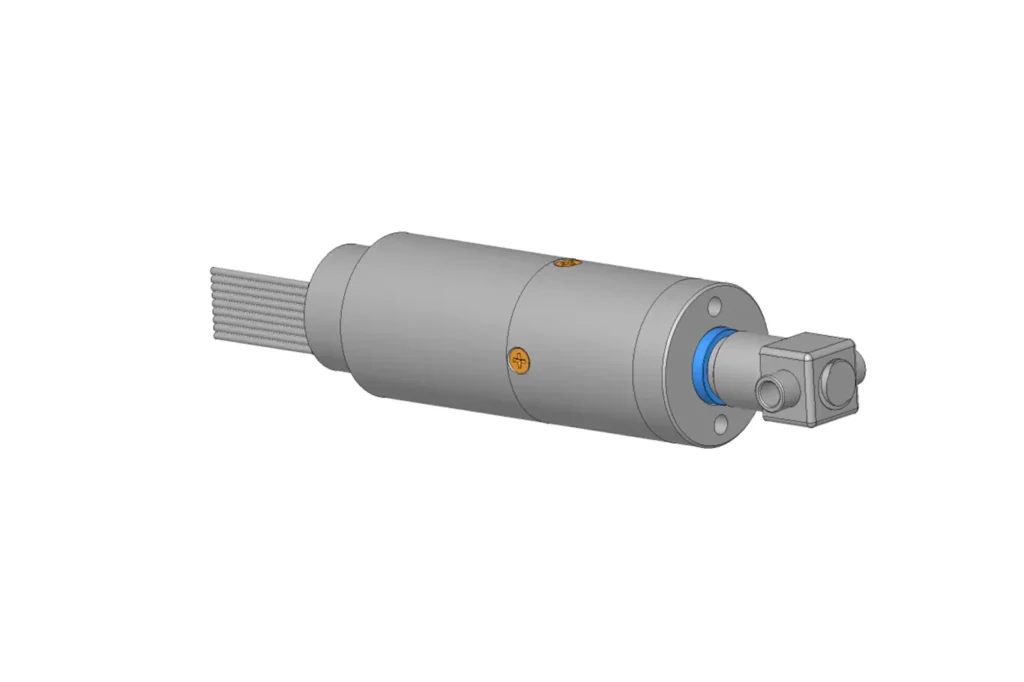
The actuator consists of a 13 mm coreless brushless DC motor, a 1:25 planetary gearbox, a trapezoidal lead screw mechanism, and an encoder. Its rated speed is 720 ±10% RPM, its rated torque is no less than 220 g·cm, and it integrates a 3-channel, 1024 PPR magnetic encoder.
Unlike the MCP joints, the thumb IP joint does not use direct rotary output. Instead, the lead screw converts motor rotation into linear displacement, which is then transferred through a linkage mechanism to drive the joint.
This arrangement allows the actuator to be installed inside the palm, reducing the size and mass of the moving components at the distal part of the thumb. It also makes it easier to adjust the joint range of motion and force output by changing the lead screw travel, linkage length, and force application point.
The integrated encoder provides the hardware foundation for position feedback and closed-loop control of the thumb IP joint.
Thumb Abduction/Adduction Joint
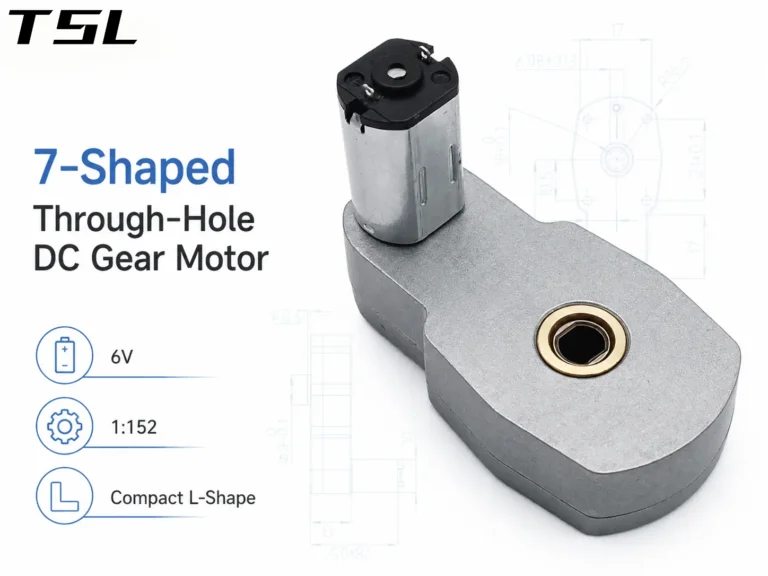
The thumb abduction/adduction joint uses the PG13K100-KW1317+MA1024 inverted actuator module.
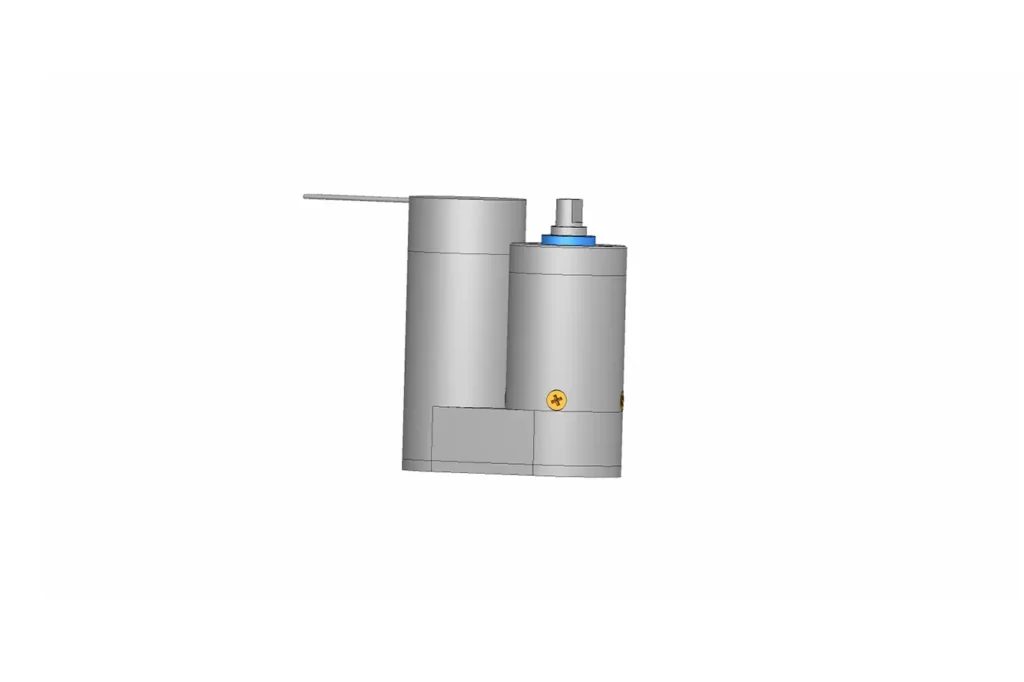
The module has a reduction ratio of 1:100, a rated speed of 180 ±10% RPM, a rated torque of no less than 0.08 N·m, and an integrated 3-channel, 1024 PPR encoder.
Thumb abduction/adduction is an important degree of freedom for opposition, lateral pinch, and enveloping grasp. However, space around the base of the thumb is extremely limited, and the actuator must avoid interference with the flexion mechanism, palm frame, and other components.
For this reason, a compact inverted layout was adopted. By offsetting the motor and reduction mechanism, the module improves space utilization within the palm. The overall module is approximately 30.2 mm long and 26 mm high, making it suitable for compact installation near the thumb base.
How Six Actuators Drive Ten Degrees of Freedom
The complete hand has 10 mechanical degrees of freedom. Six are actively driven by actuator modules, while the remaining four operate passively through mechanical coupling mechanisms.
Each of the four MCP joints has an independent actuator, allowing the index, middle, ring, and little fingers to adjust their movements individually according to the shape of the object being grasped. Compared with a simple underactuated solution in which one motor synchronously drives all four fingers, this architecture provides better grasp adaptability.
The thumb has two active degrees of freedom, responsible for abduction/adduction and IP joint movement. These motions allow the thumb to change its posture and form different grasping combinations with the other four fingers.
The remaining four degrees of freedom achieve coordinated movement through mechanical coupling. This approach preserves the essential multi-joint motion capability of the dexterous hand while reducing the number of actuators, drive channels, and overall control complexity.
Solution Value and Customer Feedback
After solution design, structural adaptation, prototype testing, and complete hand validation, the customer successfully completed product development based on the TSL MOTOR transmission solution and has now entered mass production.
The complete system uses three types of micro transmission modules to address the different requirements of the hand: high-torque output for the MCP joints, linear transmission for the thumb IP joint, and compact installation for the thumb abduction/adduction joint. This enabled the project to progress from individual actuator selection to complete hand actuation system integration.
The combination of 6 active DOFs and 4 passive DOFs achieves a practical balance among flexibility, weight, overall size, and system complexity. Compared with an architecture in which every joint is independently motorized, this solution reduces the number of motors and drive channels while retaining independent four-finger actuation and the key motion capabilities of the thumb.
The customer provided positive feedback on the structural adaptability and engineering feasibility of the transmission solution. From early-stage requirement analysis and transmission concept selection to mechanical interface adaptation, prototype testing, and full-system validation, the project was successfully completed and ultimately moved into mass production.
Flexible Micro Actuation Systems for Dexterous Hands
There is no single motor solution suitable for every dexterous hand.
The number of degrees of freedom, palm dimensions, required grip force, motion speed, and control strategy all affect actuator selection and transmission design.
TSL MOTOR provides integrated development support for dexterous hands, humanoid robots, robotic grippers, and other precision actuation systems, including coreless motors, brushless DC motors, planetary gearboxes, worm gear mechanisms, lead screw actuators, and encoder modules.
From motor performance, reduction ratio, and output direction to lead screw specifications, mounting interfaces, feedback methods, and overall internal layout, each element can be customized around the actual mechanical structure of the application.
For a dexterous hand, a well-designed transmission system is not simply about adding more actuators. The real goal is to place each actuator where it delivers the greatest value and to use effective mechanical design to create a coordinated and efficient hand actuation system.