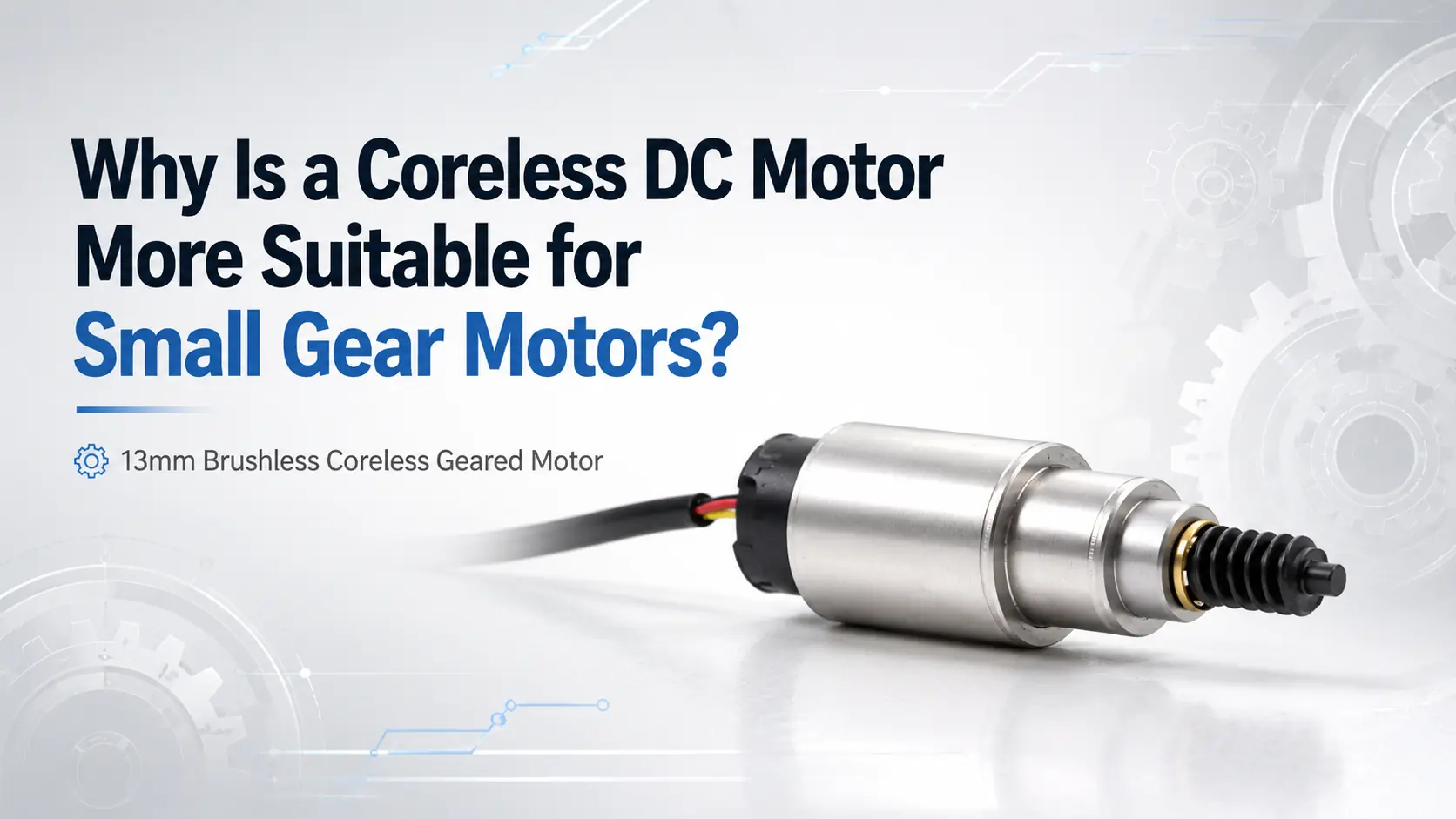

By replacing the traditional iron core with a self-supporting copper winding, a coreless motor completely eliminates cogging torque to deliver ultra-smooth rotation and low noise. Its exceptionally low rotational inertia enables instant start-and-stop responsiveness, making it the ideal high-power-density driving solution for space-constrained 6mm to 16mm micro gear motors used in robotic dexterous hands and precision medical devices
Coreless dc motor is a common type of motor used in micro drive systems.
Its main feature is that it eliminates the traditional slotted iron-core winding and uses an ironless or slotless winding structure. As a result, the motor can be made smaller and lighter, while also running more smoothly.
According to the commutation method, coreless motors can be divided into coreless brushed motors and coreless brushless motors. Both can be used in micro gear motors, but they differ significantly in control method, service life, cost, and suitable applications.
A Coreless Motor Is Not the Same as a Brushed Motor
A coreless DC motor uses a cup-shaped self-supporting coil as the rotor and completes mechanical commutation through brushes and a commutator. Therefore, when many customers hear the term “coreless motor,” they immediately think of a small brushed DC motor with two wires.
“Coreless” mainly describes the winding and magnetic-circuit structure, while “brushed” and “brushless” describe how the motor completes commutation.
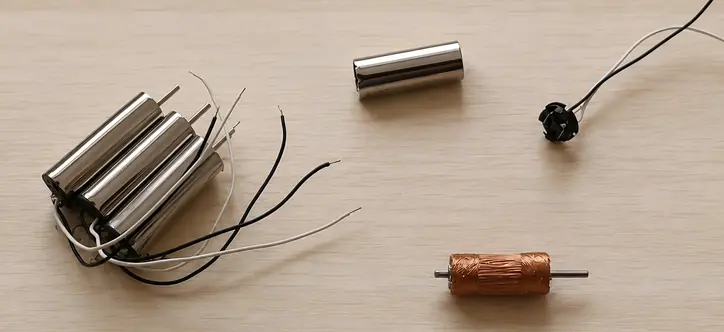
Therefore, a coreless motor can use either brushed commutation or brushless electronic commutation.
More precisely, related products on the market mainly fall into two categories:
One category is the coreless brushed DC motor, also known as a coreless brushed dc motor. The other category is the coreless brushless DC motor, which is also often called a coreless bldc motor, ironless bldc motor, or slotless brushless dc motor.
Some manufacturers prefer the term “coreless brushless,” while others emphasize “slotless brushless.” Although the specific magnetic-circuit design may vary, these terms usually highlight the absence of traditional stator slots, low torque ripple, and smooth operation.
Professional motor manufacturers may also offer both brushed ironless motors and brushless slotless motors. Portescap divides brushless DC motors into slotted and slotless types, with the slotless structure using a self-supporting cylindrical ironless coil.
What Is a Coreless Brushed DC Motor?
A coreless brushed motor uses a mechanical commutation structure.
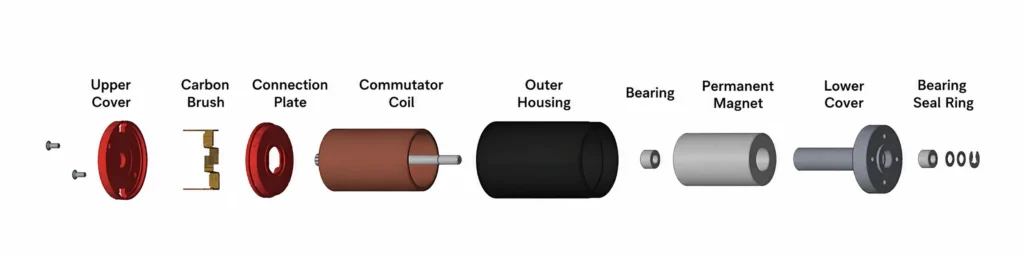
Working Principle
Its winding is usually made into a thin-walled cup-shaped or basket-shaped coil and mounted on the shaft. When the motor runs, the coil rotates around the internal permanent magnet.
Because there is no traditional silicon-steel iron core in the rotor winding, the rotor is lighter and has lower rotational inertia.
Current enters the rotor coil through the brushes and commutator. As the rotor moves to different positions, the commutator changes the direction of current in the coil, allowing the rotor to rotate continuously.
Main Features
The control method of a coreless brushed motor is relatively simple.
In basic applications, the motor can run simply by connecting it to a suitable DC power supply. Reversing the positive and negative terminals of the power supply usually changes the direction of rotation.
When speed adjustment is required, the supply voltage can be changed, or a PWM controller can be used for speed control.
Because a dedicated three-phase brushless driver is not required, the control circuit of a coreless brushed motor is simpler, and debugging is relatively easier.
At the same time, because the coreless rotor is lightweight, the motor usually responds quickly during start, stop, forward rotation, and reverse rotation.
Main Applications
Coreless brushed motors are suitable for small devices with simple structures, limited installation space, and sensitivity to control-system cost.
Common applications include electronic locks, micro pumps, small electric grippers, massage devices, toy mechanisms, and simple automation devices.
For some small actuators that run only for a few seconds each time and are not used frequently, a coreless brushed motor can usually meet the basic drive requirements.
Coreless brushed motors can also be combined with planetary gearboxes, spur gearboxes, or worm gearboxes for equipment that requires low speed and higher output torque.
Main Limitations
The main limitation of a coreless brushed motor comes from its brushes and commutator. During operation, the brushes remain in contact with the commutator, generating friction and wear.
As operating time increases, the condition of the brushes and commutator may change, affecting the motor’s service life and operating stability.
The actual service life of the motor is affected by factors such as speed, current, load, starting frequency, number of forward/reverse operations, and operating temperature.
If the device needs long-term continuous operation, or if it must complete many start-stop and reversing actions every day, the brush life must be carefully evaluated.
In addition, mechanical commutation may generate a certain level of electrical noise and sparks. Therefore, a coreless brushed motor may not be suitable for equipment with special requirements for electromagnetic interference or operating environment.
What Is a Coreless Brushless Motor?
A coreless brushless motor does not use mechanical brushes or a commutator. Instead, it completes commutation through electronic control.
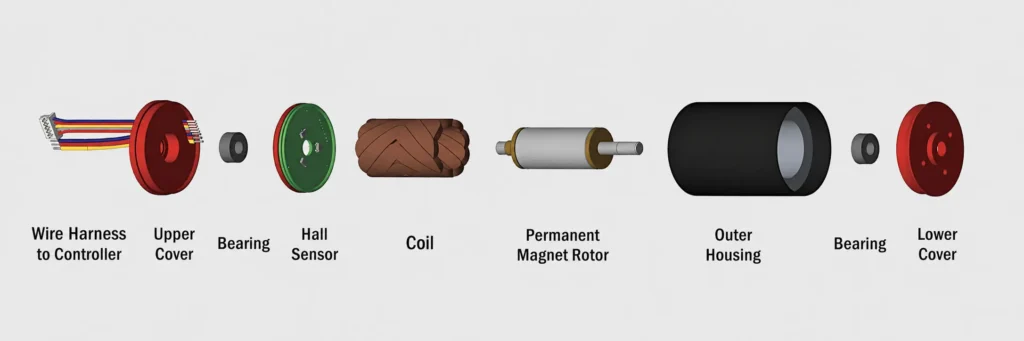
Working Principle
It usually consists of a permanent-magnet rotor, slotless or ironless stator winding, bearings, and an electronic drive system. Unlike a coreless brushed motor, the winding of a coreless brushless motor usually remains stationary, while the permanent-magnet rotor rotates.
The controller energizes different windings in a specific sequence according to the rotor position, forming a continuously changing rotating magnetic field that drives the rotor.
Therefore, a coreless brushless motor cannot run simply by connecting two power wires like an ordinary brushed motor. It requires a matched electronic driver.
Main Features
A coreless brushless motor has no brushes or commutator, so it does not have the problem of continuous brush friction and wear.
Under reasonable load and operating-temperature conditions, it is usually more suitable for long-term operation and for frequent starting, stopping, and reversing.
The slotless or ironless winding can reduce torque ripple caused by the teeth and slots of a traditional iron core, making the motor run more smoothly. This structure is also helpful for achieving higher speeds and reducing cogging at low speeds.
Coreless brushless motors usually use three-phase electronic commutation.
Some models are equipped with Hall sensors, which detect rotor position and make starting and low-speed control more stable. Some products can also use sensorless control, but starting performance, low-speed stability, and control accuracy will be affected by the drive algorithm.
Main Applications
Coreless brushless motors are suitable for equipment with higher requirements for service life, speed, noise, and control performance. Common applications include medical devices, robot joints, dexterous hands, prostheses, micro pumps, precision instruments, and automation equipment.
In equipment that requires long-term continuous operation, the brushless structure can reduce maintenance problems caused by brush wear. In systems that require frequent start-stop operation and forward/reverse rotation, coreless brushless motors are also more suitable.
If the device requires speed control, position control, or torque control, Hall sensors, encoders, and closed-loop controllers can also be used.
Coreless brushless motors can also be combined with micro planetary gearboxes, spur gearboxes, or worm gearboxes to form compact, high-response geared drive solutions.
Main Limitations
Coreless brushless motors require matched electronic drivers, so their control and wiring are more complex than those of coreless brushed motors. In addition to power wires, some models also need three-phase wires, Hall sensor wires, and encoder wires.
If precise position control is required, an encoder, controller, and related feedback circuits may also be needed. This increases the difficulty of system design, wiring, and debugging.
The motor body and supporting control system of a coreless brushless motor are usually more expensive than a simple coreless brushed motor.
In products with extremely limited installation space, it is necessary to consider not only the size of the motor and gearbox, but also the space required for the driver, sensors, and connection cables.
Therefore, although coreless brushless motors offer advantages in service life and control performance, they are not necessarily suitable for all low-cost products or products with simple control requirements.
TSL MOTOR Coreless Motors Include Both Brushed and Brushless Types
Taking TSL MOTOR products as an example, coreless products are not limited to a single brushed motor series.
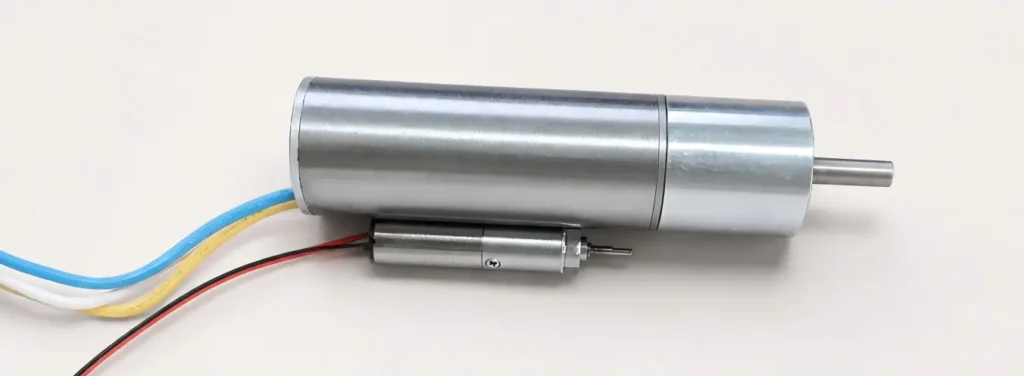
TSL MOTOR offers coreless brushed motors, such as TSL-KS1015, as well as a variety of small-diameter 4 mm, 6 mm, 7 mm, and 10 mm coreless dc motors.
These products mainly use a traditional coreless brushed structure and are suitable for equipment that requires small size, simple control, and fast response.
TSL MOTOR also offers coreless brushless motors and geared motors. For example, TSL-PG16K84-KW1630 combines a coreless brushless motor with a 16 mm planetary gearbox. TSL-PG13K256-KW1317 uses a 13 mm coreless brushless motor with a planetary gearbox.
In addition, there are products that combine coreless brushless motors with micro worm gearboxes.
This shows that the coreless structure is not limited to brushed commutation. Depending on application requirements, customers can choose either a coreless brushed motor or a coreless brushless motor.
TSL MOTOR’s public product system covers 8–16 mm brushed and brushless coreless motors, and can be combined with gearboxes, encoders, and drive-control solutions.
Why Are Coreless Structures Commonly Used in Small-Diameter Motors?
One of the most obvious advantages of a coreless motor is that it is well suited for miniaturization.
When the motor diameter is only 6 mm, 8 mm, 10 mm, 12 mm, 13 mm, or 16 mm, the available internal space is extremely limited. Bearings, shaft, winding, magnets, housing, and end caps all need to fit within a very small diameter.
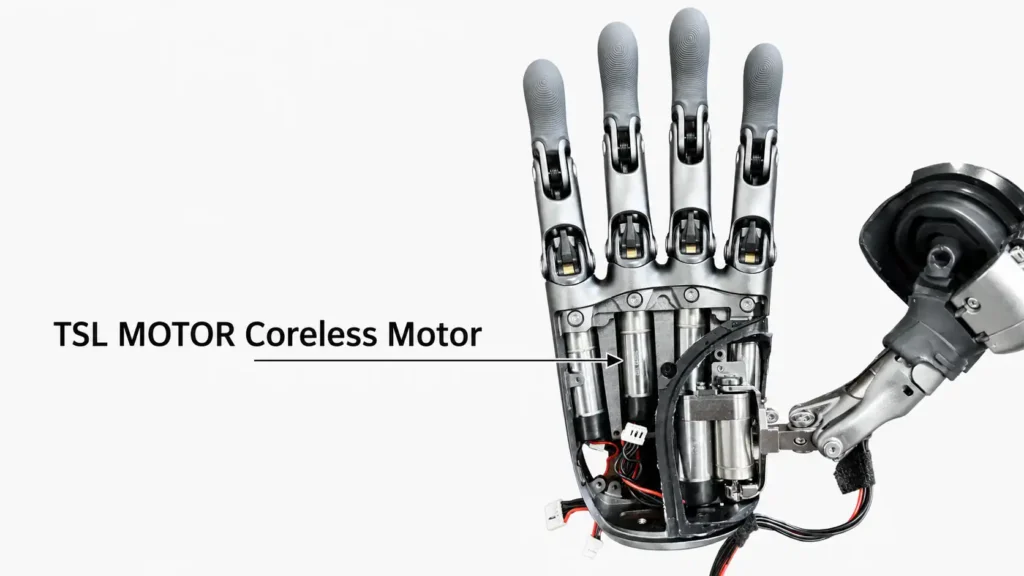
A traditional iron-core motor needs iron-core teeth and slots, with the winding placed in the slots. As the size continues to decrease, winding, insulation, and assembly become increasingly difficult.
A coreless or slotless structure reduces the space occupied by a traditional slotted iron core, making it possible to arrange effective windings within a smaller diameter.
Therefore, coreless motors can be made relatively slim and long, and they are easier to use in products with limited space.
This does not mean that all 6–16 mm motors are coreless motors. Small-diameter iron-core brushed motors and small-diameter slotted brushless motors also exist on the market.
However, in micro drive applications with higher requirements for size, weight, response speed, and smooth operation, the coreless solution is very common.
Why Are Coreless Motors Often Combined with Gearboxes?
Small-diameter coreless motors usually have high speed, but the torque that the motor body can directly output is limited. Many devices require lower speed and higher output torque.
For example, a robot finger does not need tens of thousands of revolutions per minute, but it does need to pull a joint steadily.
An electronic lock does not need high-speed continuous rotation, but it must overcome the resistance of the lock cylinder and mechanical structure at startup.
A micro valve needs to change position slowly and steadily, and it cannot directly use the motor’s original high-speed output.
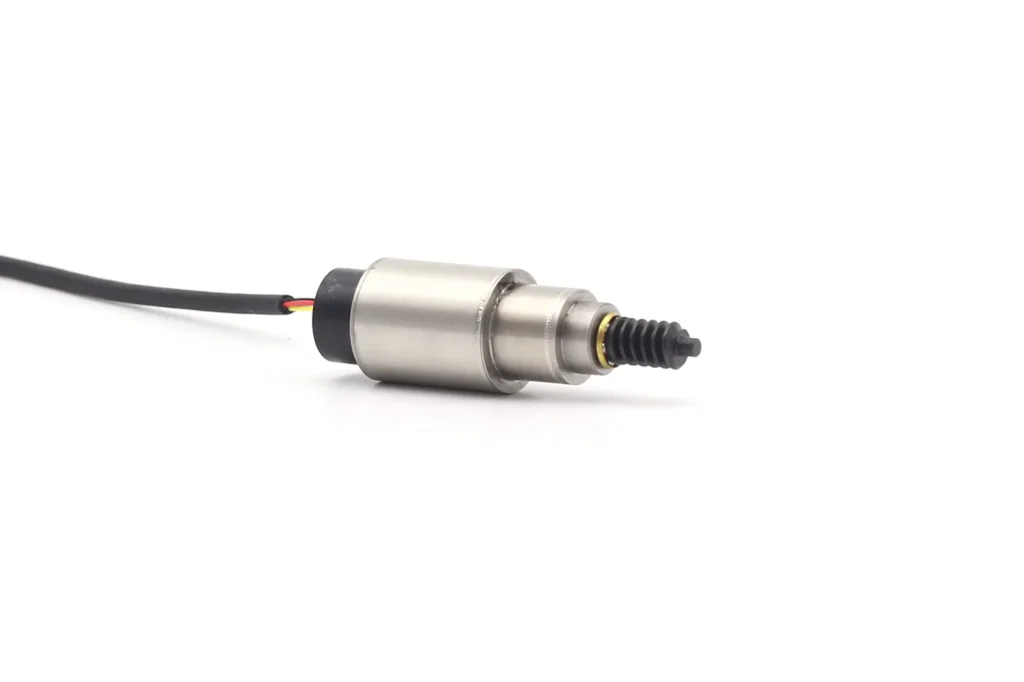
Therefore, coreless motors are often used together with gearboxes. The motor runs in a higher speed range, while the gearbox reduces speed and increases output torque within a reasonable range.
Small-diameter coreless motors can be combined with planetary gearboxes, spur gearboxes, or worm gearboxes.
Among them, micro planetary gearboxes are relatively common. A planetary gearbox adopts a coaxial structure and can arrange multiple planet gears within a small diameter, making it suitable for slim micro gear motors.
A worm gearbox can change the output direction. When the motor shaft and output shaft need to be arranged at 90 degrees, a worm gearbox is more convenient.
Why Are Coreless Motors Often Selected for 6–16 mm Gear Motors?
The 6–16 mm range is a typical size range for micro gear motors. This size range is commonly seen in dexterous hands, micro robots, prostheses, medical devices, small pumps, precision instruments, and portable devices.
These products usually have very limited internal installation space. Sometimes, a robot finger must accommodate a motor, gearbox, lead screw, sensors, wiring, and structural parts at the same time.
In this situation, every millimeter reduction in motor diameter may determine whether the entire product can be assembled. A coreless structure reduces the weight of the rotating parts and helps reduce motor diameter. Low rotational inertia also allows the motor to start, stop, and change direction more quickly.
This is important for devices that frequently rotate forward and reverse.
For example, the fingers of a dexterous hand do not always rotate in one direction. They must constantly adjust gripping force and joint position. If the rotor inertia is too high, the motion response becomes slower.
If the motor has obvious cogging torque, low-speed motion may also become less smooth.
Therefore, a small-diameter coreless motor is not only “small in size.” It is also suitable for precision micro mechanisms because of its fast response and smooth low-speed performance.
What Products Are Suitable for Coreless Brushed Gear Motors?
Coreless brushed gear motors are more suitable for products with uncomplicated control requirements. They can be powered directly by a DC power supply and can also use a simple H-bridge for forward and reverse rotation.
If a product only requires on/off operation, forward rotation, reverse rotation, and basic speed control, the brushed solution is usually easier to implement. The drive board for a coreless brushed motor is smaller, and the control program is relatively simple.
Therefore, during the early stage of product development, it can shorten prototype debugging time.
If the device only runs for a few seconds each time, is not used frequently, or does not have especially long design-life requirements, a coreless brushed gear motor usually offers good cost advantages.
For example, electronic locks, small switching mechanisms, disposable medical devices, consumer products, and short-stroke actuators can all consider a coreless brushed solution.
However, if the motor needs to run at high speed for a long time, or if it must start and stop many times every day, it is necessary to check whether the brushes and commutator can meet the service-life requirements.
What Products Are Suitable for Coreless Brushless Gear Motors?
Coreless brushless gear motors are more suitable for equipment with higher requirements for service life, noise, and control performance. Because there is no contact wear between brushes and commutator, a brushless motor is more suitable for long-term operation. It is also more suitable for high-speed operation.
When used with Hall sensors or encoders, it can also achieve closed-loop speed control, closed-loop position control, and torque control.
Coreless brushless gear motors have high application value in robot joints, dexterous hands, prostheses, medical pumps, surgical tools, and precision automation equipment.
These devices usually require not only motor rotation, but also accurate motor control.
For example, a dexterous hand needs to know where the finger has moved. A prosthesis needs to adjust movement speed according to the user’s control signal. A precision pump needs to control the amount of liquid delivered each time.
These applications are more suitable for a complete closed-loop drive system consisting of a brushless motor, encoder, gearbox, and driver.
However, the brushless solution requires more controllers and wiring. In devices with very tight space, it is not enough to consider only the size of the motor body. Space must also be reserved for the drive board, sensors, and connection cables.
Main Advantages of Coreless Motors
The first advantage of a coreless motor is its small size.It can provide practical speed and power within a small diameter, making it suitable for products with limited installation space.
The second advantage is low rotational inertia.The rotor or slotless magnetic-circuit structure is relatively light, which helps improve starting, stopping, and reversing speed.
The third advantage is smooth operation.Without traditional iron-core teeth and slots, cogging torque and torque ripple can usually be reduced.
The fourth advantage is suitability for high-speed operation.The ironless or slotless structure reduces part of the iron loss, which is beneficial for high-speed motors.
The fifth advantage is that it can easily form a micro drive module.A coreless motor can be combined with a gearbox, encoder, lead screw, and driver to form a complete compact actuator.
However, these advantages must be evaluated according to the specific design.
Whether the motor is quiet will also be affected by the bearings, dynamic balancing, gearbox precision, and assembly quality.
Whether the motor is efficient will also be affected by the winding, voltage, load point, controller, and gearbox efficiency.
Therefore, the final performance of a product cannot be judged simply by the word “coreless.”
Coreless Motors Also Have Limitations
Coreless windings are usually more difficult to manufacture than ordinary iron-core windings. A self-supporting coil must maintain stable roundness, dimensions, and mechanical strength.
When the motor rotates at high speed, the winding must also withstand centrifugal force and temperature rise. This places high requirements on winding, forming, bonding, insulation, and dynamic balancing processes.
Therefore, for the same size, a coreless motor may be more expensive than an ordinary iron-core motor.
Coreless brushed motors are also limited by brush life. Although coreless brushless motors have no brush wear, they require electronic drivers, which increases system cost and control difficulty.
In addition, small-diameter motors have limited heat-dissipation area. Even if the motor efficiency is high, it cannot operate above the allowable current for a long time.
Especially under stall conditions, the motor speed is zero and the current may rise rapidly. Without current limiting and stall protection, the winding, driver, or gearbox may be damaged.
Large-Diameter Motors Can Also Use a Coreless Structure
Coreless motors are not limited to diameters below 16 mm. Slotless brushless motors with larger diameters such as 20 mm, 22 mm, 26 mm, 35 mm, and 40 mm also exist on the market.
For example, Portescap offers 40 mm slotless brushless motors and emphasizes high speed, no cogging torque, and smooth operation as product features. FAULHABER also offers various larger brushless motors with ironless windings.
TSL MOTOR likewise provides 32 mm coreless brushless geared motors, featuring compact size, high efficiency, and smooth operation for precision applications
Therefore, the statement that “there are no large-diameter coreless motors” is incorrect.
A more accurate statement is: large-diameter coreless motors do exist, but in the ordinary large-diameter motor market, iron-core or slotted structures are usually more common.
Why Do Large-Diameter Motors More Often Use Iron-Core Structures?
When the motor diameter is small, miniaturization is usually a major issue in product design. As motor diameter increases, the internal space is no longer so tight, and customer priorities also change.
Large-diameter motors often place more emphasis on continuous torque, heat-dissipation capability, structural strength, and cost. Iron-core or slotted motors have mature winding and assembly processes and are easier to mass-produce.
For applications that require long-term continuous output, the iron core and housing can also form a relatively stable structure and heat-conduction path.
In ordinary industrial equipment, household appliances, automotive actuators, and larger gear motors, cost is usually an important factor.
If the device does not require especially low rotational inertia or very low cogging torque, using a more cost-effective iron-core motor is often more practical.
In addition, when the load itself is heavy, the load inertia may be much greater than the motor rotor inertia. In this case, even replacing the rotor with a lighter coreless rotor may not significantly improve the response speed of the whole mechanical system.
Therefore, large-diameter motors use coreless structures less often not because it is technically impossible, but because ordinary applications do not need to increase cost for this part of the performance.
When Is a Large-Diameter Coreless Motor Still Worth Using?
If the equipment requires high speed, low vibration, low torque ripple, and fast response, a large-diameter coreless motor is still valuable.
For example, high-speed medical tools, precision pumps, test instruments, and high-performance servo systems may require larger-diameter slotless brushless motors.
The requirements of these applications are not simply that the motor can drive the load. They also need the motor to remain stable at high speed and reduce the influence of vibration on equipment accuracy.
Therefore, motor diameter is only one selection condition. It is not appropriate to make an absolute distinction such as “small-diameter motors use coreless structures, while large-diameter motors do not.”
A more reasonable judgment is whether the equipment truly needs the performance brought by the coreless structure.
What Parameters Should Be Provided When Selecting a Coreless Gear Motor?
When selecting a motor, it is not enough to provide only the motor diameter. A Coreless DC Motor with the same diameter can have different lengths, voltages, windings, and speeds.
Maximum allowable diameter and total length.
Supply voltage.
Target speed.
Load torque.
Operating mode.
Whether an encoder is required.
Conclusion
A coreless motor can be either a brushed structure or a brushless structure.
In 6–16 mm small-diameter gear motors, the coreless structure is very common because it combines small size, low inertia, and smooth operation.
TSL MOTOR products also cover both brushed and brushless coreless motors, and they can be combined with planetary gearboxes, worm gearboxes, encoders, and drivers.
Large-diameter coreless motors also exist, but ordinary large-diameter applications usually place more emphasis on continuous torque, heat dissipation, and cost, so iron-core or slotted motors are used more often.
When making a final selection, you should not judge only by whether the motor is coreless. More importantly, you should consider size, service life, speed, torque, control method, operating time, and cost to choose the drive solution that is truly suitable for the device.
FAQ
Q1: What is the main difference between coreless motors and standard DC motors?
A: Standard motors use a slotted iron core inside the rotor, whereas coreless motors feature a slotless, self-supporting cylindrical copper winding. This design entirely eliminates iron losses and cogging torque, resulting in smoother rotation, lower noise, and lighter weight.
Q2: Are all coreless motors brushed?
A: No. “Coreless” defines the slotless rotor winding structure, while “brushed” or “brushless” defines how the motor completes commutation. You can choose either Coreless Brushed Motors (mechanical commutation, cost-effective for short-time duty) or Coreless BLDC Motors (electronic commutation, long lifespan for continuous runtime).
Q3: Why do 6mm to 16mm micro gear motors frequently choose coreless structures?
A: Because space in miniature applications like robotic dexterous hands and medical devices is extremely limited. The coreless design allows the motor to be ultra-slim and compact. Additionally, its low rotational inertia enables ultra-fast start-and-stop response, which is crucial for frequent reversing actions in precision joints.
Q4: Why are micro coreless motors usually paired with gearboxes?
A: Micro coreless motors naturally run at high speeds (often tens of thousands of RPM) but output limited raw torque. Applications like electronic locks or robotic fingers require lower speeds and higher torque to drive mechanisms. Pairing them with a planetary gearbox or a 90-degree worm gearbox customizes the output to match application needs.
Q5: Can I get larger sizes of coreless or slotless brushless motors?
A: Yes, coreless/slotless technology is not restricted to sizes under 16mm. While standard large industrial motors use iron cores for cost efficiency and continuous high torque, high-end applications like surgical tools, precision pumps, and high-speed instruments widely utilize 20mm to 40mm slotless brushless motors for zero-vibration, zero-cogging performance.