
In global life science research, clinical in vitro diagnostics (IVD), innovative drug development, biobanking, food safety testing, and other core industries, fully automated pipetting workstations have become essential equipment for achieving high-throughput, high-precision, and unattended liquid handling.
The positioning accuracy, operational stability, and repeatability of their motion control systems directly determine the reliability of experimental data, the accuracy of testing results, and the long-term operational efficiency of the equipment.
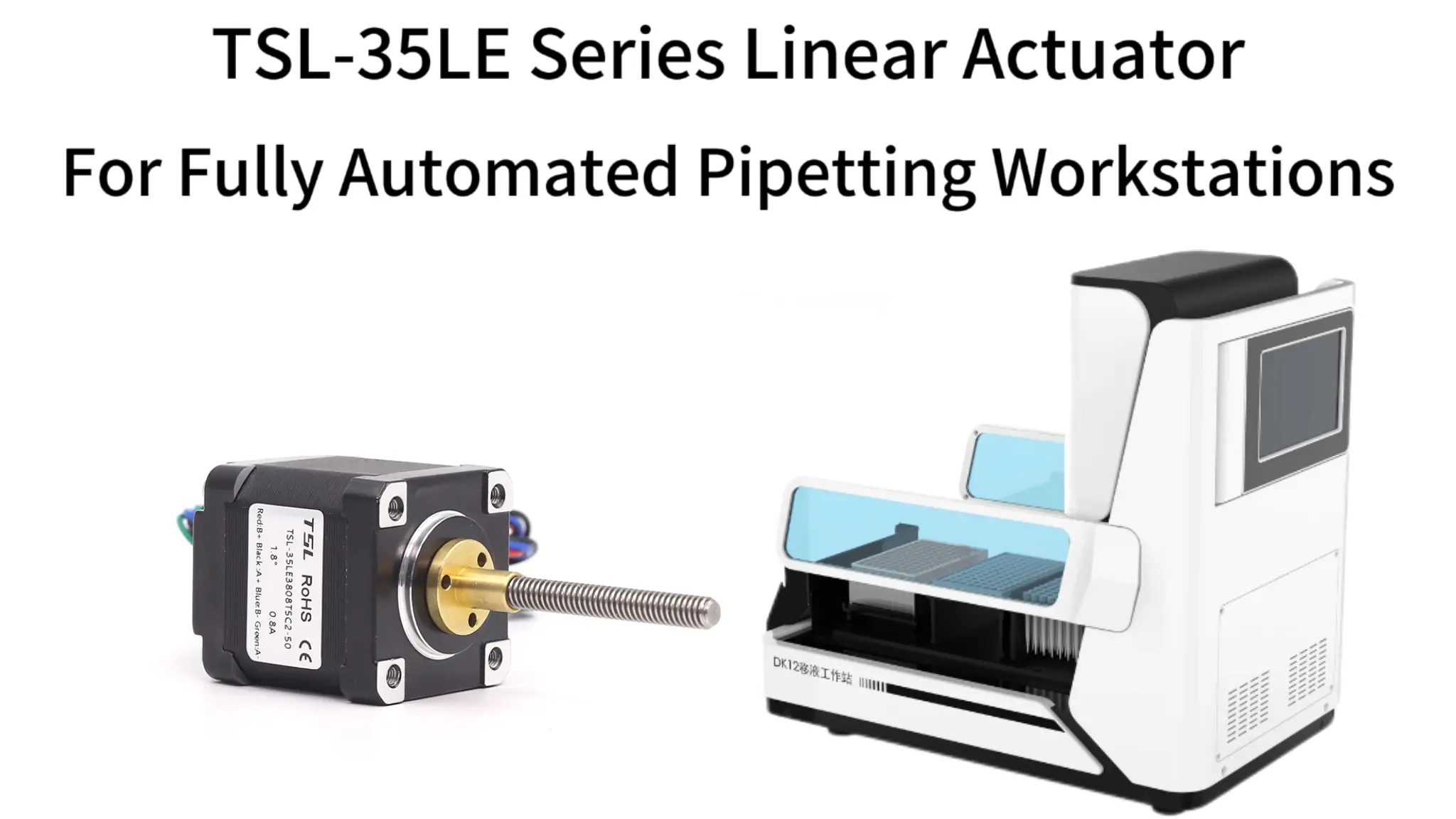
The TSL-35LE series flange lead screw hybrid stepper motor provides an ideal drive solution for multi-axis motion control in automated pipetting workstations, fully meeting the stringent compliance and performance requirements of global laboratory automation equipment.
Key Takeaways
- The TSL-35LE series integrates a 35mm hybrid stepper motor with a high-precision lead screw.
- Configurable closed-loop options with optional encoders prevent step loss and ensure data reliability.
- Standard NEMA 14 flange dimensions allow for easy drop-in replacement in global workstations.
- Integrated lead screw technology eliminates couplings to reduce mechanical backlash and size.
- Ultra-smooth motion at low speeds prevents sample splashing or droplet dripping during dispensing.
- Ball screw and trapezoidal screw options provide flexibility for high-speed or self-locking needs.
- Global compliance (CE, RoHS, UL) ensures the motor is ready for international medical markets.
Core Working Principle of Fully Automated Pipetting Workstations
A fully automated pipetting workstation is a core laboratory automation platform integrating automatic control, precision mechanical transmission, machine vision, and liquid handling technology. It can replace manual operation to achieve accurate liquid transfer from nanoliter to milliliter levels.
It enables fully standardized workflows including liquid aspiration, dispensing, gradient dilution, sample loading, reagent mixing, microplate replication, and sample extraction, fundamentally eliminating the efficiency bottlenecks, operational errors, and biosafety risks associated with manual pipetting.
From the perspective of its core workflow, the workstation operates through pre-programmed experimental procedures set by the host computer system, while the motion control system drives the mechanical structure to perform coordinated multi-axis movements:
First, the X/Y-axis planar motion system drives functional modules such as sample carriers, microplate stations, reagent racks, and tip boxes to achieve precise planar positioning, delivering target samples, reagents, or consumables to the pipette tip working area.
Second, the Z-axis vertical motion system performs height adjustment and lifting operations, adapting to the height differences of centrifuge tubes, deep-well plates, reagent bottles, and other consumables.
At the same time, machine vision and barcode scanning systems perform real-time position calibration to ensure accurate alignment between samples, consumables, and pipetting channels, while the pipetting pump module completes the entire liquid handling process.
Among all these operations, the full-stroke precision movement of the X/Y/Z axes is the fundamental basis for achieving high-throughput and high-precision automation.
Only when positioning errors are controlled within micron-level precision can every well position in ultra-high-density 96-well, 384-well, or even 1536-well microplates align precisely with the pipette tips, preventing dispensing errors, sample cross-contamination, and pipette tip collisions. This is also the core application scenario of the TSL-35LE series lead screw stepper motor.
Core Functions of Motors in Fully Automated Pipetting Workstations
In the motion control system of a fully automated pipetting workstation, the lead screw hybrid stepper motor serves as the core drive and execution component for precise multi-axis movement, directly determining positioning accuracy, operational efficiency, and process reliability.
Its functions are mainly concentrated in four core dimensions:
X-Axis Horizontal Precision Positioning Drive
For full-stroke horizontal movement, the motor converts rotational motion directly into high-precision linear motion through its integrated lead screw structure, driving the pipetting stage left and right to align with different microplate columns and multi-channel pipettes.
This ensures fast and accurate positioning at every target station across the full travel range, supporting continuous high-throughput sample transfer operations.
Y-Axis Longitudinal Precision Positioning Drive
The Y-axis motor controls forward and backward movement of the pipetting stage and works together with the X-axis motor to create a planar coordinate system for precise positioning anywhere on the workstation surface.
It supports alignment for 96-, 384-, and 1536-well plates and enables rapid switching among sample areas, reagent zones, tip storage areas, incubation zones, and waste stations, significantly improving automation efficiency.
Z-Axis Vertical Precision Height Adjustment
For vertical lifting and fine height adjustment, the motor provides stable linear thrust to precisely control pipetting stage height, adapting to consumables of varying heights such as centrifuge tubes, reagent bottles, and deep-well plates.
It can also dynamically calibrate micro-scale travel in coordination with the pipetting arm to avoid collisions between pipette tips and container bottoms or liquid volume errors caused by height deviation.
Multi-Axis Coordinated Motion and Dynamic Closed-Loop Position Control
When equipped with an encoder, the lead screw hybrid stepper motor can provide real-time feedback of actual position and operating status, forming a fully closed-loop system with the main controller and machine vision system.
This enables real-time compensation for position deviations caused by mechanical backlash, load changes, or external vibration.
The motor also precisely controls motion speed and acceleration, maintaining smooth operation during high-speed start-stop cycles while eliminating overshoot and step loss, ensuring stable 24/7 operation.
Core Requirements for Motors in Fully Automated Pipetting Workstations
Fully automated pipetting workstations operate continuously in laboratory environments with constant temperature and humidity while also facing potential biological reagent corrosion risks. At the same time, they must meet high-throughput and high-precision operational requirements.
Therefore, the drive motors must satisfy requirements far beyond ordinary industrial applications.
Micron-Level Precision
For ultra-high-density microplates such as 384-well and 1536-well formats, the spacing between adjacent wells can be as small as 2.25mm.
This requires motor positioning accuracy within ±50μm and repeat positioning accuracy at the ±10μm level.
No accumulated positioning error is allowed across the full stroke to avoid dispensing errors, cross-contamination, or pipette collisions.
Smooth and Quiet Operation
Laboratory environments impose strict noise requirements, typically requiring total equipment noise below 55dB.
Therefore, the motor must operate with low vibration and low noise during high-speed starts, stops, and directional changes.
At low speeds, there must be no crawling or vibration to prevent droplet dripping or sample splashing caused by movement instability.
Long Service Life
Top-tier global laboratories often require fully automated pipetting workstations to operate unattended 24/7.
The motor therefore requires excellent durability, brushless design, and highly wear-resistant transmission components to ensure long-term reliability.
High Integration Density
Laboratory automation equipment is increasingly moving toward miniaturized, integrated, and desktop designs, resulting in extremely limited internal installation space.
Integrated lead screw motor designs eliminate the need for additional screws, couplings, and transmission components, simplifying mechanical structure and improving space utilization.
Closed-Loop Control
In medical and life science applications, motion control failure may cause expensive sample loss, equipment damage, or biosafety incidents.
Therefore, the motor must provide real-time position feedback and closed-loop control to detect and correct step loss or overshoot while also supporting overload and stall protection.
Global Compliance
Equipment intended for global markets must comply with CE, FDA, UL, RoHS, and other international regulations.
The motor must satisfy EMC standards to avoid interference with precision detection modules and must also resist corrosion and humidity in laboratory environments.
Why Prefer Lead Screw Hybrid Stepper Motors?
When selecting drive solutions for automated pipetting workstations, global equipment manufacturers evaluate five key factors: precision, reliability, integration, cost, and adaptability.
Configurable lead screw hybrid stepper motors have become the optimal choice thanks to their modular design, flexible configuration, micron-level precision, and excellent cost-performance ratio.
| Comparison Dimension | Ordinary Brushed DC Motor | Open-Loop Stepper + External Lead Screw | BLDC Motor + Lead Screw Module | Miniature Servo Motor + Lead Screw Module | Configurable Lead Screw Hybrid Stepper Motor (TSL-35LE Series) |
| Positioning Accuracy | Low (millimeter-level) | Medium (hundreds of microns) | Medium (tens of microns) | High (micron-level) | Extremely High (micron-level, configurable open/closed loop) |
| Closed-Loop Capability | None | No closed-loop expansion | Requires encoder/control board | Mandatory closed-loop | Encoder optional |
| Integration Level | Low | Low | Low | Low | Extremely High |
| Operating Noise | High | Medium | Low | Low | Extremely Low |
| Service Life | Short | Long | Long | Long | Ultra Long |
| Configuration Flexibility | Very Low | Low | Low | Very Low | Extremely High |
| Overall Cost | Low | Medium | Medium-High | Extremely High | Moderate |
| Global Market Suitability | Unsuitable | Average | Average | Limited to high-end equipment | Optimal |
Advantages of the TSL-35LE Series Lead Screw Hybrid Stepper Motor
The TSL-35LE series is a 35mm flange modular configurable lead screw hybrid stepper motor specifically designed for global laboratory automation and life science equipment.
It has been fully optimized for automated pipetting workstation motion control applications.
Fully Modular Configurable Design
The series adopts a standardized base motor platform.
The standard version is a high-performance open-loop hybrid stepper motor, while customers can optionally configure incremental encoders of different resolutions to achieve semi-closed-loop or fully closed-loop control.
This fundamentally eliminates step loss issues associated with traditional open-loop stepper motors.
Without changing motor dimensions or mounting structures, users can upgrade from economical to high-end solutions simply by adding encoders.
Multiple Lead Screw and Nut Configurations
The series supports both ball screws and precision trapezoidal screws for different X/Y/Z-axis application requirements.
Ball screw versions are suitable for high-speed, high-precision, and long-life applications, while precision trapezoidal screws are ideal for economical, low-noise, and self-locking applications.
Different nut types including flange nuts, anti-backlash nuts, and round nuts are also supported.
Standard Flange Design
The motor uses a globally standardized 35mm × 35mm NEMA 14 flange for easy replacement and integration.
Its integrated motor and lead screw structure eliminates couplings, external screw modules, and mounting brackets, significantly reducing installation size.
Smooth and Quiet Operation
Optimized magnetic tooth structures and precision screw transmission design, combined with dedicated silent drive algorithms, reduce no-load noise below 40dB and full-load noise below 50dB.
There is no crawling or vibration during low-speed micro-feeding, and no obvious overshoot during high-speed operation.
Wide Torque Output and Ultra-Long Service Life
The motor provides holding torque from 0.12N·m to 0.5N·m within a compact 35mm frame.
It can easily drive X/Y/Z-axis movements under full-load conditions while maintaining stable power output.
The brushless design eliminates brush wear, while the high-strength stainless steel lead screw components provide ultra-long service life exceeding 25,000 hours.
Global Compliance Design
All series products comply with CE, UL, and RoHS standards and satisfy EN 61326 EMC requirements.
The products use environmentally friendly materials and can be directly integrated into exported equipment worldwide.
Compatibility and Expandability
The motor is compatible with mainstream global stepper drivers and can also integrate with gearboxes, brakes, and limit switches to create customized drive systems.
Customization Services and Technical Support
To meet the diverse needs of global automated pipetting workstation manufacturers, TSL has established a complete service system covering standardized configuration, deep customization, and full-process technical support.
Standardized Modular Services
Customers can freely select lead screw types, encoder configurations, and electrical parameters without requiring additional mold development.
Customized Development Services
Customized mechanical structures, ultra-quiet or ultra-high-precision solutions, corrosion-resistant upgrades, and integrated motor-driver-transmission systems are all available.
Full Technical Support
TSL provides complete lifecycle support including selection evaluation, simulation testing, prototype debugging, parameter optimization, mass production support, and quality management.
Global Compliance Support
Professional compliance teams provide documentation and support for CE, RoHS, and other international certifications to accelerate global product launch timelines.
Industry Trends and Future Outlook
As global life sciences, precision medicine, and innovative pharmaceutical industries continue developing rapidly, automated pipetting workstations are evolving toward higher throughput, higher precision, modularization, miniaturization, and intelligence.
Three major trends currently dominate the industry:
- First, platform-based and modular equipment architectures are becoming mainstream.
- Second, ultra-high throughput and ultra-high precision are becoming core competitive advantages.
- Third, miniaturized, desktop, and unattended operation trends are accelerating.
In the future, TSL will continue focusing on laboratory automation drive solutions, further optimizing modular design, control precision, silent operation, stability, intelligence, and miniaturization to support next-generation equipment development worldwide.
Conclusion
The TSL-35LE series 35mm flange lead screw hybrid stepper motor supports multiple transmission structures including ball screws and precision trapezoidal screws, while offering configurable encoder-based closed-loop solutions.
It perfectly meets the X/Y/Z-axis motion control requirements of automated pipetting workstations ranging from economical systems to high-end flagship platforms.
The series achieves an excellent balance between performance and cost while satisfying global compliance requirements, making it an ideal drive solution for fully automated pipetting workstations.
In the future, TSL will continue focusing on precision drive technology, working together with global equipment manufacturers to promote innovation in life science automation through mature product platforms, flexible customization services, and worldwide technical support.
FAQ
Q1:Why use an integrated lead screw motor instead of a motor with a separate coupling?
The integrated design eliminates the coupling and external screw module. This reduces mechanical “slop” (backlash), saves significant internal space, and simplifies the assembly of X/Y/Z stages in desktop workstations.
Q2:Can this motor handle the ultra-fine spacing of 1536-well microplates?
Yes. With positioning accuracy within ±50μm and the option for high-resolution encoders, the TSL-35LE can achieve the micron-level precision necessary to center tips in wells as narrow as 2.25mm.
Q3:How does the motor ensure no samples are lost during a power failure or error?
The TSL-35LE can be configured with an incremental encoder for closed-loop control. This allows the system to detect “step loss” in real-time, triggering a safety stop or correction to protect expensive biological reagents.