
As humanoid robots move from laboratory prototypes toward commercial production, the dexterous hand actuator has become one of the most challenging components to industrialize. A transmission solution that performs well in a prototype does not necessarily offer the cost, reliability, manufacturing consistency, and scalability required for mass production.
For a mass-produced dexterous hand, the choice of final-stage transmission architecture therefore plays a critical role in determining whether a design can successfully move from prototype validation to volume production.
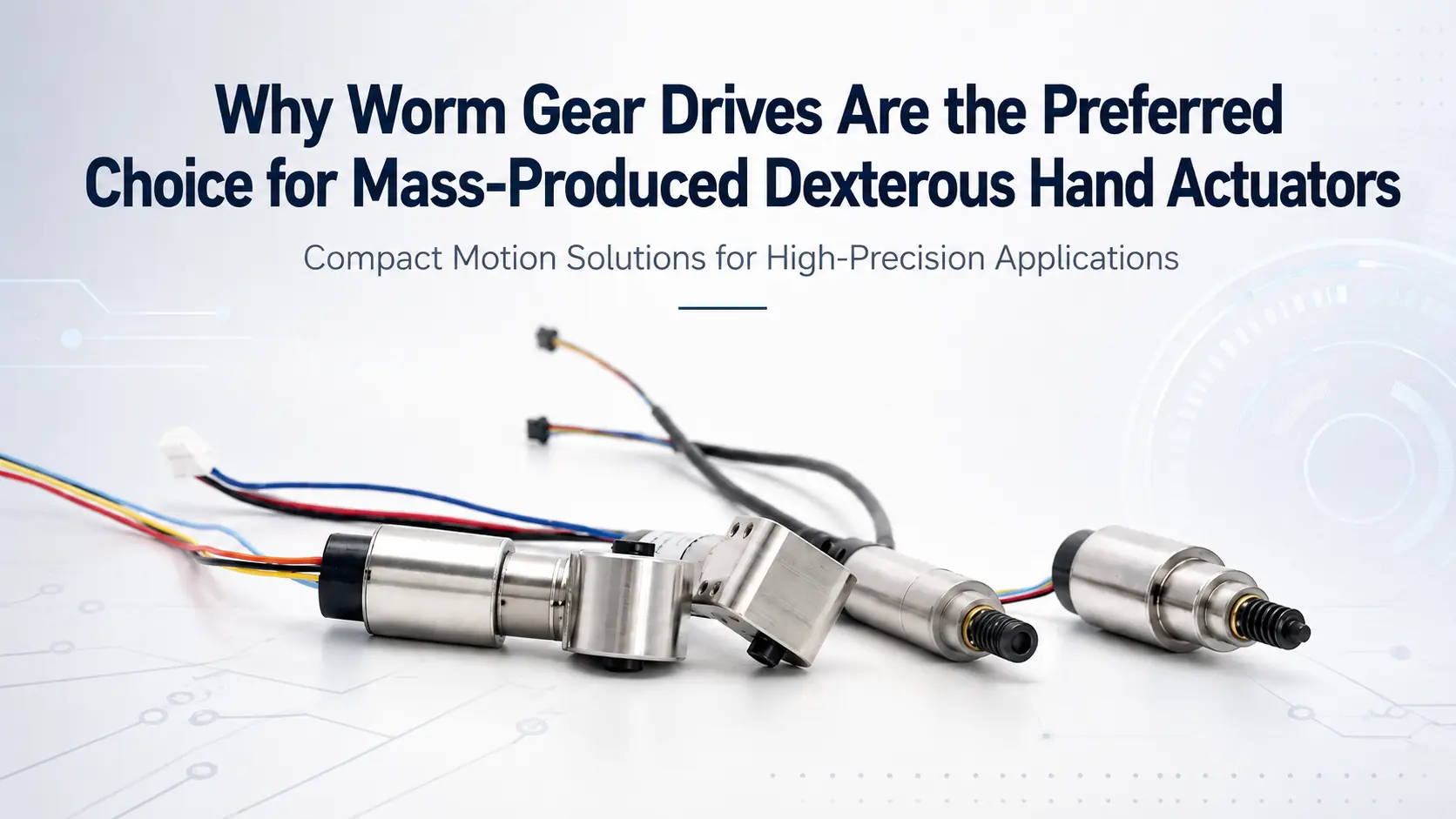
Based on our in-house development and manufacturing capabilities covering micro motors, planetary gearboxes, and final-stage transmission components, we have evaluated multiple dexterous hand transmission solutions, including lead screw drives, planetary roller screws, harmonic drives, and worm gear transmissions.
After evaluating these technologies from the perspectives of cost, manufacturing feasibility, reliability, and scalability, our conclusion is clear: among the solutions we have evaluated, the worm gear drive currently provides the best overall balance for mass-produced dexterous hand actuators.
1. Cost: Why Worm Gear Drives Are Well Suited to Mass-Produced Dexterous Hand Actuators
Cost is one of the most important considerations when a dexterous hand actuator moves from prototype development to large-scale production.
Because we manufacture motors, planetary gearboxes, and transmission components through an integrated supply chain, we have been able to evaluate and optimize the manufacturing costs of different transmission architectures.
Even under these optimized conditions, the worm gear drive maintains a significant cost advantage and is the solution that best matches the cost requirements of high-volume dexterous hand production among the transmission technologies we have evaluated.
Lead Screw Transmission
Conventional lead screw solutions are mechanically straightforward, but their long-term operating stability can be difficult to maintain. During extended operation, problems such as jamming, wear, and misalignment may occur, making it more difficult to achieve the reliability required for mass-produced robotic hand actuators.
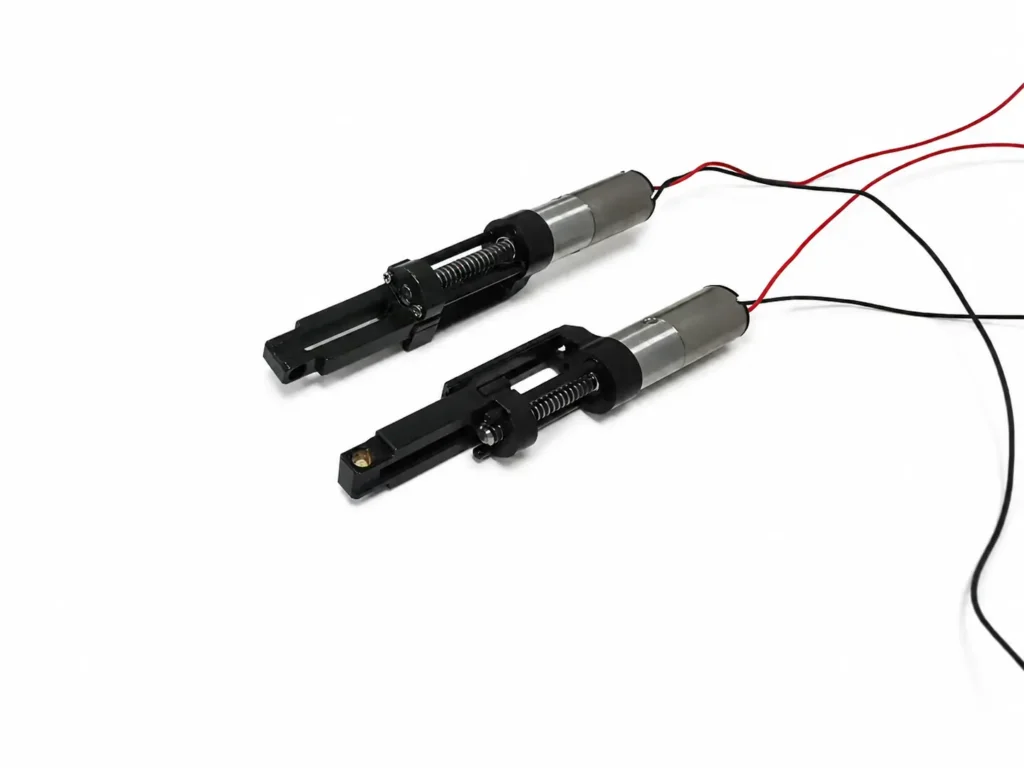
Upgrading to a ball screw can improve stability, but it also significantly increases material costs and machining precision requirements. Even after supply-chain and manufacturing optimization, the overall cost remains higher than that of a worm gear transmission.
Planetary Roller Screws and Harmonic Drives
High-precision transmission solutions such as planetary roller screws and harmonic reducers can provide excellent performance.
However, when these technologies are miniaturized for dexterous hand applications, they require extremely high component machining accuracy and more demanding assembly processes. This results in substantially higher material and manufacturing costs.
They can be suitable for prototype development and specialized applications, but their cost structure makes large-scale commercialization more challenging.
Worm Gear Transmission
By comparison, a worm gear transmission has a relatively simple mechanical structure, with the worm and worm wheel forming the core transmission pair.
The machining processes are mature, production equipment is widely available, and the transmission does not require the same level of specialized ultra-high-precision manufacturing equipment as some alternative technologies.
Within an integrated mass-production system, this allows the worm gear drive for dexterous hand actuators to achieve a highly competitive BOM cost while maintaining the mechanical performance required for practical robotic hand applications.
2. Manufacturing Scalability: A Key Advantage of Worm Gear Drives
A successful dexterous hand actuator is not defined by cost alone.
For volume production, the manufacturing process must also provide stable yields, controllable quality, scalable production capacity, and consistent performance between individual units.
This is where the maturity of worm gear transmission technology becomes particularly important.
Worm gears have been used in industrial transmission systems for decades, resulting in mature machining and assembly processes. Compared with more precision-sensitive transmission technologies, worm gear production generally provides a wider manufacturing process window and more manageable production yields.
Combined with our established mass-production supply chain for 8–16 mm coreless planetary geared motors, the complete actuator system can be scaled more efficiently while maintaining predictable delivery schedules and consistent product quality.
This makes the combination of a coreless planetary gear motor and worm gear drive particularly suitable for compact dexterous hand joints.
Challenges of Scaling Lead Screw Solutions
Lead screw systems are highly sensitive to coaxiality, straightness, and assembly alignment.
During prototype development or small-batch production, these factors can often be controlled through individual adjustment and manual calibration.
Once production volumes increase, however, maintaining the same level of consistency becomes more difficult. Small variations in machining or assembly can lead to fluctuations in performance, defect rates, and long-term reliability.
Challenges of Scaling High-Precision Reducers
High-precision transmission technologies face a different production challenge.
Their manufacturing capacity can be limited by the machining requirements of critical components as well as the complexity of precision assembly. As a result, increasing production volume can require significantly more manufacturing investment and process control.
For a mass-produced dexterous hand actuator, manufacturing scalability therefore becomes just as important as theoretical transmission performance.
3. Backlash: Why It Is Not a Fundamental Barrier for Dexterous Hand Applications
One of the most common concerns about using a worm gear drive in a dexterous hand actuator is backlash.
A common assumption is that worm gear transmissions inherently have excessive backlash and therefore cannot provide sufficient positioning accuracy for robotic fingers.
From a mass-production engineering perspective, however, the issue needs to be considered at the system level rather than only at the individual transmission-pair level.
Attempting to achieve virtually zero backlash within a single worm gear pair can dramatically increase machining accuracy requirements and assembly complexity. This in turn increases manufacturing cost and reduces production tolerance—both of which work against the objectives of large-scale production.
In practical dexterous hand transmission design, worm gear backlash does not necessarily need to be eliminated entirely within the gear pair itself.
Instead, backlash can be compensated for through mechanical anti-backlash structures and system-level design within the complete dexterous hand.
This approach allows the actuator to meet the required motion accuracy without excessively increasing the manufacturing cost of every individual worm and worm wheel.
For more information about whole-hand mechanical backlash compensation, please refer to our dedicated technical note (link to be added).
Why Worm Gear Drives Offer the Best Overall Balance
There is no single transmission technology that provides the highest theoretical performance in every parameter.
Planetary roller screws, ball screws, harmonic drives, and other transmission technologies all have their own advantages and may be appropriate for specific robotic applications.
However, when a dexterous hand actuator is designed for commercial mass production, the evaluation criteria change.
The transmission must balance:
- Manufacturing cost
- Mechanical reliability
- Production consistency
- Scalable manufacturing capacity
- Compact dimensions
- Assembly complexity
- Supply-chain stability
- Long-term production feasibility
From this system-level perspective, the worm gear drive for dexterous hand actuators currently provides one of the strongest combinations of cost efficiency, reliability, and mass-production capability among the solutions we have evaluated.
When combined with our independently mass-produced 8–16 mm coreless planetary geared motors, the worm gear transmission architecture can help customers move more efficiently from prototype development to scalable dexterous hand production.
For companies developing humanoid robots, robotic hands, or compact robotic hand actuators, the worm gear drive therefore represents a practical and commercially viable transmission architecture for the transition from engineering prototype to volume production.