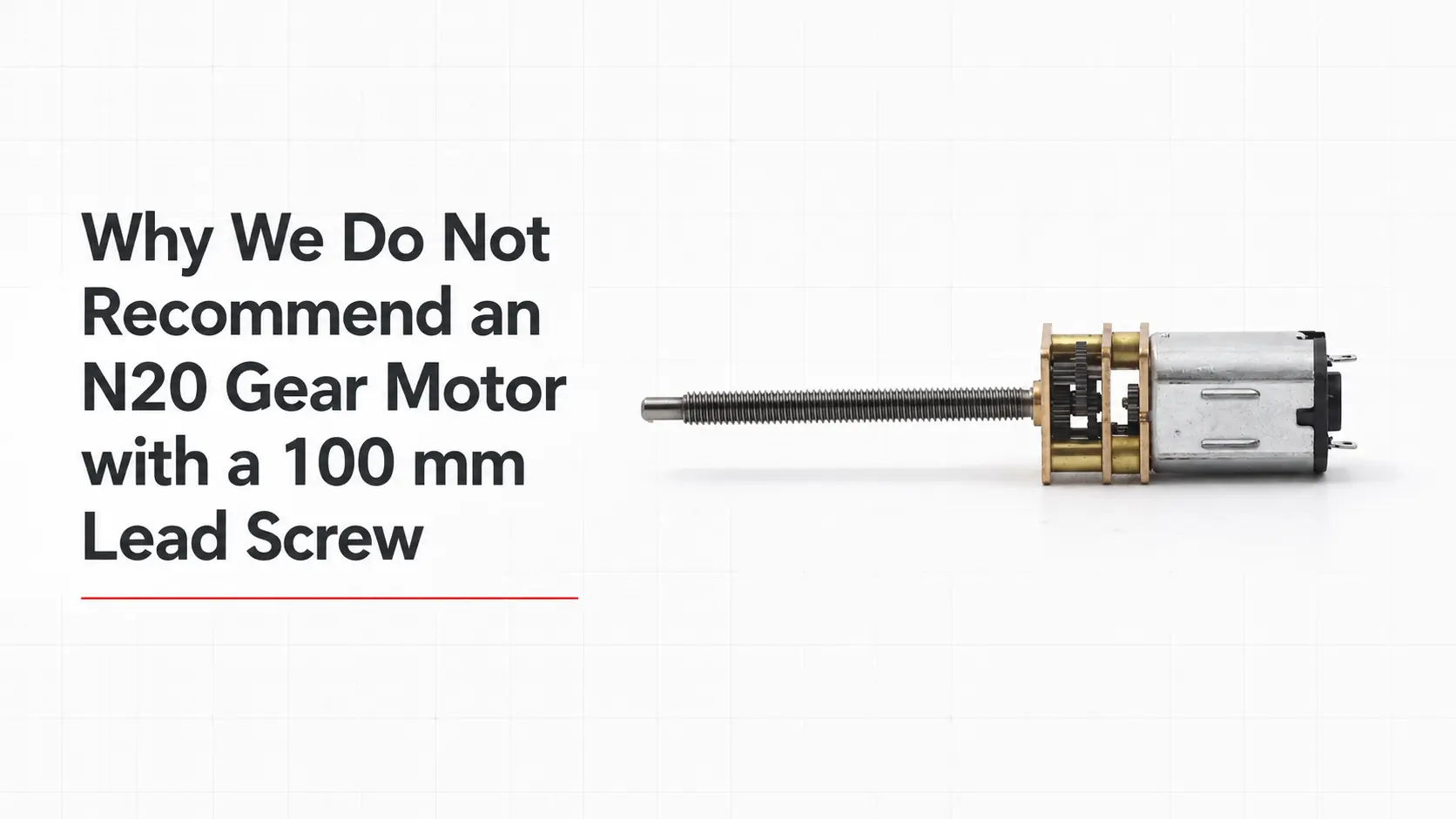

In miniature linear transmission applications, an N20 Gear Motor with Long Lead Screw is commonly used to build compact linear actuators. When selecting the lead screw stroke, however, it is necessary to balance operating reliability, production yield, and overall cost.
For applications requiring a 100 mm stroke, we currently do not include this configuration in our standard mass-production range. The main reasons are related to two factors: operating stability and mass-production economics.
At a Galance
For an N20 gear motor with a cantilever-mounted lead screw, a 100 mm stroke can cause excessive screw runout, increasing vibration, noise, uneven wear, and the risk of jamming while reducing machining and assembly yield.
To balance operating stability, product consistency, and production cost, we currently recommend a maximum stroke of 55 mm. Longer strokes require a motor and lead screw structure with greater radial stiffness and additional support.
Excessive Lead Screw Runout Reduces Operating Reliability
An N20 gear motor is a compact transmission motor with a short output-shaft support span and limited radial rigidity. When a lead screw is connected directly to the motor, the structure is essentially a cantilever-supported configuration.
When the lead screw stroke reaches 100 mm, the length-to-diameter ratio of the screw becomes excessively high. As a result, the radial rigidity at the unsupported end decreases significantly, and noticeable radial runout or wobbling may occur during operation.
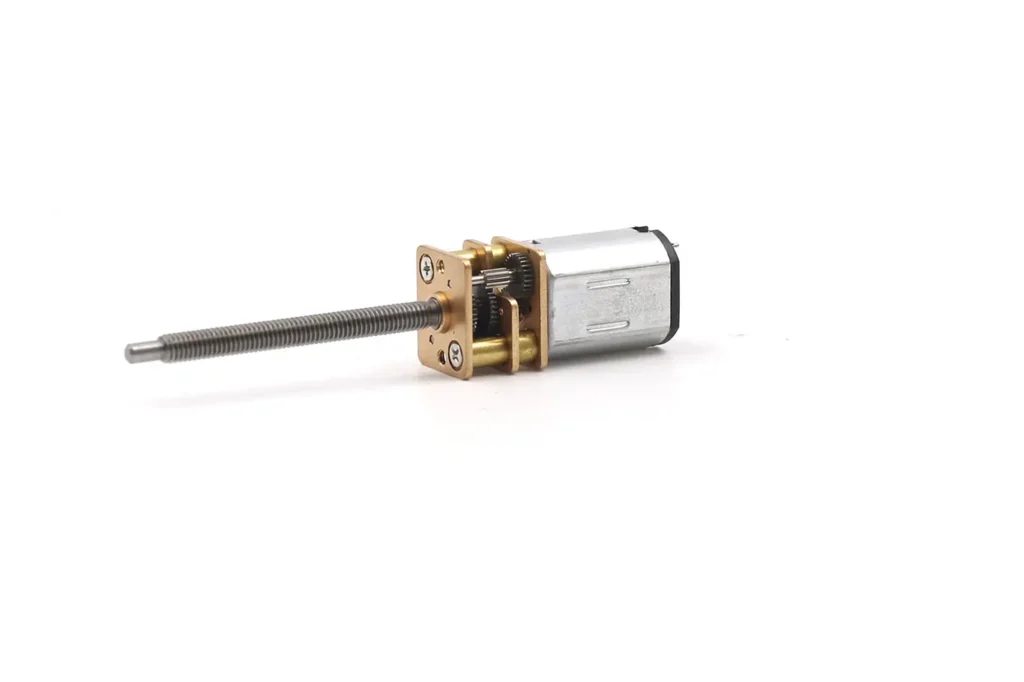
For an N20 Gear Motor with Long Lead Screw, this runout can lead to several problems.
First, operating noise and vibration increase significantly, making the system less suitable for precision equipment.
Second, the engagement force between the lead screw and nut becomes uneven. This can cause accelerated localized wear and shorten the service life of the actuator.
Third, under load, the mechanism is more likely to experience jamming, unstable motion, or excessive positioning error, making it difficult to guarantee consistent operating performance.
From a structural point of view, the supporting capability of the N20 motor platform is not sufficient to maintain stable operation with a lead screw of approximately 100 mm stroke. This is an inherent structural limitation and cannot be completely solved through simple manufacturing-process improvements.
Higher Defect Rates Significantly Increase Overall Cost
A 100 mm stroke N20 Gear Motor with Long Lead Screw is also less suitable for mass production because of the higher yield loss throughout the manufacturing process.
During lead screw machining, controlling the straightness and concentricity of a long and slender screw is considerably more difficult than with a shorter lead screw. As a result, the component production yield becomes lower and the material cost increases.
The assembly process is also more demanding. Maintaining proper concentricity between the long lead screw and the motor output shaft requires more precise adjustment. This increases assembly complexity and the amount of labor required for each unit.
At the same time, the first-pass yield after assembly decreases.
Lead screw runout can also cause more finished products to fail final inspection. This results in a higher proportion of rework, additional screening, and scrapping.
Consequently, the total production cost of a 100 mm long-stroke solution is significantly higher than that of conventional stroke lengths. Product consistency and delivery stability also become more difficult to guarantee, making this configuration unsuitable for stable large-scale production.
Recommended Stroke for Mass Production
Based on the balance between operating reliability and production economics, the maximum stroke of the N20 Gear Motor with Long Lead Screw solutions that we currently manufacture in stable volume production is 55 mm.
At this stroke length, the lead screw maintains a more reasonable length-to-diameter ratio, and radial runout can be controlled within an acceptable range.
The machining and assembly processes are also more mature, resulting in more stable production yield.
A 55 mm stroke provides a better balance between linear travel, operating stability, product lifetime, manufacturing cost, and production consistency. It is suitable for most miniature linear transmission applications.
What If a Longer Stroke Is Required?
If an application requires a longer linear stroke, we do not recommend simply extending the lead screw on the existing N20 motor platform.
Instead, a motor or actuator structure with better lead screw support and higher output rigidity should be selected.
A more appropriate mechanical structure can achieve the required long stroke while maintaining long-term operating stability and a more reasonable lifecycle cost.
Conclusion
Although an N20 Gear Motor with Long Lead Screw can provide a compact solution for miniature linear motion, increasing the stroke to 100 mm introduces significant challenges in lead screw runout, vibration, wear, positioning stability, production yield, and manufacturing cost.
For stable mass production, we currently recommend a maximum stroke of 55 mm for the N20 platform.
For applications requiring a longer stroke, selecting a more suitable motor and support structure is generally a more reliable solution than simply increasing the lead screw length.