
With the rapid development of the global in vitro diagnostics (IVD) industry, biochemical analyzers have become essential core platforms for clinical disease diagnosis, therapeutic monitoring, health screening, and pathological research. They are now indispensable testing systems in medical institutions, third-party diagnostic laboratories, and biopharmaceutical research organizations worldwide.
Precise microfluidic transmission and quantitative control are critical to achieving high-precision and highly repeatable testing in biochemical analyzers. Among these, the syringe pump serves as the core execution unit for reagent and sample dispensing, and the performance of its drive motor directly determines the detection accuracy and operational stability of the analyzer.
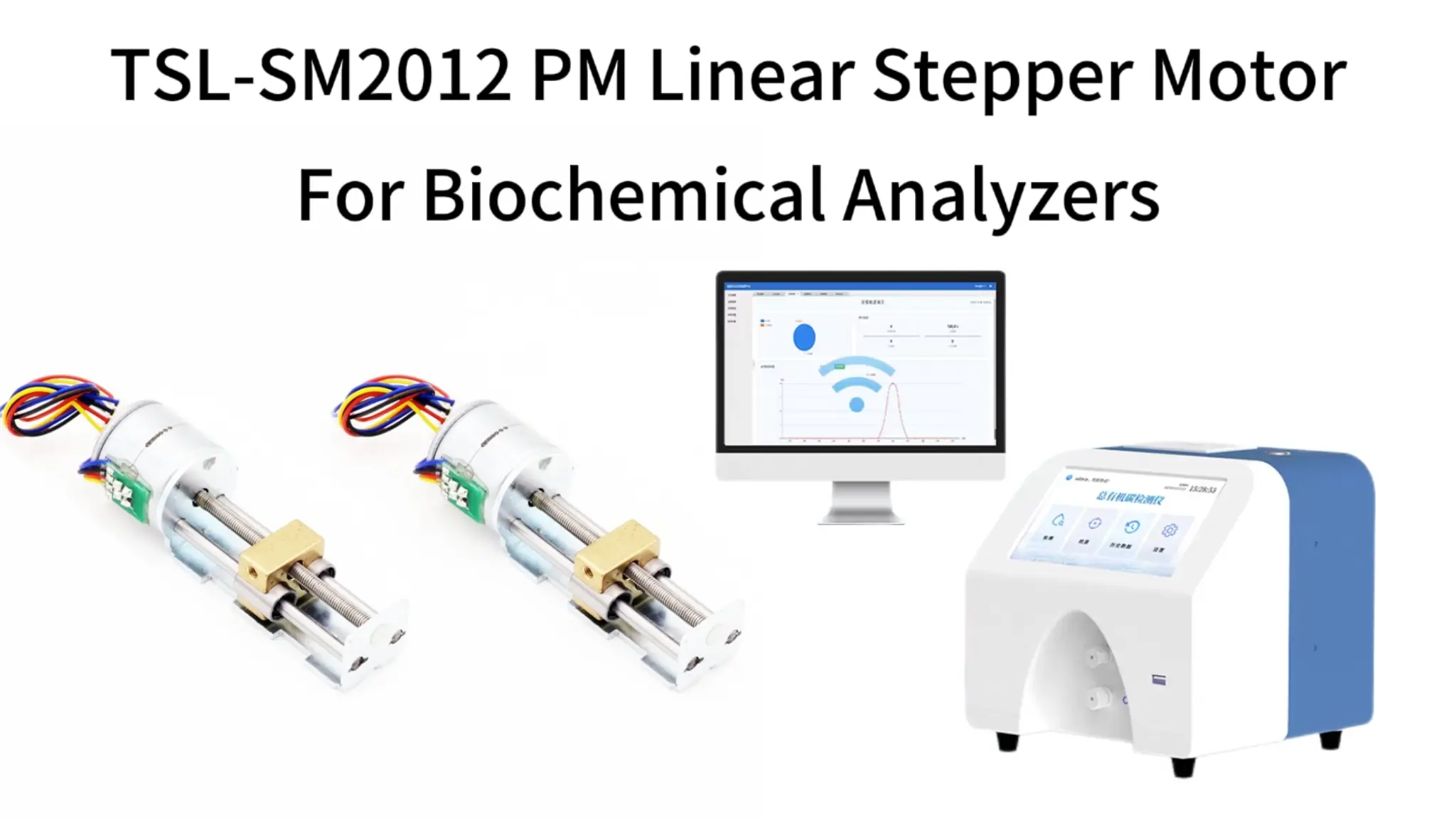
The TSL-SM2012 permanent magnet linear stepper motor is specially developed for micro-syringe pump drive applications in biochemical analyzers and other IVD equipment. It is an integrated linear drive solution combining a permanent magnet stepper motor, precision lead screw transmission, and linear slide guide mechanism into one compact unit, providing global IVD equipment manufacturers with a cost-effective and highly reliable engineering solution.
Key Takeaways
- The TSL-SM2012 motor integrates a 20mm stepper motor with a precision lead screw and slide guide.
- Linear travel resolution of 0.025mm enables ultra-precise quantitative dispensing of reagents.
- A compact coaxial design supports the high-density, multi-channel layouts of modern analyzers.
- The brushless permanent magnet structure ensures a long, maintenance-free operational life.
- High thrust output (10N) overcomes seal friction to prevent plunger sticking or “crawling.”
- Low noise and low EMI protect the accuracy of sensitive optical detection modules.
- Standardized electrical connectors allow for “plug-and-play” integration with medical control systems.
Working Principle of Biochemical Analyzers
A biochemical analyzer is an automated analytical device based on biochemical detection principles, used for quantitative analysis of biochemical indicators, immune markers, and drug concentrations in human body fluids such as blood, urine, and cerebrospinal fluid. Its core workflow revolves around precise biochemical reaction construction and quantitative optical signal detection.
The main operating procedures are as follows:
Sample and Reagent Pretreatment
Samples, calibrators, quality controls, and reagents are sequentially loaded and pre-incubated at constant temperature through sample racks and reagent trays to ensure temperature consistency of the reaction system.
Precise Quantitative Dispensing
Micro-syringe pumps accurately aspirate and dispense liquids ranging from nanoliter to milliliter levels, delivering specified amounts of samples and reagents into reaction cuvettes to establish the reaction system ratio.
Mixing and Incubation
Samples and reagents are fully mixed in the reaction cuvette, and biochemical colorimetric or immunological binding reactions are completed under strictly controlled temperature and timing conditions to ensure reaction consistency.
Optical Detection and Signal Acquisition
Optical systems such as monochromatic light and spectrophotometers detect absorbance and light scattering signals from reacted liquids and convert biochemical reaction signals into quantifiable electrical signals.
Data Processing and Result Output
Built-in algorithms analyze the collected optical signals and compare them against calibration curves to calculate analyte concentrations, completing data storage, review, and report output.
System Cleaning and Maintenance
The syringe pump precisely delivers cleaning fluid and removes waste liquid to automatically clean reaction cups, dispensing pipelines, and sampling needles, preventing cross-contamination and ensuring accuracy in subsequent tests.
Throughout the entire process, precise aspiration and dispensing control by the micro-syringe pump forms the foundation of all testing operations. Dispensing accuracy directly determines reaction ratio accuracy and ultimately affects result reliability. The core driving component of the syringe pump is the linear slide stepper motor.
Core Functions of Motors in Biochemical Analyzers
The core function of the TSL-SM2012 permanent magnet linear stepper motor is to drive the micro-syringe pump in precise reciprocating linear motion, enabling accurate liquid aspiration, dispensing, and transfer. It serves as the key execution unit enabling automated and high-precision testing in biochemical analyzers.
Its functions extend throughout the entire testing process, mainly focusing on four critical areas:
Precise Quantitative Dispensing of Samples and Reagents
This is the motor’s most critical application scenario. Through precise linear travel control, the motor drives the syringe plunger to perform constant-speed and quantitative aspiration and dispensing operations.
For different testing projects and reagent ratio requirements, the motor can flexibly adjust feed speed, travel distance, and start-stop timing, supporting applications ranging from routine biochemical testing to ultra-sensitive micro-volume analysis.
Gradient Dilution of Standards and Quality Controls
Through high-precision stepping control, the motor accurately controls dilution ratios between stock solutions and diluents, ensuring dilution concentration accuracy and providing core support for traceability and reliability of analytical results.
System Cleaning and Pipeline Maintenance
The motor drives the syringe pump to precisely deliver cleaning fluid and extract waste liquid, ensuring accurate control of cleaning flow rate and timing to eliminate cross-contamination between samples and reagents.
Precise Timing Control of Testing Processes
Biochemical reactions are highly time-dependent. Deviations in incubation time, dispensing intervals, and reaction termination timing directly affect test accuracy.
The motor provides precise start-stop control and speed adjustment to strictly match analyzer timing sequences, ensuring timing precision in every reaction stage and enabling orderly parallel operation of multi-channel and multi-project testing, thereby improving throughput and result consistency.
Core Requirements of Biochemical Analyzers for Motors
Based on the automated testing process, micro-syringe pump operating characteristics, and clinical application scenarios of IVD equipment, drive motors must satisfy multiple stringent performance requirements.
High Positioning Accuracy
Biochemical testing requires quantitative liquid control at microliter or even nanoliter levels. Motors therefore require sub-millimeter travel resolution, extremely small transmission backlash, and smooth low-speed operation without vibration or crawling to ensure stable aspiration and dispensing flow rates.
High Integration Density
Fully automated biochemical analyzers require simultaneous operation of multiple testing channels, resulting in highly compact internal layouts. Multi-channel syringe pumps must support dense array arrangements, requiring compact motors with high integration that can directly connect to syringe plungers without additional transmission conversion mechanisms.
Stable Thrust Output
When driving syringe plungers, the motor must continuously overcome friction from syringe sealing rings while maintaining stable thrust output during frequent forward-reverse and start-stop operations. This prevents insufficient aspiration, residual dispensing, or plunger sticking.
Long Service Life
Laboratory biochemical analyzers often operate continuously for extended periods. Motors must withstand high-frequency start-stop and directional switching operations without wear-prone structures, providing maintenance-free long-term stable operation.
Low Electromagnetic Interference
Biochemical analyzers integrate highly sensitive optical detection modules, temperature sensors, and pressure sensors. Motors must operate without electromagnetic interference to avoid affecting optical signal acquisition and sensor accuracy. Low operational noise is also essential in hospitals and laboratories.
Standardized Interfaces
Motors should feature standardized mechanical mounting dimensions and electrical interfaces compatible with various medical syringe specifications and mainstream analyzer control systems, reducing selection, adaptation, and development complexity.
Wide Environmental Adaptability
Motors must adapt to laboratory temperature and humidity environments while meeting medical equipment insulation and dielectric safety standards and supporting disinfection and cleaning procedures.
Why Choose Permanent Magnet Linear Stepper Motors
Given the stringent requirements for precision, size, reliability, and integration in biochemical analyzers, permanent magnet linear stepper motors have become the optimal technology choice for syringe pump drives.
Limitations of Brushed DC Motors + Lead Screw Slide Assemblies
This solution is widely used in low-end semi-automatic biochemical analyzers and portable POCT devices, accounting for over 60% of domestic low-end analyzer applications.
However, its structural limitations make it unsuitable for high-end fully automated analyzers requiring high precision and long service life.
Carbon brush wear requires frequent maintenance and replacement, increasing downtime and maintenance costs.
Mechanical commutation sparks generate severe electromagnetic interference, often causing optical signal drift and sensor distortion.
The need for additional lead screws, slides, and couplings results in bulky structures, low integration, and accumulated backlash that rapidly degrades dispensing accuracy.
Limitations of Closed-Loop Stepper Motors + Ball Screw Assemblies
This is a mainstream solution for mid-range fully automated analyzers.
However, the separated structure of motors, screws, slides, and couplings requires manual assembly and calibration by equipment manufacturers, making coaxial alignment difficult.
Under high-frequency reciprocating motion, screw wear and sticking easily occur, leading to increased backlash and reduced dispensing accuracy over time.
The overall structure is relatively large and unsuitable for high-density multi-channel layouts.
Limitations of Brushless Servo Motors + Ball Screw Modules
This is a mainstream solution for imported high-end analyzers such as Roche cobas, Hitachi 7600, and Beckman Coulter AU series.
While highly precise, the procurement cost is 7–8 times higher than permanent magnet linear stepper motors, making large-scale production costly for domestic manufacturers.
Complex control logic also requires dedicated servo drivers and encoder feedback systems.
Limitations of Brushed Coreless Motors + Lead Screw Systems
Used mainly in some imported portable POCT devices, these solutions improve size through high power density coreless motors but still retain brush wear and mechanical commutation issues.
Frequent start-stop operation causes brush wear and accuracy degradation, while commutation sparks still generate electromagnetic interference requiring additional shielding.
Advantages of the TSL-SM2012 Permanent Magnet Linear Stepper Motor
The TSL-SM2012 is specifically designed for micro-syringe pump applications in biochemical analyzers. Its Φ20mm permanent magnet stepper motor, precision lead screw, and linear guide are integrated into a coaxial structure that fundamentally solves the limitations of traditional drive solutions.
Compact Integrated Design
The Φ20mm compact integrated structure combines the motor, lead screw transmission, and linear guide into one module, enabling direct syringe plunger connection and supporting dense multi-channel analyzer layouts.
Ultra-High Precision Control
The module uses an 18° step angle bipolar drive design with 20 steps per revolution and a minimum travel resolution of 0.025mm, achieving sub-millimeter linear positioning accuracy.
Precision-machined lead screws and linear bearings minimize backlash, ensuring repeatable aspiration and dispensing without vibration or crawling.
Stable Thrust Output
Rated pull-out thrust exceeds 1000gf (10N), fully satisfying syringe seal friction requirements even during frequent directional switching.
Maximum response frequency reaches 1300Hz (PPS), supporting both rapid liquid transfer and smooth low-speed dispensing.
Long Service Life
The brushless permanent magnet structure eliminates carbon brushes and mechanical commutation, enabling maintenance-free long-term operation.
Core transmission components use brass sliders and linear bearings for excellent wear resistance and shock resistance.
Operating temperature range covers -20°C to +50°C, with Class E insulation (120°C) and dielectric strength of 100V-1S.
Low Interference
The bipolar 2-2 phase excitation drive produces no commutation sparks and extremely low electromagnetic radiation, ensuring no interference with optical detection systems or precision sensors.
Optimized drive design also enables extremely low operational noise.
Standardized Interfaces
The module features AWG#28 UL1571-certified leads and a PHR-4 standard connector compatible with mainstream stepper motor drivers and biochemical analyzer control systems.
Standardized mounting dimensions directly support medical syringes from 100μL to 10mL.
Overview of the TSL-SM2012 Permanent Magnet Linear Stepper Motor Module
The TSL-SM2012 is a dedicated permanent magnet linear slide stepper motor developed for micro-syringe pump applications in biochemical analyzers and other IVD devices.
It can quickly adapt to various biochemical analyzer control systems and micro-syringe structures, fully covering dispensing, precision dilution, and pipeline cleaning applications.
Customization Services and Technical Support
As a professional miniature precision motor manufacturer, we provide comprehensive global customization and technical support services.
Motor Winding Customization
Supports different operating voltages such as 6V and 24V while optimizing speed and thrust characteristics.
Travel and Lead Screw Customization
Maximum travel and screw pitch can be adjusted according to syringe specifications and dispensing accuracy requirements.
Mechanical Structure Customization
Slider output structure, flange dimensions, mounting holes, and plunger connection structures can be customized.
Electrical Interface Customization
Lead length, wiring definitions, and connector specifications can be customized.
Material and Protection Customization
Materials and protection levels can be optimized for medical sterilization and anti-corrosion requirements.
We provide full-process technical support from initial selection and parameter matching to prototype testing, optimization, mass production, and after-sales maintenance.
Industry Development Trends and Future Outlook
The global IVD industry is experiencing rapid growth driven by increasing healthcare demand, improved medical systems, and accelerated biopharmaceutical development.
Future biochemical analyzers will evolve toward four major directions:
Modularization and Standardization
Universal drive modules with standardized interfaces will become mainstream, enabling rapid adaptation and interoperability across different manufacturers.
Higher Integration and Miniaturization
With the rise of portable POCT devices and high-density multi-channel systems, drive modules will become increasingly integrated, compact, and lightweight.
Higher Precision and Reliability
Detection technologies are moving toward micro-volume and ultra-sensitive analysis, requiring higher positioning resolution, lower backlash, longer service life, and maintenance-free operation.
Lower Power Consumption and Intelligence
Portable devices require lower power consumption, while intelligent drive modules integrating position sensing, force feedback, self-diagnosis, and adaptive control will better support fully automated analyzer development.
We will continue focusing on miniature precision linear stepper motor and transmission technologies, continuously optimizing product performance and developing advanced drive solutions for biochemical analyzers, immunoassay analyzers, coagulation analyzers, and other IVD devices.
Conclusion
The TSL-SM2012 permanent magnet linear stepper motor directly addresses the common challenges in micro-syringe pump drive systems for biochemical analyzers by providing a highly integrated, high-precision, highly reliable, and cost-effective linear drive solution.
Combined with our comprehensive customization services and professional technical support system, the TSL-SM2012 will become the preferred syringe pump drive solution for biochemical analyzers, accelerating the commercialization and widespread adoption of IVD devices and driving the global IVD industry into a new era of high-quality and large-scale development.
FAQ
Q1:Why is a linear stepper motor preferred over a traditional motor and belt system?
The TSL-SM2012 integrates the motor and lead screw into one coaxial unit. This eliminates the backlash and “play” associated with belts and couplings, allowing for much finer control over the syringe plunger’s movement and more accurate liquid dispensing.
Q2:Can this motor handle the friction of high-pressure medical syringes?
Yes. It provides a stable pull-out thrust exceeding 1000gf (10N). This is more than enough to overcome the friction of rubber plunger seals while maintaining smooth, non-jerky movement during aspiration.
Q3:How precise is the liquid dispensing?
The motor features a minimum travel resolution of 0.025mm per step. When paired with a micro-syringe, this allows the analyzer to accurately dispense liquids at the microliter and even nanoliter scale with high repeatability.