
With the rapid development of global life sciences, medical diagnostics, biopharmaceuticals, chemical testing, food safety, and environmental monitoring industries, centrifuges have become indispensable core equipment for sample separation, pretreatment, and analytical testing in laboratories, medical institutions, and industrial production environments.
As the core power component of a centrifuge, the performance of the drive motor directly determines the separation accuracy, operational stability, and service life of the equipment.
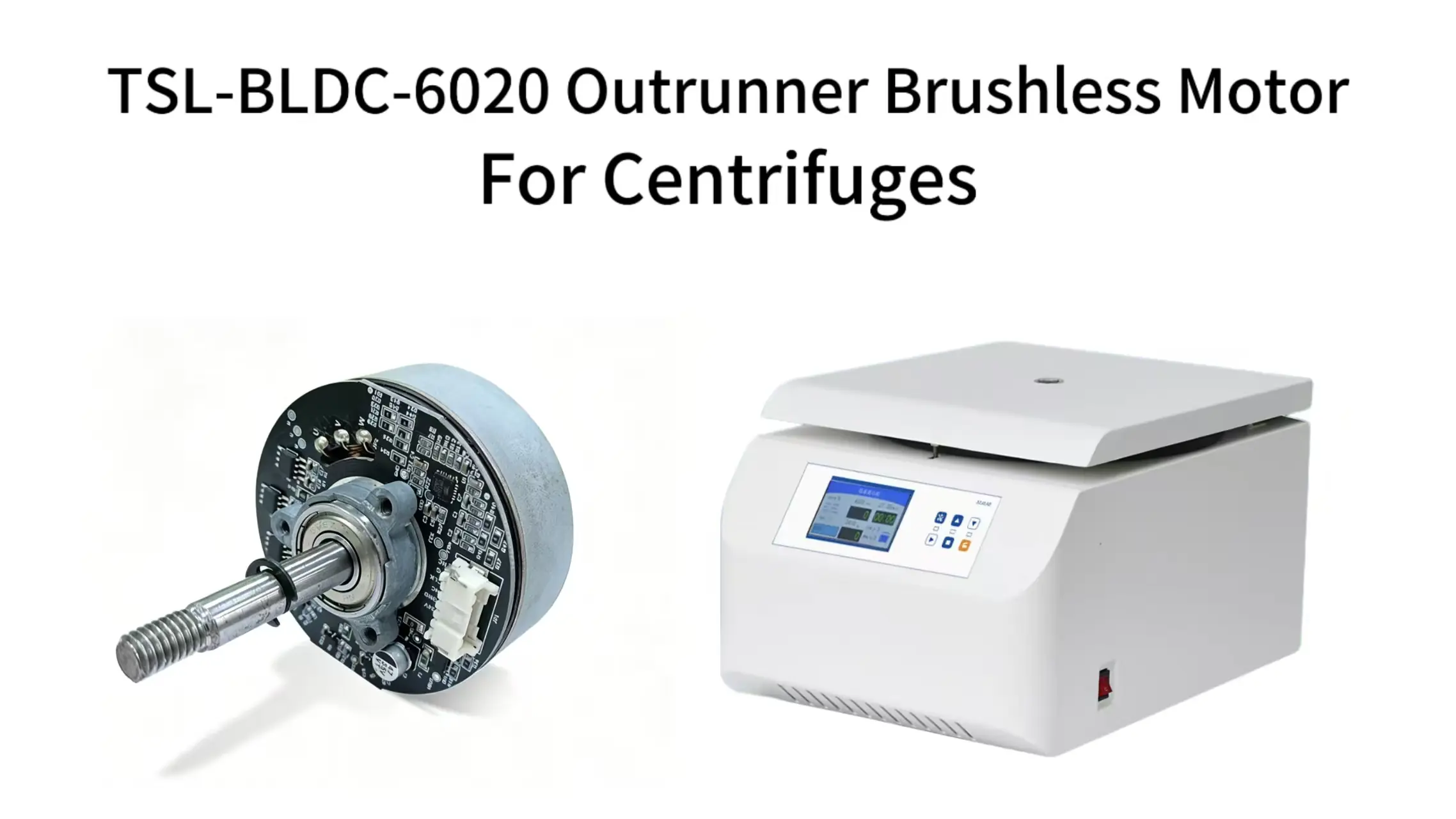
The TSL-BLDC-6020 integrated drive outrunner brushless motor is specifically developed for centrifuge operating conditions. It is an integrated drive solution that combines the outrunner brushless motor body, built-in drive control, position sensing, and comprehensive protection functions into one system.
Key Takeaways
- The TSL-BLDC-6020 motor integrates an outrunner brushless motor with a built-in drive controller.
- A flat, compact structure enables the design of ultra-thin desktop and portable centrifuge units.
- Hall sensor closed-loop feedback ensures precise speed control across the entire RPM range.
- High conversion efficiency minimizes heat transfer to the sample chamber during long runs.
- The brushless design eliminates carbon brush wear, providing a maintenance-free service life.
- Built-in safety protections automatically shut down the motor in case of rotor blockage or overspeed.
- Low vibration and noise create a quiet and stable environment for sensitive laboratory testing.
Working Principle of Centrifuges
A centrifuge is a separation device based on the principle of centrifugal sedimentation. Its core function is to drive a rotor at high speed to generate a strong centrifugal force field, accelerating the sedimentation speed of particles with different densities and particle sizes in a mixed liquid, thereby efficiently separating substances with different sedimentation coefficients and buoyant densities.
The magnitude of centrifugal force is proportional to the square of the rotor speed and the rotation radius. Under a fixed rotation radius, the precision, stability, and controllability of the rotor speed directly determine the uniformity of the centrifugal force field, ultimately affecting sample separation performance and repeatability.
According to different application scenarios and separation requirements, centrifuges can adjust rotational speed to generate different levels of centrifugal force, enabling processes ranging from fine separation of trace samples to rapid sedimentation of large-volume samples. They are widely used in clinical testing, biopharmaceuticals, chemical analysis, food testing, environmental monitoring, and many other fields.
Core Functions of Motors in Centrifuges
The motor is the core power source of a centrifuge and the foundation for achieving centrifugal separation. Its performance directly determines the overall capability limit of the centrifuge. It performs six major functions:
Core Power Output
Provides rotational power for the centrifuge rotor and drives stable high-speed rotation. It is the only power source generating controllable centrifugal force and directly determines the centrifuge’s maximum speed and load capacity.
Precise Speed Regulation
Responds to commands from the control system to achieve wide-range speed adjustment and precise speed locking, adapting to different samples and separation processes requiring varying centrifugal forces while ensuring process consistency and repeatability.
Stable Operating Condition Maintenance
Under conditions such as varying sample loads, long-term continuous operation, and frequent start-stop cycles, the motor quickly corrects speed deviations and maintains constant preset speed, preventing uneven sample separation or layering failure caused by speed fluctuations.
Equipment Safety Protection
Through built-in protection mechanisms, the motor can quickly respond to and protect against abnormal conditions such as overspeed, overcurrent, overheating, and rotor blockage, ensuring equipment and operator safety during high-speed operation.
Structural Integration Compatibility
The motor’s size, structure, and mounting method directly determine the overall layout, size, and portability of the centrifuge, making it a key limiting factor in the development of compact and portable centrifuges.
Compatibility with Supporting Equipment
The motor’s electromagnetic compatibility directly affects the signal stability of high-precision supporting components such as optical detection systems, temperature sensors, and data acquisition systems, ensuring accurate detection data.
Core Requirements of Centrifuges for Drive Motors
Based on centrifuge operating principles and application characteristics, combined with the practical requirements of medical, laboratory, and industrial applications, centrifuges impose comprehensive performance requirements on drive motors throughout the entire equipment lifecycle.
Wide-Range High-Precision Speed Regulation
The motor must provide wide-range speed adjustment with minimal speed fluctuation and high control accuracy across the full speed range. It must stably support both low-speed, large-capacity centrifugation and high-speed micro-volume centrifugation, with speed errors strictly controlled within a minimal range to ensure consistent separation performance.
Excellent Load Adaptability and Dynamic Response
Under varying sample loads and changing weights, the motor must quickly restore preset speed without obvious speed drop or fluctuation, adapting to centrifugation requirements with different sample tube capacities and quantities. Frequent start-stop operation must not result in step loss or overshoot.
Low Vibration and Low Noise Operation
Centrifuges are widely used in laboratories and clinical testing environments with strict environmental requirements. The motor must operate smoothly with extremely low vibration and noise while minimizing vibration impact on internal precision detection components to extend equipment service life.
Long Service Life and High Reliability
Since centrifuges often require long-term continuous operation and frequent start-stop cycles, the motor must feature maintenance-free operation without wear-prone components and maintain stable performance under long-term alternating operating conditions.
High Integration and Compact Design
Desktop and portable centrifuges have extremely limited installation space, requiring flat and compact motor structures. Integrated drive and all-in-one designs are preferred to simplify wiring and assembly processes while reducing overall equipment size.
Comprehensive Safety Protection Mechanisms
The motor must include built-in protection functions for overvoltage, overcurrent, overheating, rotor blockage, and overspeed, enabling real-time operating status monitoring and rapid protection activation under abnormal conditions, meeting medical and laboratory safety standards.
Excellent Electromagnetic Compatibility
The motor must generate minimal electromagnetic radiation and interference to avoid affecting high-precision sensors and testing instruments, ensuring stable signal acquisition and data accuracy.
High Efficiency and Low Heat Generation
During long-term continuous operation, the motor must maintain low energy consumption and low heat generation, reducing the influence of motor heat on the centrifuge chamber temperature and preventing temperature-sensitive materials such as biological agents and pharmaceutical samples from being damaged.
Why Choose Outrunner Brushless DC Motors
Current mainstream centrifuge drive solutions include ordinary brushed DC motors, AC induction motors, stepper motors, and brushless DC motors. Different solutions show clear differences in core performance, compatibility, and operating cost.
Limitations of Ordinary Brushed DC Motors
Brushed DC motors use carbon brushes and mechanical commutators. Carbon brushes wear continuously during operation and require regular replacement, making them unsuitable for long-term maintenance-free centrifuge applications.
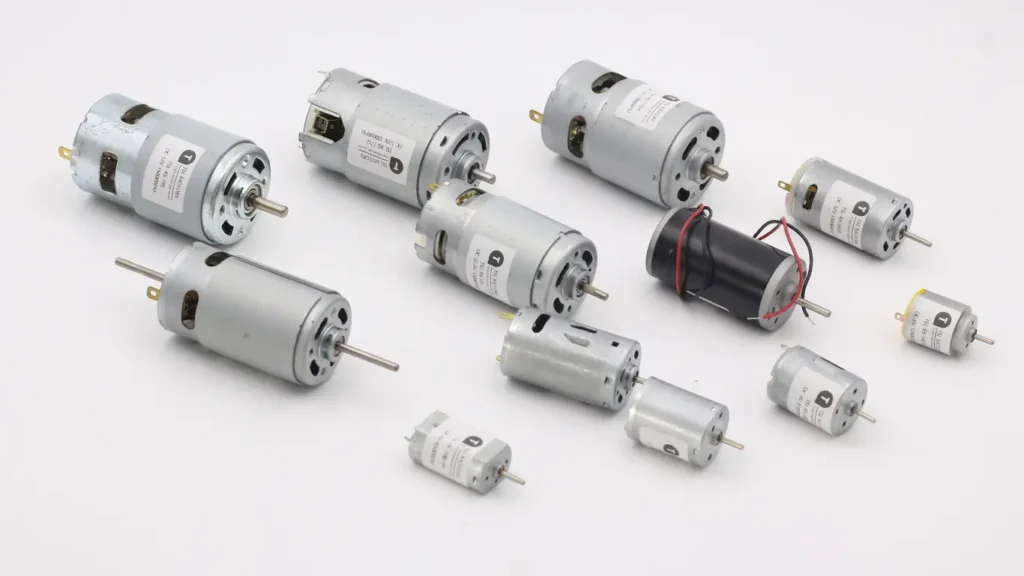
Mechanical commutation generates sparks and serious electromagnetic interference, which can distort signals in supporting detection equipment.
At high speeds, wear and heat generation increase significantly, limiting maximum speed and control precision. Overall efficiency is only 40%-50%, resulting in high energy consumption and heat generation that can affect temperature stability inside the centrifuge chamber.
Limitations of AC Induction Motors
AC induction motors have low speed control accuracy and narrow speed regulation ranges. Stability at low speeds is poor, making precise centrifugal force control difficult.
For the same power level, these motors are bulky and heavy with low power density, making them unsuitable for compact centrifuge installations.
Limitations of Stepper Motors
Stepper motors experience severe torque reduction at high speeds and cannot meet the high-speed rotation requirements of centrifuges. They are also prone to step loss, resulting in inaccurate speed control.
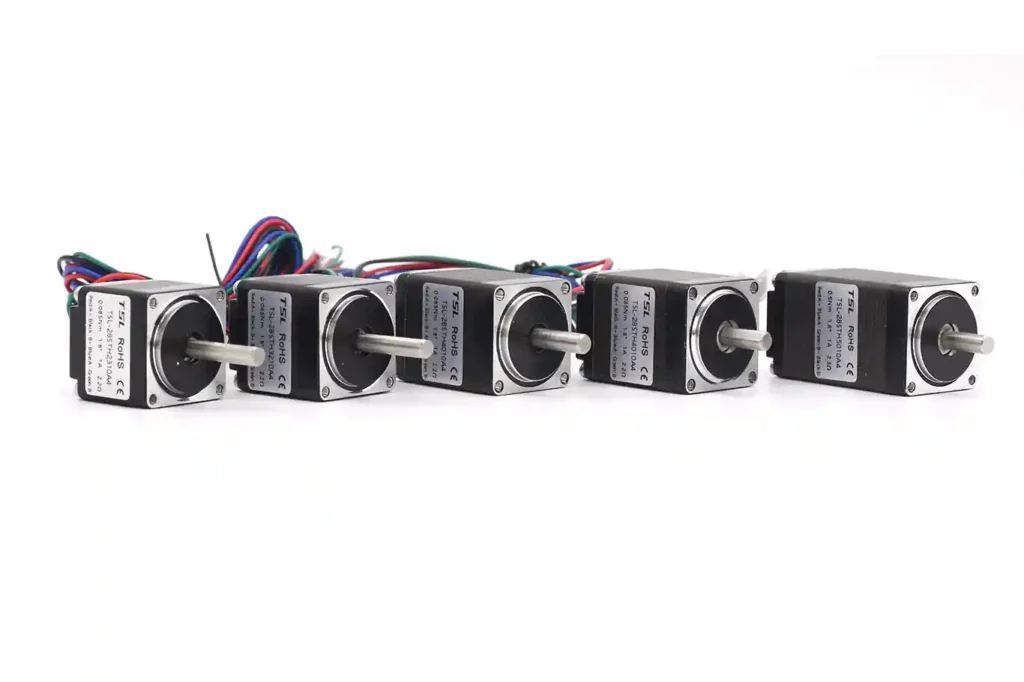
Under open-loop control, excitation current is continuously present, generating significant heat even under no-load conditions, resulting in high energy consumption and poor temperature control.
Low-speed operation often causes low-frequency resonance, making stable low-speed centrifugation difficult.
Without position feedback, high-precision closed-loop speed control cannot be achieved, making them unsuitable for centrifuge speed accuracy requirements.
Advantages of Outrunner Brushless DC Motors
Brushless DC motors use electronic commutation without carbon brush wear, enabling long-term maintenance-free operation.
Combined with Hall sensor closed-loop control, they provide wide-range high-precision speed regulation with extremely low speed fluctuation, perfectly meeting centrifuge speed control requirements.
The outrunner structure directly couples the rotor with the load, providing larger rotational inertia and smoother operation. At the same power level, the axial size is shorter, enabling flat and compact structural design suitable for miniaturized centrifuges.
They also offer high efficiency, low heat generation, low electromagnetic interference, and integrated comprehensive protection functions, fully solving the core issues of traditional solutions and becoming the optimal choice for modern centrifuge drives.
Overview of the TSL-BLDC-6020 Centrifuge Drive Module
The TSL-BLDC-6020 is an integrated drive outrunner brushless motor module specially developed for centrifuge equipment. It adopts a flat compact structure design with built-in high-precision Hall position sensing and comprehensive protection units.
It is equipped with a standard 6-pin interface for rapid compatibility with various centrifuge control systems, fully covering the operating requirements of centrifuges used in laboratories, medical applications, chemical analysis, food testing, and other fields.
Customization Services and Technical Support System
As a professional developer and manufacturer of miniature DC motors, we provide a complete global customization service and full-process technical support system.
We offer one-stop services from solution design and product development to mass production, covering the full lifecycle requirements of centrifuge equipment from prototype development to large-scale manufacturing.
Our customization services include:
Motor Winding Parameter Customization
Support for different operating voltages such as 6V, 12V, and 36V. Winding designs can be optimized according to centrifuge speed and torque requirements.
Mechanical Structure Customization
Output shaft configuration, mounting flange size, outer diameter, and axial height can be adjusted to fit different centrifuge structures and installation spaces.
Drive and Control Function Customization
PWM speed regulation range, closed-loop speed control precision, communication protocols, and speed signal output methods can be customized to match various centrifuge control systems.
Sensor and Protection Function Customization
Encoder resolution upgrades, temperature sensing, vibration monitoring, and optimized protection thresholds can be added for medical and industrial safety requirements.
Special Protection Level Customization
Special moisture-proof, dust-proof, and anti-static designs are available for high-humidity and high-dust environments.
Global Compliance Certification
Products can be customized to comply with CE, FCC, RoHS, and other certification standards according to regional regulations.
We have a professional engineering team providing full technical support including solution selection, structural adaptation, debugging optimization, and after-sales service to help customers efficiently solve technical issues and shorten development cycles.
Industry Development Trends and Future Outlook
The global life science, medical diagnostics, biopharmaceutical, and chemical testing industries continue to grow steadily, maintaining stable demand growth for centrifuges as core separation and analysis equipment.
With the rapid development of IVD, precision medicine, and biopharmaceutical industries, centrifuges are evolving toward higher precision, miniaturization, intelligence, and lower energy consumption, placing higher requirements on drive motor performance and integration.
Future centrifuge drive systems will continue evolving in four core directions:
Integration and All-in-One Design
Highly integrated solutions combining motors, drive controllers, sensors, and protection modules will become mainstream. This simplifies wiring and assembly, reduces failure rates, decreases product size, and improves space utilization.
Higher Precision and Stability
As biopharmaceutical and clinical testing fields demand higher separation accuracy, brushless motor solutions with high-precision closed-loop control and low speed fluctuation will fully replace traditional brushed and AC motor solutions.
Low Energy Consumption and Intelligence
High-efficiency, low-heat motor solutions will become a key development direction. Intelligent sensing and control algorithms enabling adaptive speed regulation, self-diagnosis, fault warning, and remote monitoring will significantly improve centrifuge intelligence and safety.
Standardization and Universal Compatibility
Universal drive modules with standardized mechanical and electrical interfaces will reduce development barriers and adaptation costs, promoting large-scale industrial development and technology upgrades.
We will continue focusing on miniature brushless DC motors and precision drive control technologies, continuously optimizing product performance and launching more advanced solutions for the global centrifuge market.
Through close cooperation with global equipment manufacturers and research institutions, we believe we can jointly promote centrifuge technology innovation and industrial development, supporting continued progress in life sciences, healthcare, and industrial testing.
Conclusion
The TSL-BLDC-6020 integrated drive outrunner brushless motor precisely addresses the common pain points in current global centrifuge drive development, providing equipment manufacturers and developers with a new universal core drive solution.
Its integrated drive structure fully meets the drive requirements of centrifuges used in clinical testing, biopharmaceuticals, chemical analysis, food testing, and environmental monitoring, perfectly adapting to products ranging from desktop microcentrifuges to portable field-testing centrifuges.
Combined with our comprehensive global customization services and professional full-process technical support system, the TSL-BLDC-6020 integrated drive outrunner brushless motor helps accelerate the development, commercialization, and large-scale adoption of centrifuge products, promoting the global centrifuge industry into a new era of high precision, integration, and intelligence.
FAQ
Q1:Why is an “outrunner” motor better for centrifuges than an “inner-runner” motor?
In an outrunner motor, the outer shell rotates. This design provides naturally higher rotational inertia, which ensures smoother speed stability and more uniform centrifugal force, preventing sample disturbance during high-speed runs.
Q2:How does the “integrated drive” simplify centrifuge manufacturing?
The TSL-BLDC-6020 has a built-in driver. Manufacturers don’t need to design or install a separate motor controller board, which reduces wiring complexity, saves internal space, and lowers the overall failure rate of the device.
Q3:Can this motor maintain precise speed under varying sample loads?
Yes. It uses high-precision Hall sensor closed-loop control. Whether the centrifuge is half-full or at maximum capacity, the motor quickly corrects speed deviations to maintain the exact preset RPM.