
Global smart manufacturing is growing fast. Customized production is also expanding. 3D printing, or additive manufacturing, is flexible. It has short development cycles. It also adapts well to different needs. It has moved beyond prototyping. It is now used in mass production in aerospace, automotive manufacturing, medical implants, consumer electronics, and many other fields.
The motion control system is a core unit of 3D printing equipment. Its positioning accuracy matters. Its running smoothness and reliability also matter. These factors directly affect part quality, dimensional accuracy, and production efficiency.
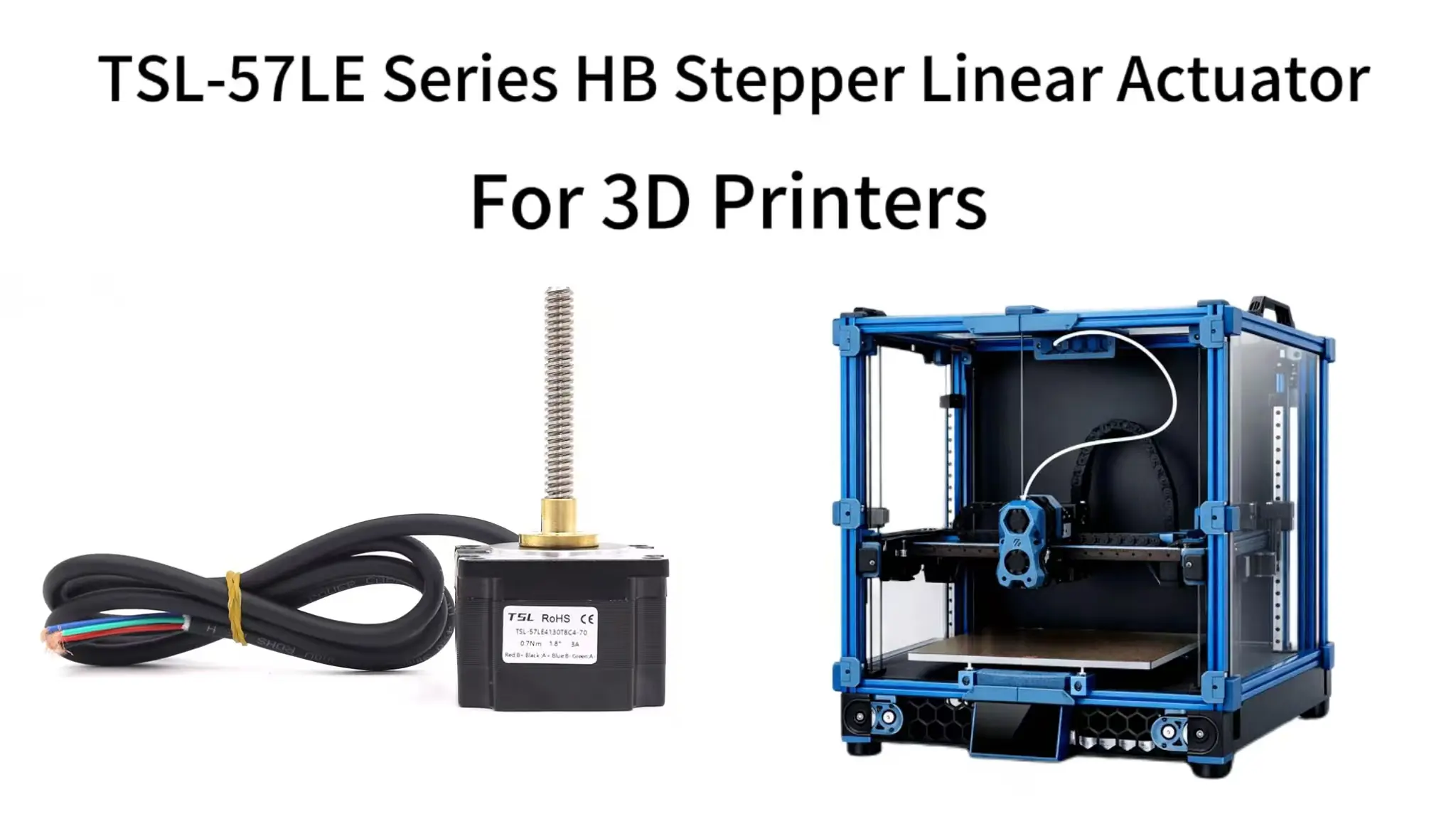
The TSL-57LE Series 57 lead screw hybrid stepper motor is designed for high-precision linear motion control. It uses an integrated structure. It offers strong power performance and broad compatibility. It provides stable, efficient, and precise drive solutions for all types of 3D printers.
Key Takeaways
- The TSL-57LE motor integrates a NEMA 23 stepper with a high-precision lead screw.
- Integrated design eliminates couplings to reduce mechanical backlash and “Z-wobble.”
- Maximum thrust of 91 kg supports heavy-duty industrial print platforms and gantries.
- Micron-level positioning ensures consistent layer thickness and dimensional accuracy.
- Low-vibration operation prevents surface ripples and horizontal “banding” on parts.
- Closed-loop capability is available via an optional encoder to eliminate missed steps.
- Maintenance-free longevity supports continuous mass production for hundreds of hours.
Core Working Principle of 3D Printers
3D printing is a digital manufacturing technology. It is based on a three-dimensional digital model. It forms physical parts by stacking and solidifying material layer by layer.
Fused deposition modeling, or FDM, is the most widely used 3D printing process today. Its core workflow is simple:
First, slicing software divides the 3D digital model into many 2D cross-section layers. The control system reads the layer data. It then drives the motion mechanism to make precise movements along the X, Y, and Z axes.
At the same time, the extrusion system heats thermoplastic filament until it melts. It extrudes and deposits the material layer by layer along a preset path. After cooling, the material bonds layer by layer. Finally, a complete three-dimensional part is formed.
During the whole forming process, the X/Y axes control the planar path of the print head. The Z axis controls the vertical layer height of the print platform.
Core Requirements for Drive Motors in 3D Printers
3D printers range from desktop high-precision models to industrial mass-production models. All of them place strict and clear demands on drive motors. The main needs are as follows:
High Positioning Accuracy
3D printing usually requires layer thickness control at the 0.1 mm level. High-precision industrial equipment may even require micron-level positioning accuracy. The motor must make every step precise and controllable. It must not lose steps. It must not create accumulated errors.
This keeps the print path fully matched with the design model. It also prevents defects such as layer shifts, dimensional errors, and surface banding.
Low Vibration and Low Noise
During printing, motor vibration is directly transferred to the print head or the print platform. This can cause ripples and layer marks on the printed part. It can seriously affect surface quality and forming accuracy.
Both desktop and industrial equipment also have strict noise requirements. The motor must run smoothly across the full speed range. It must suit office, production, and other operating environments.
Stable Thrust
The motion mechanism of a 3D printer must drive the print head, gantry, print platform, and other loads in fast reciprocating motion. It must also handle load changes at different print speeds.
The motor must deliver high thrust at low speed. It must avoid obvious power loss at high speed. This prevents step loss and stalling during operation. It also meets the speed and load needs of different printing scenarios.
Long Service Life
3D printing often requires long continuous operation. This is especially true in industrial batch production. Equipment may run without interruption for dozens or even hundreds of hours.
The motor must have no easily worn parts. Its core transmission parts must offer strong wear resistance and fatigue resistance. Its structure must be stable and reliable. It must support long-term and high-frequency continuous operation. It must also reduce equipment failure rates and maintenance costs.
Standardization
To fit 3D printers of different sizes and structures, the motor must use standard mounting dimensions common in the industry. The structure must be compact. It should directly fit the transmission structures of mainstream models. It should not require major changes to the machine body. This helps equipment manufacturers integrate it quickly and apply it in batches. It also reduces development and maintenance costs.
Why Use Lead Screw Hybrid Stepper Motors In 3D Printing
An integrated lead screw hybrid stepper motor combines a hybrid stepper motor with a lead screw transmission structure. In 3D printing, this solution balances accuracy, reliability, cost, and ease of use. It is a mainstream choice in the industry.
Compared with Standard DC Brushed Motors
A DC brushed motor uses brushes for commutation. The brushes keep wearing during operation. This shortens service life. It also causes electric sparks and obvious noise. Its positioning accuracy is poor.
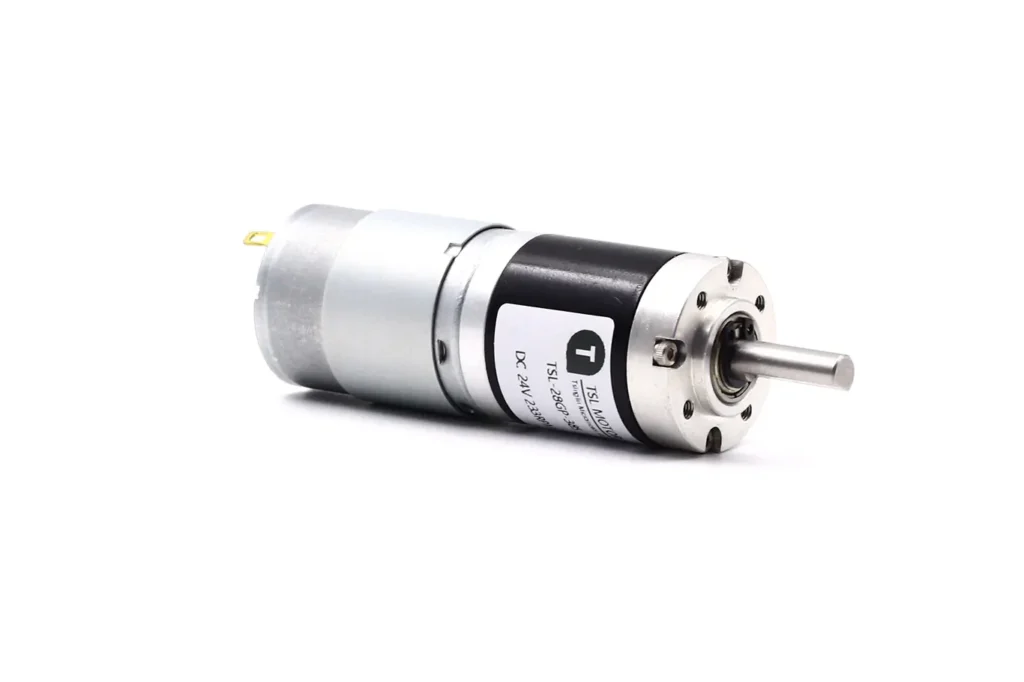
The brushed dc motor cannot provide the precise step control required by 3D printing. It can easily cause dimensional errors and severe layer marks. It cannot meet the core needs of medium- and high-precision 3D printing.
Compared with DC Gear Motors
A DC gear motor uses a gearbox to increase torque. However, its open-loop control cannot provide precise displacement control. Backlash in the gearbox can cause repeated positioning errors to accumulate. This affects layer thickness consistency.
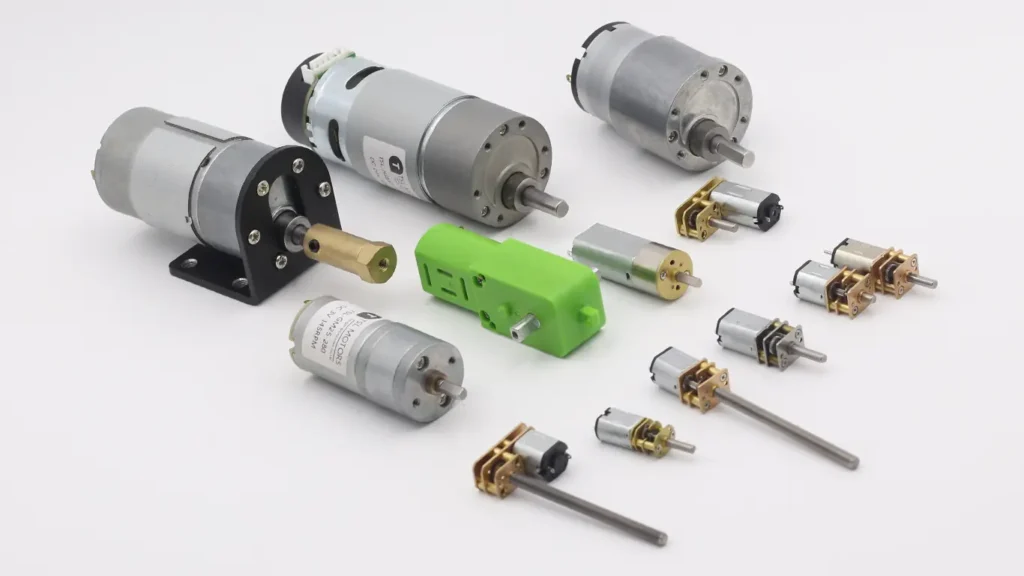
At the same time, both the brushes and gears wear out. This greatly shortens the service life of equipment in continuous operation. It is only suitable for entry-level equipment with very low precision requirements.
Compared with Standard Open-Loop Stepper Motors
A standard open-loop stepper motor can provide precise step angle control. However, it has no position feedback. It can easily lose steps during high-speed operation or sudden load changes. This directly causes print misalignment and model failure.
The open-loop stepper motor also requires extra transmission parts such as lead screws and couplings. This increases structural complexity. It introduces transmission clearance. It reduces overall positioning accuracy. It also makes installation and debugging more difficult.
Compared with Servo Motors
A servo motor offers closed-loop control, high precision, and fast response. However, the system is complex. Debugging is difficult. Purchase and maintenance costs are very high. For most 3D printers, its performance is excessive. It also raises the total machine cost sharply. It is mainly used in a small number of high-end industrial machines. It is difficult to popularize at scale.
| Motor Type | Acc. | Integr. | Smooth | Life | Cost | Fit |
| Std. brushed DC motor | Low | Low | Poor | Short (brush wear) | Low | Not suitable |
| DC gear motor | Medium | Low | Medium | Medium (gear and brush wear) | Medium | Fair (low-precision entry models only) |
| Open-loop stepper | Medium | Low | Medium | Long | Medium | Fair (may lose steps; needs extra parts) |
| Servo motor | High | Low | Excellent | Long | High | High-cost option (high-end industrial only) |
| Integrated lead screw stepper | High | High | Excellent | Long | Moderate | Optimal |
Core Product Advantages of the TSL-57LE Series 57 Lead Screw Hybrid Stepper Motor
The TSL-57LE Series is a 57 mm integrated lead screw hybrid stepper motor based on the NEMA 23 standard. It is designed for high-precision linear motion control. It fully meets the strict drive requirements of 3D printing equipment.
Integrated Structure
The motor integrates the hybrid stepper motor body with a high-precision lead screw transmission structure. It directly converts rotary motion into linear motion. It eliminates couplings, extra lead screw supports, and other parts. It also removes backlash and installation errors found in traditional transmission structures.
This greatly improves positioning accuracy and repeat positioning accuracy. It keeps 3D printing layer thickness uniform and paths precise. It effectively prevents layer marks, dimensional deviations, and other defects.
Excellent Thrust Output
With optimized electromagnetic design and lead screw transmission, the motor delivers excellent thrust output. It maintains high and smooth thrust at low speed. It also keeps stable power performance at high speed.
The maximum load limit can reach 91 kg. The motor can easily drive the print head gantry, print platform, and other loads. It supports high-speed reciprocating motion and precise positioning. It fits equipment with different print speeds and print sizes. It can run continuously without step loss or stalling.
Low Vibration and Low Noise
The motor uses an optimized stator and rotor structure. It also works with a high-precision lead screw pair. During operation, vibration is very small and noise is very low. It remains smooth across the full speed range.
This reduces surface ripples and horizontal marks caused by motor vibration at the source. It greatly improves surface smoothness and forming accuracy. It also meets the needs of quiet office and production environments.
Long Service Life
The product uses high-quality permanent magnet materials and high-strength wear-resistant lead screw materials. It is made with precision manufacturing processes. Its core transmission parts offer excellent wear resistance. It has no brushes or other easily worn parts.
It has strong fatigue resistance and environmental adaptability. It can meet the need for dozens or even hundreds of hours of continuous 3D printer operation. It greatly reduces failure rates and later maintenance costs.
Standardized Design
The motor uses industry-standard NEMA 23 mounting dimensions. Its structure is compact. Its standardization level is high. It can directly replace same-size models on the market. It does not require major changes to the 3D printer body structure.
This effectively shortens the product development cycle for equipment manufacturers. It reduces development and modification costs. It can also work flexibly with mainstream 3D printer control systems. Debugging is easy. Batch application is convenient.
Expandable Closed-Loop Control
The motor can include a high-precision encoder as needed. This enables real-time rotor position feedback and full closed-loop control. It solves the step loss problem of traditional stepper motors at the source.
Even under extreme conditions, such as sudden load changes and high-speed operation, the motor can still ensure precise positioning. It prevents print model failure caused by motor step loss. It greatly improves equipment stability and finished product yield.
TSL-57LE Series 57 Lead Screw Hybrid Stepper Motor Product Overview
The TSL-57LE Series 57 lead screw hybrid stepper motor is an integrated drive product designed for high-precision linear motion. It uses a standard NEMA 23 mounting interface. Lead screw specifications and end machining can be customized flexibly. It can perfectly fit all types of 3D printing equipment.
Customization Services and Technical Support
Global 3D printer manufacturers have diverse and differentiated product development needs. To meet these needs, we provide full-dimensional customization services for the TSL-57LE Series lead screw hybrid stepper motor. We also provide full-process technical support. This helps customers shorten the product development cycle. It also helps them achieve fast product launch and global market deployment.
- Lead screw transmission customization: We can customize lead screw lead, lead screw length, and lead screw end machining according to customer equipment needs. Options include shaft diameter, keyway, flat section, thread, and many other specifications.
- Electrical performance customization: We can customize motor winding parameters, rated current, and holding torque according to customer drive systems and use scenarios. We can also customize cable length, wiring method, and interface type.
- Closed-loop system customization: Built-in high-precision encoder options are supported. Encoder resolution and output protocol can be customized according to customer needs.
- Environmental adaptability customization: For special operating environments in industrial 3D printing equipment, the motor can be upgraded for higher waterproof and dustproof ratings.
- Structural adaptation customization: Motor body length, mounting flange, output interface, and other mechanical structures can be customized flexibly.
We provide global customers with full-cycle technical support. The support covers early-stage selection through later mass-production maintenance. We have built a global technical service network. We can provide multilingual technical support and respond quickly to customer needs.
For customer equipment design needs, we provide professional motor selection, solution evaluation, and performance simulation services. We help customers choose the best drive solution and avoid design risks.
For customer mass-production needs, we provide stable supply chain support and standardized product quality control. We also provide product maintenance, troubleshooting, technical upgrades, and other full-lifecycle services. This ensures stable operation of customer equipment in mass production.
Industry Development Trends and Future Outlook
As global smart manufacturing and customized production grow quickly, 3D printing is moving from prototyping to mass production. It is also moving from general applications to high-precision professional applications. Its use is deepening in aerospace, automotive manufacturing, medical implants, consumer electronics, construction engineering, and other fields.
In the future, high-precision integrated linear drive will be a core direction for 3D printer motion control systems. Closed-loop intelligent control will also be important. High power density and miniaturization will matter. Low-vibration and quiet operation will also become key trends.
On one hand, desktop 3D printers have higher requirements for print accuracy, surface quality, and operating noise. They need drive solutions with better cost performance and higher integration.
On the other hand, industrial 3D printers are moving toward high speed, large build size, and continuous mass production. They place stricter requirements on motor thrust output, continuous operation stability, and positioning accuracy.
We will continue to focus on drive technology upgrades in 3D printing. We will keep optimizing the integrated performance of lead screw hybrid stepper motors. We will improve product performance in positioning accuracy, running smoothness, thrust density, quiet operation, and intelligent control.
At the same time, we will keep improving our customized product system and global technical service network. We will launch drive solutions that better meet the needs of next-generation 3D printing equipment. We will provide continuous and stable power support for innovation in the global 3D printing industry.
Conclusion
The TSL-57LE Series 57 lead screw hybrid stepper motor offers integrated high-precision transmission. It provides excellent thrust output, low vibration, low noise, high reliability, long service life, and easy standardized integration. It can perfectly meet the X/Y/Z-axis drive needs of all types of 3D printers, from desktop high-precision models to industrial mass-production models.
This series ensures forming accuracy, printing efficiency, and operating stability for 3D printing equipment. It also effectively reduces development, integration, and maintenance costs. It is an ideal choice for 3D printer drive systems.
As the global 3D printing industry continues to grow rapidly, we will keep focusing on high-precision motion control. We will provide stable and reliable drive support for the upgrade of global smart manufacturing.