
Multi-rotor UAVs are now widely used. They excel in aerial photography, mapping, and agriculture. You can also find them in power inspection and logistics. Their flexible take-off and easy control make them essential. They are indispensable in modern industry and daily life.
The motor is the core power component. Its performance is critical. It directly determines flight endurance and load capacity. It also affects flight stability and efficiency.
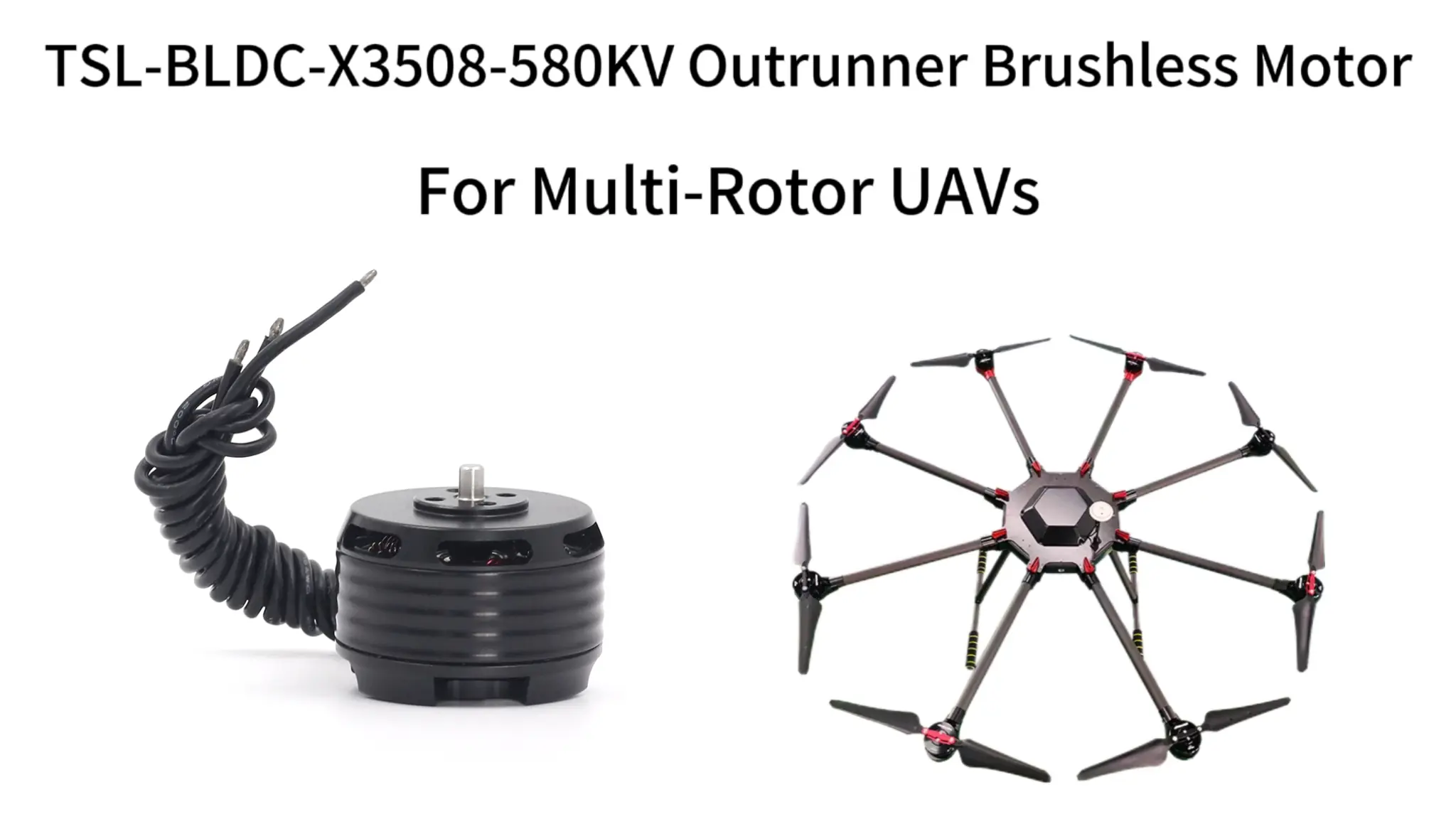
The X3508-580KV motor is a top choice. It features precise parameter design. It also offers reliable operation. This outrunner brushless DC motor is powerful. It is a high-quality solution for multi-rotor UAVs.
Key Takeaways
- Multi-rotor drones are evolving toward fully autonomous operations through the integration of AI vision and navigation technology.
- Long-endurance flight remains a primary goal for the industry, driving continuous optimization in propulsion system efficiency.
- Future drone motors must achieve significantly higher power density to support the growing demand for heavy-lift capabilities.
- The TSL-BLDC-X3508-580KV motor delivers a precise balance of lightweight design and 400W high-power output.
- Intelligent speed control technology will be deeply integrated with flight controllers to optimize real-time torque and response.
- External rotor BLDC motors have established themselves as the core choice for drone propulsion due to their superior stability.
- Customized motor parameters are essential for maximizing the performance of drones in specific scenarios like agriculture or inspection.
What is a Multi-Rotor UAV
A multi-rotor UAV has multiple rotors. It controls flight attitude by adjusting rotor speeds. Unlike fixed-wing drones, it does not need a runway. It can take off vertically and hover. This makes it ideal for narrow spaces.
Structurally, there are several layouts. Common types include quadrotors and hexarotors. More rotors mean stronger load capacity. The flight logic relies on speed differences. This depends entirely on precise motor response.
These drones fit different scenarios. They are either consumer-grade or industrial-grade. Consumer models focus on portability and photos. Industrial models demand high power and endurance. They must also adapt to harsh environments.
How Motors Drive Multi-Rotor UAVs
Multi-rotor drones operate in complex scenarios, presenting “multi-dimensional and high-precision” requirements for propulsion motors. The core demands can be summarized into the following five points:
High Power Density
Industrial-grade drones often need to carry payloads such as mapping cameras, spraying tanks for agricultural protection, and inspection equipment. This requires motors to output sufficient power and torque within limited volume and weight, preventing insufficient power from limiting payload capacity.
Fast Response
In scenarios involving obstacle avoidance, attitude adjustment, and sudden wind gusts, motors are required to respond rapidly to speed commands. This reduces attitude deviations caused by latency and ensures flight stability.
Long Endurance Characteristics
Endurance is one of the core pain points for multi-rotor drones. Motors must feature low-loss characteristics to reduce energy waste during the electrical-to-mechanical conversion process, thereby extending the operational duration per charge. This is particularly critical for long-endurance industrial operations.
Lightweight and Reliability
The weight of the airframe directly affects flight energy consumption and payload capacity. Motors must be lightweight while guaranteeing performance. Furthermore, industrial operation scenarios demand extremely high durability from motors, requiring them to run stably for long periods with a low failure rate.
Why Choose an Outrunner Brushless DC Motor?
In the power system selection for multi-rotor drones, the Outrunner Brushless DC (BLDC) Motor has gradually become the mainstream choice. Compared to brushed motors, inrunner brushless motors, and coreless motors, its advantages are significant:
Comparison with Brushed Motors
Brushed motors rely on the physical contact between brushes and a commutator for conduction. This leads to mechanical wear, resulting in poor contact and a short lifespan during long-term operation. Additionally, their speed stability is poor, failing to meet the high-precision control requirements of drones.
In contrast, the TSL-BLDC-X3508-580KV motor features a brushless design. It achieves speed control through electronic commutation, eliminating mechanical wear for a longer lifespan. Furthermore, it offers minimal speed fluctuation, making it well-suited for the precise control needs of drones.
Comparison with Inrunner Brushless Motors
In an inrunner brushless motor, the rotor is located inside the stator. Its torque output characteristics lean towards high speed and low torque, making it difficult to directly meet the lift requirements of multi-rotor drones, which demand heavy loads and high torque at low speeds.
The outrunner brushless motor features a rotor that envelops the stator. With a larger rotor diameter and higher rotational inertia, it can directly output high torque without the need for additional reduction gears. This not only simplifies the power system structure and reduces energy loss but also makes it better suited for the low-speed, high-lift requirements of multi-rotor propellers.
Comparison with Coreless Motors
While coreless motors offer fast response and light weight, they generally suffer from low power and insufficient torque. They are prone to overheating when carrying loads or operating continuously for long periods, making it difficult to support the hovering and payload requirements of multi-rotor drones.
The outrunner brushless motor maintains lightweight characteristics while delivering greater continuous power and torque. With superior heat dissipation performance, it is suitable for long-duration stable flights, offering significantly better comprehensive durability and load capacity.
Vertical Comparison Table of Power Motors for Multi-Rotor UAVs
| Comparison Dimension | Brushed Motor | Inrunner Brushless Motor | Coreless Motor | Outrunner Brushless DC Motor (TSL-BLDC-X3508-580KV) |
| Commutation Method | Mechanical commutation with brushes + commutator | Electronic commutation | Electronic commutation | Electronic commutation |
| Mechanical Wear | Obvious wear, easy to damage | No mechanical wear | No mechanical wear | No mechanical wear |
| Torque Characteristics | Small torque, poor stability | High speed, low torque | Insufficient torque, small power | Low speed and high torque, stable output |
| Load Capacity | Weak, unable to meet heavy load requirements | Relatively weak, requires additional deceleration mechanism | Weak, not suitable for long-term work with loads | Strong, can directly support conventional loads of UAVs |
| Service Life | Short, prone to poor contact | Relatively long | Medium, easy to heat loss during long-term work | Long, no wearing parts, low failure rate |
| Adaptability (Multi-Rotor UAVs) | Low, unable to meet precise control | Medium, needs to be adapted to deceleration mechanism | Low, only suitable for small light-load toy UAVs | High, fits lightweight and high stability requirements |
Advantages of TSL-BLDC-X3508-580KV
Combining the core requirements of multi-rotor drones, the X3508-580KV motor offers multiple outstanding advantages in terms of performance, design, and adaptability:
Precise KV Value and Speed Matching
The 580 rpm/V KV value is a core parameter specifically designed for multi-rotor drones. When paired with mainstream drone battery voltages, it directly outputs the optimal speed range for propellers without the need for complex speed regulation mechanisms. This ensures efficient lift output while reducing energy consumption and improving endurance performance.
High Power Density
With a maximum continuous power of 400W and a maximum continuous current of 5A, the motor achieves high power output within a lightweight 72g chassis. Its excellent power density allows it to easily support conventional payloads such as aerial photography cameras and small agricultural spraying tanks, meeting the load requirements of both consumer and partial industrial-grade scenarios.
Low Loss and Long Endurance Performance
The brushless design minimizes mechanical friction losses. With a no-load current of only 0.4A, the motor boasts higher electrical conversion efficiency. This effectively reduces the drone’s energy consumption and extends flight time per charge, addressing the endurance bottleneck common in multi-rotor drones.
Stable Operating Characteristics
The design featuring 24 stator poles and 28 rotor poles ensures smaller speed fluctuations and smoother torque output during operation. Combined with a compact outer diameter of 40.3mm and a body length of 26.5mm, it fits well within multi-rotor drone layouts, reducing flight drag and further enhancing flight stability.
Reliable Environmental Adaptability
The motor adopts a compact structural design with good dust resistance, making it suitable for routine outdoor operating environments. The brushless structure has no wearing parts, resulting in a low failure rate during long-term operation, satisfying the demands for frequent takeoffs/landings and continuous operations.
TSL-BLDC-X3508-580KV Overview
The TSL-BLDC-X3508-580KV is an outrunner brushless DC motor specifically engineered for multi-rotor drones. It centers on precise speed adaptation with a 580KV rating, high power density, and a lightweight design, all while balancing stable operation with long-endurance performance.
Suitable for both consumer-grade and select industrial-grade multi-rotor drone scenarios, this motor features no mechanical wear and strong load-bearing capabilities. Please refer to the datasheet below for detailed technical parameters and performance metrics.
TSL Customization Capabilities
In addition to the standard TSL-BLDC-X3508-580KV motor, we possess comprehensive customization capabilities. We can tailor motor parameters—including KV value, power, dimensions, and weight—to match specific multi-rotor drone application scenarios (such as aerial photography, agricultural plant protection, and inspection). This allows us to precisely align with diverse load, endurance, and flight requirements, effectively solving the pain point where standard products fail to fit specialized scenarios.
Furthermore, we can simultaneously design and manufacture matching electronic speed controllers (ESCs) and drivers. This achieves deep adaptation between the motor, ESC, and driver, optimizing the efficiency of the power system. By reducing signal latency and energy loss, we further enhance the drone’s flight stability, control precision, and endurance, providing customers with a one-stop power system solution.
Future Outlook of Multi-Rotor UAVs and Motors
Combined with the current industry technology iteration and practical application requirements, the development direction of multi-rotor UAVs has gradually become clear, and its core is to continuously break through operation efficiency, endurance capacity and application boundaries.
From the perspective of practical engineering applications, future multi-rotor UAVs will develop steadily in the direction of “intelligence, long endurance and heavy load”, and realize fully autonomous operation combined with AI vision and autonomous navigation technology, greatly reducing manual intervention.
At the same time, the single operation time will be extended through breakthroughs in battery technology and power system optimization to meet the needs of long-distance inspection, logistics and transportation and other scenarios. In addition, the load capacity will be improved for large material transportation, heavy equipment mounting and other scenarios, and its application boundaries will be continuously expanded.
As the core power source of multi-rotor UAVs, the technological upgrading of motors is synchronized with the development of UAVs, directly determining the upper limit of UAV performance.As industry engineers, we judge that motor technology will continue to upgrade around multiple core dimensions, achieving higher power density in a smaller volume to improve the load capacity of UAVs.
Maximize endurance performance by reducing power loss and combining with intelligent speed regulation technology, and at the same time realize deep integration with the flight control system to complete real-time dynamic optimization of speed and torque to improve flight adaptability.In addition, components such as sensors and heat dissipation modules will be integrated to simplify the power system structure, and exclusive motor parameters will be developed for different scenarios such as plant protection, aerial photography and inspection to further improve scenario adaptability.
Conclusion
The development of multi-rotor UAVs has always been supported by power motor technology, and outrunner brushless DC motors have become the core choice for the power system of multi-rotor UAVs by virtue of their unique structure and performance advantages.
With a precise KV value of 580rpm/V, a high power output of 400W, a lightweight design of 72g, as well as the characteristics of low loss and high stability, the TSL-BLDC-X3508-580KV motor perfectly fits the core power requirements of multi-rotor UAVs. It can not only meet the portability and stability requirements of consumer-grade aerial photography, but also support the light-load operation requirements of some industrial-grade scenarios.
Relying on complete customization capabilities and supporting design of ESCs and drivers, we can provide customers with a one-stop power system solution to adapt to various special scenario requirements.
With the development of multi-rotor UAVs towards long endurance, heavy load and intelligence, the performance of power motors will continue to upgrade. The design concept of “high power density, precise adaptation, stability and reliability” represented by the X3508-580KV motor will also become the core direction of the future development of multi-rotor UAV motors.
Precise power matching is the basis for efficient operation of multi-rotor UAVs, and continuous optimization of motor performance and improvement of supporting services are the key driving forces to promote the continuous expansion of multi-rotor UAV application scenarios.
FAQ
Q1: How do I choose the right motor KV value based on a drone’s payload requirements?
A: The KV value determines the relationship between voltage and RPM. For heavy-lift models requiring high thrust, low-KV motors (such as 580KV) are typically paired with large-diameter propellers to maximize efficiency. Conversely, small photography drones favor high-KV motors to achieve faster dynamic response times.
Q2: How does the X3508-580KV motor ensure long-endurance performance in industrial applications?
A: This motor utilizes a lightweight design (only 72g) to reduce the drone’s overall takeoff weight. By combining a low-loss internal structure with precise power matching, it effectively extends operational flight time on the same battery capacity.
Q3: Why must future motors undergo “deep integration” with flight control systems?
A: Deep integration allows the flight controller to obtain real-time data on the motor’s RPM and torque status. This feedback mechanism enables the drone to adjust its attitude more rapidly in turbulent airflow, significantly enhancing flight stability and adaptability to extreme environments.