
The global UAV industry is rapidly evolving toward high-definition imaging and precision sensing. High-precision gimbal cameras have become essential tools for mapping, inspection, security, and emergency rescue.
Stabilization performance directly determines imaging quality and operational accuracy. High-performance motors serve as the core components that ensure smooth movement and precise control of the gimbal system.
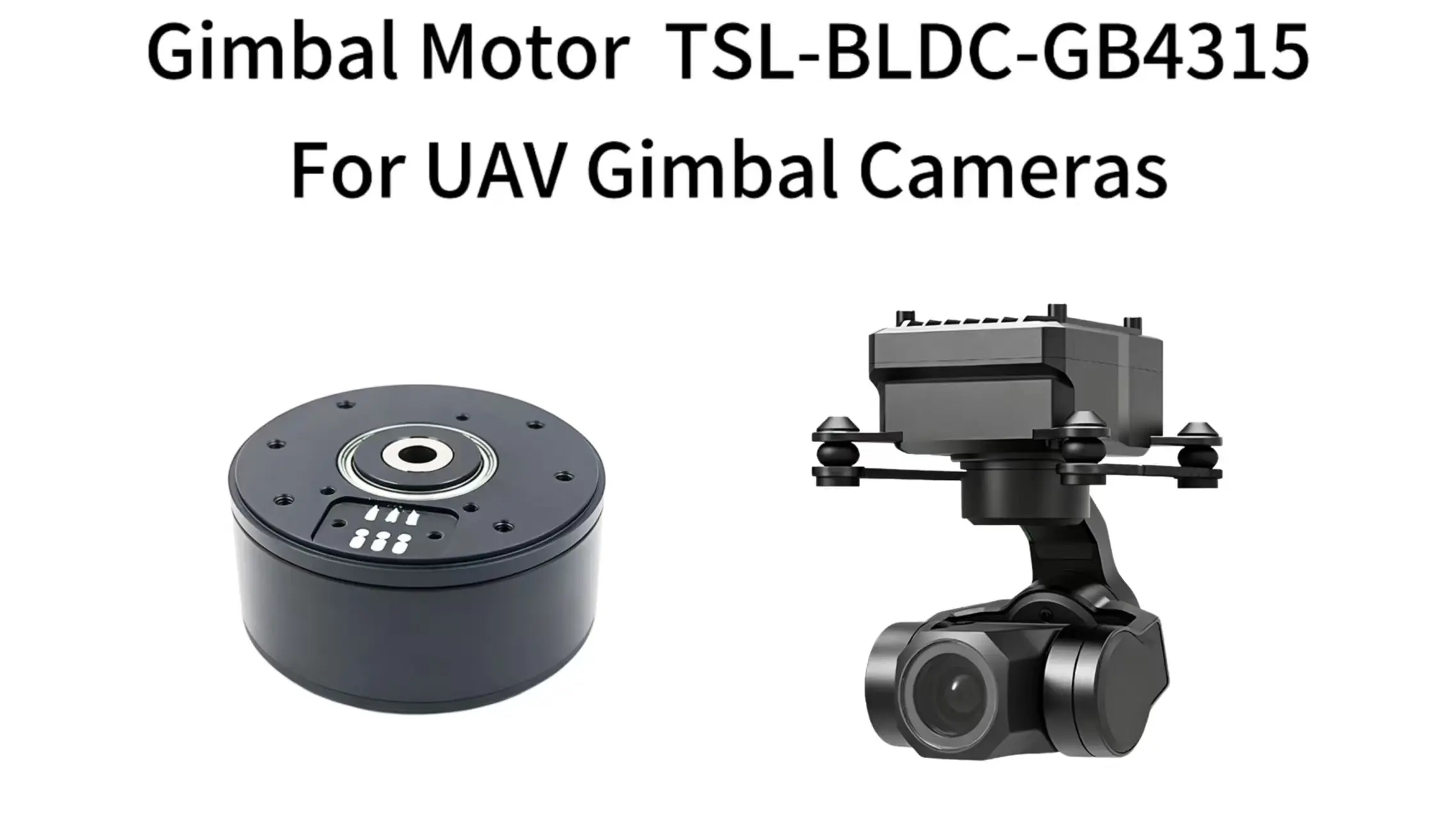
The TSL-BLDC-GB4315 hollow-shaft motor features low vibration, high torque, and fast response. This mature, mass-producible solution provides global OEMs with reliable and dedicated power for professional UAV gimbals.
Key Takeaways
- The TSL-BLDC-GB4315 motor delivers high-precision stability for professional UAV gimbals.
- Integrated hollow shafts enable seamless internal cable routing for 3-axis systems.
- Outer-rotor technology provides the high torque density required for heavy camera loads.
- Brushless commutation ensures ultra-low vibration and minimal electromagnetic interference.
- The motor’s fast response compensates for high-speed flight jitter in real-time.
- Industrial-grade components support stable operation in extreme weather and high altitudes.
- Standardized interfaces simplify integration for UAV OEMs and gimbal manufacturers.
Overview of UAV Gimbal Cameras
A UAV gimbal camera integrates a high-precision gimbal with HD imaging equipment. Its core function is to counteract flight interference. This includes airframe vibration, airflow, and attitude changes. Consequently, the camera maintains a stable direction. It outputs clear, jitter-free, and smear-free data.
The gimbal’s value lies in three-axis stability: pitch, roll, and yaw. It adjusts camera attitude in real time. This isolates flight-induced vibration and jitter. It meets strict stability needs for aerial photography, surveying, inspection, and reconnaissance.
Compare this to cameras directly mounted without a gimbal. Professional gimbals offer significant improvements. They boost operational accuracy and image availability. Furthermore, they increase the overall mission success rate.
These cameras are now widely used. Applications range from consumer aerial photography to industrial operations and special missions. They are a key standard component. They upgrade UAVs from simple “flight platforms” to advanced “operational platforms”.
Core Functions of Gimbal Motors in UAV Gimbal Cameras
The gimbal motor is the core execution component. It directly determines stabilization accuracy. It also controls response speed and imaging quality.
The motor responds to control algorithms in real time. It offsets flight vibration and airflow disturbance. It also counters airframe attitude changes. This keeps the camera level and locked on target. It fundamentally eliminates picture jitter, blurring, and smearing.
It adjusts pitch, roll, and yaw axes with micro-level precision. It supports professional modes like fixed-point locking, uniform scanning, and target following. This meets strict requirements for consistent viewing angles in aerial surveying, inspection, and reconnaissance.
With gimbal motors, loads like cameras and sensors maintain stable attitude. They do not drift or jitter. This holds true during acceleration, steering, and strong winds. It ensures operational reliability under heavy loads and complex environments.
The motor acts as the execution terminal of the closed-loop system. It responds to signals quickly. It achieves high-dynamic, high-precision, and lag-free correction. This guarantees high-precision stability control.
It features hollow routing and a lightweight, standardized design. This simplifies the internal gimbal structure. It improves the integration level of the complete machine. It provides key power support for miniaturized, lightweight, and high-performance gimbals.
Core Requirements for Drive Motors in UAV Gimbal Cameras
UAV gimbal cameras are precision actuators with requirements for high accuracy, high stability, and high dynamic response, imposing far stricter technical standards on drive motors than ordinary power motors:
High-precision positioning and low jitter
The gimbal needs to achieve micro-radian level attitude adjustment, so the motor must have high resolution, low backlash, and smooth low-speed operation to avoid picture jitter.
High torque density and lightweight
With limited load capacity of the gimbal, the motor is required to output sufficient holding torque and dynamic torque in a compact size and light weight to support the stable operation of the camera.
Hollow routing structure
Camera signal lines, power lines, and control lines need to pass through the interior of the gimbal, and the hollow shaft design can simplify wiring, and improve reliability and aesthetics.
Ultra-low vibration and low electromagnetic interference (EMI)
Motor operation vibration will directly impair imaging quality, and electromagnetic interference will affect the normal operation of image transmission, flight control, and sensors, so ultra-low vibration and low EMI must be achieved.
Wide temperature range and high reliability
Adapt to outdoor environments from -20℃ to 60℃ and high-altitude low-pressure working conditions, support long-term continuous and stable operation, with a fault-free service life that meets industrial operation requirements.
Fast dynamic response
Can respond to gimbal control algorithm instructions in real time, quickly correct attitude deviations, and maintain stability even under high-speed flight and strong disturbance conditions.
Standardized interface and easy integration
Adopt universal installation dimensions and signal interfaces, can quickly adapt to mainstream gimbal controllers, cameras and UAV platforms, and reduce development costs.
Preferred Solution for UAV Gimbals: Hollow-Shaft Outer-Rotor Brushless DC Motors
This motor features hollow routing and a lightweight, standardized design. It simplifies the internal gimbal structure. It improves the integration level of the complete machine. It provides key power support for miniaturized, lightweight, and high-performance gimbals.
Comparison with traditional servos
Servos adopt a reduction gear structure, which has the defects of large backlash, low-speed jitter, response lag, and short service life. They cannot meet the requirements of high precision, jitter-free, and continuous dynamic adjustment of gimbals, and are only suitable for low-end fixed-angle scenarios, unable to support professional high-definition gimbal operations.
Comparison with ordinary inner-rotor brushless motors
Ordinary inner-rotor brushless motors have low torque density, strong high-speed characteristics, and poor low-speed smoothness. It is difficult for them to achieve the low-speed, high-torque smooth operation required by gimbals. In addition, they have no hollow structure and cannot meet the routing requirements of gimbals, making them unsuitable for direct use in precision gimbal drives.
Comparison with brushed motors
Brushed motors rely on carbon brushes for commutation, which have the defects of large electromagnetic interference, obvious vibration, short service life, and frequent maintenance. They will seriously affect camera imaging and UAV electronic systems, and cannot meet the long-term stable operation requirements of professional gimbals.
Performance Comparison Table
| Comparison Dimension | Traditional Servos | Ordinary Inner-Rotor Brushless Motors | Brushed Motors | Hollow-Shaft Outer-Rotor Brushless DC Motors |
| Positioning Accuracy | Low, large backlash | Medium, low-speed jitter | Low | High |
| Vibration and EMI | High vibration, medium interference | Medium vibration, low interference | High vibration, strong interference | Ultra-low vibration, low electromagnetic interference |
| Torque Density | Low | Medium | Low | High |
| Hollow Routing | Not supported | Not supported | Not supported | Fully supported |
| Low-Speed Smoothness | Poor | Fair | Poor | Excellent |
| Service Life | Short | Medium | Short | Ultra-long |
| Gimbal Compatibility | Poor | Fair | Poor | Optimal |
| Overall Cost Performance | Low | Medium | Low | High |
Core Advantages of the TSL-BLDC-GB4315 Gimbal Motor
The TSL-BLDC-GB4315 is a hollow-shaft outer-rotor brushless DC gimbal motor. It is specially developed for UAV gimbal cameras.This motor fully matches the driving requirements of professional gimbals. It delivers high precision, high stability, and high reliability.
Integrated Hollow Design
It adopts a hollow shaft structure. This allows signal and power lines to pass through easily. It optimizes the internal space layout of the gimbal. The design reduces cable wear and improves reliability. It perfectly adapts to the three-axis gimbal structure.
High Precision and Low Jitter
The motor features an optimized magnetic circuit and winding design. It achieves ultra-smooth low-speed operation without cogging. High positioning accuracy ensures clear, blur-free, and smear-free images.
Ultra-Low Vibration and Low Electromagnetic Interference
Precision dynamic balance adjustment ensures minimal vibration and low noise. The brushless structure prevents electric spark interference. This protects camera imaging and flight control signals.
High Torque Density
It delivers large holding torque in a compact body. It stably supports loads like mirrorless and zoom cameras. It accurately locks attitude without jitter or drift, even under strong disturbance.
Wide Environmental Adaptability
It uses high and low temperature resistant materials. The motor works stably from -20℃ to 60℃. It performs well in high altitude and complex outdoor airflow environments.
Fast Response and High Controllability
The motor cooperates with the gimbal closed-loop drive system. It offers fast response speed and high control accuracy. It adjusts attitude in real time to follow flight control instructions.
Standardization and Easy Integration
It adopts industry-general installation hole positions and interfaces. It adapts quickly to mainstream controllers and UAV platforms. This eliminates the need for custom modification and shortens development cycles.
TSL-BLDC-GB4315 Gimbal Motor Overview
The TSL-BLDC-GB4315 is a hollow-shaft outer-rotor brushless DC motor dedicated to UAV three-axis gimbal cameras. It adopts optimized magnetic circuit design, hollow routing structure, and is equipped with standardized installation interfaces.
It can be quickly adapted to various aerial photography, surveying and mapping, and inspection gimbal systems, with performance fully covering all working conditions required for high-precision stability control of gimbals.
Customized Services and Technical Support
For global UAV gimbal camera manufacturers and complete machine manufacturers, we provide one-stop customized solutions and full-cycle technical support, covering the entire process of product design, prototype development, test verification, and mass production:
- Parameter Customization: Tailor KV, torque, speed, and voltage. Adjust hollow aperture to fit load requirements.
- Structural Customization: Customize shaft diameter, mounting holes, and connectors. Adapt waterproof rating and shaft structure.
- Performance Optimization: Optimize for smoothness and vibration suppression. Enhance heat dissipation and anti-interference capabilities.
- System Adaptation: Joint debugging with controllers and flight systems. Optimize dynamic response and control parameters.
- Environmental Reinforcement: Upgrade materials for extreme temperatures. Reinforce protection against humidity and salt spray.
- Full-Cycle Support: Support from design and prototyping to mass production. Assistance with after-sales maintenance.
Industry Development Trend and Future Outlook
In the future, UAV gimbal cameras will develop toward higher definition, more miniaturization, lighter weight, more intelligence, and higher stability:
- Miniaturization: Gimbals shrink while load capacity grows. Demands higher motor torque density.
- Higher Stability: 8K and telephoto lenses require ultra-low jitter. Demands higher precision and smoother operation.
- Intelligence: AI tracking requires faster motor response. Needs higher closed-loop control accuracy.
- Standardization: Industrial scale drives modular design. Focuses on high reliability and low cost.
- Mainstream Solution: Hollow-shaft outer-rotor motors lead the market. TSL-BLDC-GB4315 sets the technological direction.
Hollow-shaft outer-rotor brushless gimbal motors will become the absolute mainstream solution for professional gimbals. The TSL-BLDC-GB4315 series motors feature hollow structure, high precision, low vibration, and high torque density. They will continue to lead the industry’s technological direction. They will provide core power support for the upgrading of the global UAV gimbal industry.
Conclusion
The TSL-BLDC-GB4315 is a hollow-shaft outer-rotor brushless DC gimbal motor. It has core advantages of hollow routing, high precision, low jitter, high torque density, ultra-low vibration, low electromagnetic interference, wide environmental adaptability, and easy integration. It perfectly matches the professional driving requirements of UAV gimbal cameras with these strengths.
TSL-BLDC-GB4315 effectively solves the industry pain points of traditional servos, ordinary brushless motors, and brushed motors in terms of accuracy, stability, reliability, and structural adaptability.
It provides a mature, reliable, and mass-producible dedicated power solution for gimbal systems to global UAV manufacturers in aerial photography, surveying and mapping, inspection, security and other fields. It helps customers improve the core competitiveness of their products. It promotes the in-depth application and popularization of high-precision UAV gimbal cameras in various industries around the world.
FAQ
Q1:Why is the hollow-shaft design critical for professional UAV gimbals?
The hollow shaft allows for internal routing of power and signal cables (such as HDMI or SDI). This prevents wire tangling during 360° rotations, reduces external cable drag, and protects sensitive wiring from environmental wear, significantly increasing system reliability.
Q2: Can the TSL-BLDC-GB4315 support heavy zoom lenses or mapping cameras?
Yes. Thanks to its high torque density and outer-rotor architecture, the GB4315 provides superior holding torque. It is specifically designed to stabilize payloads like mirrorless cameras, optical zoom lenses, and LiDAR sensors without jitter or attitude drift.
Q3:How does this motor improve image quality in high-wind conditions?
The motor features a fast dynamic response and ultra-low cogging effect. This allows the gimbal controller to make micro-adjustments in real-time, instantly counteracting wind gusts and airframe vibrations to ensure blur-free 4K/8K imaging.