
High-performance liquid chromatography (HPLC) is a key analytical instrument used in pharmaceuticals, food, environmental monitoring, chemical industries, and other fields. Its detection accuracy and stability highly depend on the reliable drive of fluid control valve assemblies.
Fluid control components such as sample injection switching valves, six-port valves, and liquid chromatography valves require motor drives with high precision, low vibration, and long service life.
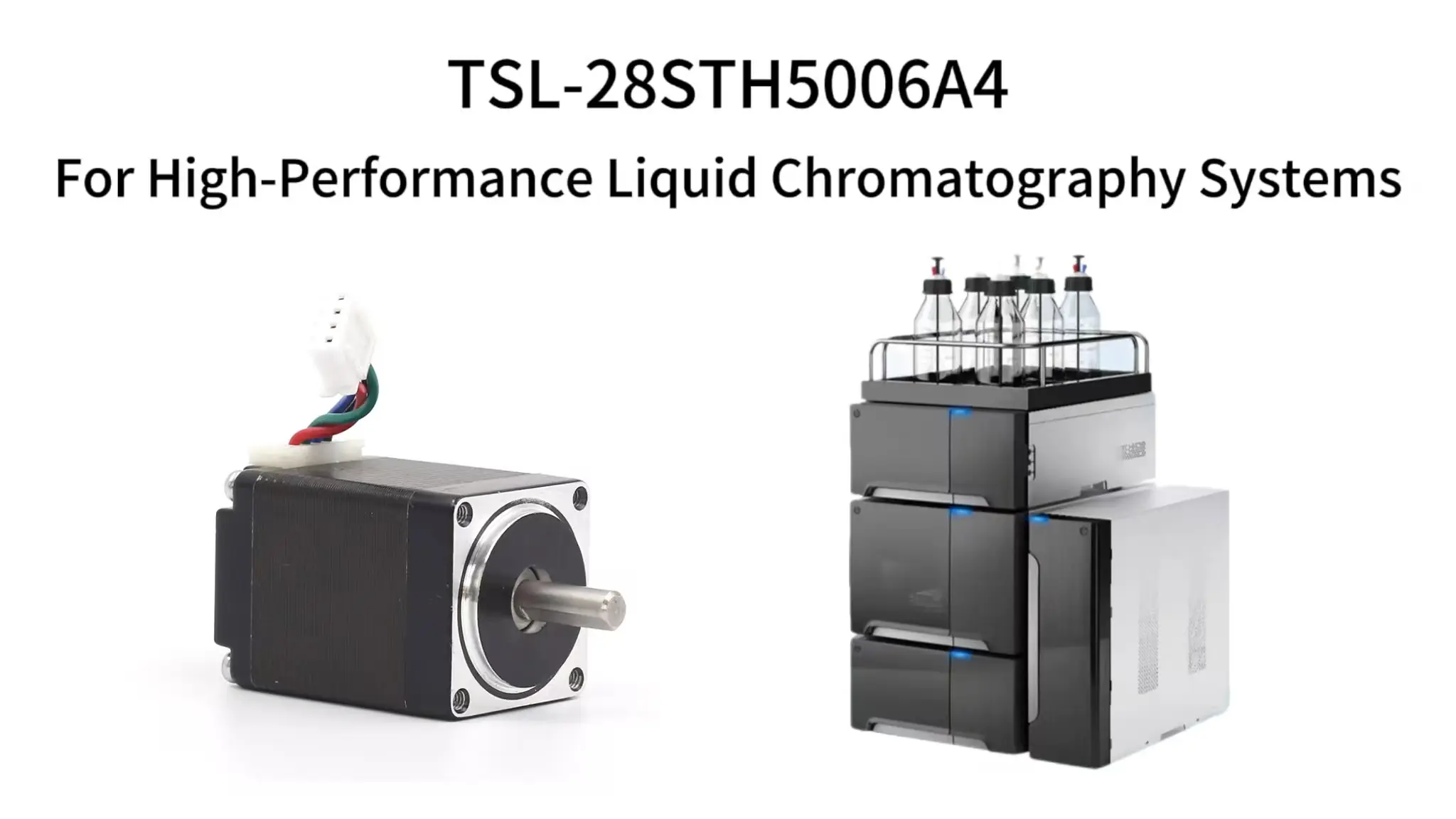
The TSL-28STH5006A4 28mm hybrid stepper motor is specifically designed for HPLC valve drive applications. It can stably adapt to mainstream valve bodies such as Valco VICI, providing precise, reliable, and efficient power support for analytical instruments.
key Takeaways
- The TSL-28STH5006A4 motor provides the high-torque, high-precision drive needed for HPLC fluid valves.
- A 1.8° step angle enables micro-stepping for precise alignment of injection and six-port valves.
- Ultra-low vibration design ensures that detector signals remain stable and free from mechanical interference.
- The brushless hybrid structure offers a maintenance-free lifespan exceeding 5,000 hours of continuous use.
- Standardized 28mm mounting allows for seamless integration into compact, high-throughput analytical instruments.
- High repeatability (RSD < 1%) guarantees consistent results across thousands of automated sample injections.
- IP54 protection ensures the motor remains reliable even in the presence of laboratory solvents or moisture.
Working Principle of High-Performance Liquid Chromatography Systems
High-performance liquid chromatography (HPLC) is a core analytical instrument widely used in pharmaceuticals, chemicals, food safety, environmental monitoring, and life sciences. Its working principle is based on differences in partition coefficients between the mobile phase and stationary phase, enabling separation, qualitative analysis, and quantitative analysis of complex mixtures.
Its typical workflow is as follows:
- A high-pressure delivery pump pushes the mobile phase into the chromatographic column system at a stable flow rate, while the sample is accurately injected into the flow path through the injection valve.
- Driven by the mobile phase, the individual components of the sample are separated inside the chromatographic column.
- The separated components then pass through the detector, where they are converted into electrical signals and displayed as chromatograms.
- Finally, the data processing system completes signal analysis, result output, and data storage.
Among these components, fluid control valve assemblies centered around Valco VICI chromatographic sample injection switching valves, six-port valves, and liquid chromatography valves are key components for sample injection, flow path switching, and quantitative loop calibration.
The motion precision, positioning consistency, and response speed of the valve assembly directly determine the repeatability, accuracy, and reliability of HPLC analytical results. As the power source of the valve micro-drive mechanism, the motor’s performance is the core prerequisite for ensuring stable valve operation.
Core Role of Motors in High-Performance Liquid Chromatography Systems
In HPLC systems, the core role of the motor is to precisely drive fluid control valve assemblies, mainly reflected in three key aspects:
Sample Injection Switching Control
The motor drives six-port valves and liquid chromatography valves to complete flow path switching, enabling core operations such as sample injection, mobile phase replacement, and quantitative loop filling. It serves as the “power hub” of the sample introduction system.
Positioning Accuracy Assurance
Through precise angle and displacement control, the motor drives the valve core to rotate to designated positions, ensuring accurate alignment of flow channels, preventing leakage and cross-flow, and maintaining continuity of the analytical process.
Response Speed Matching
The motor meets the rapid analysis requirements of HPLC by enabling fast response of valve operations, shortening sample switching cycles, and improving instrument analysis efficiency, especially for high-throughput detection scenarios.
Core Requirements of HPLC Systems for Motors
As a high-precision analytical instrument, HPLC imposes extremely stringent requirements on built-in drive motors. The core requirements can be summarized as follows:
Ultra-High Positioning Accuracy
Valve core positioning errors must be minimized to ensure accurate flow path switching, directly affecting sample injection accuracy and analytical repeatability.
Low Interference and Low Vibration
During operation, additional vibration and electromagnetic interference must be minimized to avoid affecting chromatographic separation performance and detector signal stability, thereby ensuring detection sensitivity.
Long-Term Stable Operation
HPLC systems often operate continuously for hours or even days. Motors are therefore required to provide long-term stable output without overheating, step loss, or performance degradation, meeting laboratory long-duration testing requirements.
Miniaturization and Compatibility
The internal space of HPLC instruments is compact. Motors must therefore support miniaturized and lightweight designs while matching valve installation interfaces and torque requirements, balancing space utilization and power output efficiency.
Why Choose Hybrid Stepper Motors
Conventional motors (such as ordinary brushed DC motors and AC motors) cannot meet the stringent requirements of HPLC due to their structural and performance limitations. The core differences compared with hybrid stepper motors are shown below:
In summary, conventional motors can only provide basic power output and cannot simultaneously satisfy the precision positioning, low interference, high stability, and miniaturization requirements of HPLC systems. Hybrid stepper motors are therefore the optimal choice for HPLC valve drive applications.
| Comparison Dimension | Dedicated HPLC Motor | Ordinary Brushed DC Motor | AC Motor |
| Positioning Accuracy | High precision, precise valve core displacement control | Low precision, no precise positioning function, requires additional complex transmission mechanisms | No precise positioning capability, poor speed stability, difficult to adapt to precise valve control |
| Operational Interference | Extremely low vibration, negligible electromagnetic interference, does not interfere with instrument signals | Noticeable vibration during operation, brush friction easily generates electromagnetic interference | Large startup and operating vibration, easily interferes with chromatographic systems and detectors |
| Response Speed | Millisecond-level fast response, suitable for high-throughput analysis | Relatively slow response, obvious start-stop delay | Slow response, unsuitable for rapid switching scenarios |
| Stability | No performance degradation during long-term operation, no leakage or step-loss risk | Brush wear and performance decline during long-term operation, poor stability | Highly affected by voltage fluctuations, insufficient speed stability |
| Size Compatibility | Miniaturized design suitable for compact instrument spaces | Large size with redundant torque output, low space efficiency | Large and heavy, unsuitable for integration into core instrument components |
Advantages of the TSL-28STH5006A4 28mm Hybrid Stepper Motor
The TSL-28STH5006A4 28mm hybrid stepper motor offers core advantages including high precision, low interference, long service life, and excellent compatibility.
Ultra-Precise Positioning
The step angle is accurately controlled to 1.8°, with positioning error controlled within ±0.05°, enabling millimeter-level precise valve core alignment and ensuring error-free sample switching. This significantly improves HPLC analytical repeatability, with RSD values controlled within 1%.
Zero-Interference Operation
The motor adopts a brushless structure design, with operational vibration ≤0.01mm. Electromagnetic interference intensity complies with instrument-grade standards, ensuring no interference with detector signals or chromatographic separation performance and maintaining detection sensitivity.
Durable, Stable, and Reliable
The IP54 protection rating is suitable for corrosive laboratory environments, while the Class B insulation rating supports long-term continuous operation. The cumulative operating life exceeds 5000 hours without step loss, leakage, or performance degradation, meeting 24/7 HPLC operating requirements.
Highly Compatible Design
With a compact 28mm size and standardized mounting interfaces, the motor can directly adapt to Valco VICI and mainstream domestic six-port chromatographic valves without additional modifications, reducing integration costs for instrument manufacturers.
Overview of the TSL-28STH5006A4 28mm Hybrid Stepper Motor
A dedicated motor designed for HPLC valve drive applications, integrating high precision, low interference, and long service life advantages. It can accurately drive Valco VICI chromatographic sample injection switching valves, six-port valves, and liquid chromatography valves, fully covering all HPLC valve drive operating conditions.
Customization Services and Technical Support
As a professional DC motor manufacturer, TSL has established a comprehensive customization and technical support system tailored to the needs of the HPLC industry, helping customers optimize products and improve performance.
Parameter Customization
Motor core parameters such as step angle, holding torque, and voltage can be adjusted according to customer-specific requirements including valve torque, positioning accuracy, and installation space.
Structural Customization
Support is provided for optimizing installation interfaces, shaft diameters, and wiring methods, adapting to valve structures of different chromatograph brands such as Waters, Agilent, and Shimadzu, improving integration compatibility.
Functional Expansion
Optional accessories such as encoders and temperature control modules can be integrated to enable real-time motor status monitoring and meet intelligent control requirements of high-end HPLC instruments.
Pre-Sales Selection Guidance
A professional technical team provides accurate motor matching and performance validation recommendations based on valve types, analysis throughput, and operating environments.
Installation and Commissioning Support
Detailed installation manuals, wiring specifications, and commissioning parameters are provided to assist customers with motor and valve integration and resolve mechanical and electrical compatibility issues.
After-Sales Technical Service
A 7×24-hour technical response mechanism is established, providing remote support for troubleshooting, performance optimization, and maintenance. On-site technical training and equipment inspection services are available for key customers.
All customized motors undergo strict performance testing including positioning accuracy, torque output, corrosion resistance, and long-term operation testing to ensure compliance with HPLC industry standards.
We provide a 12-month warranty service. Non-human-induced performance failures during the warranty period are repaired or replaced free of charge. A product traceability system records production, testing, and delivery information for every motor to ensure quality traceability.
Industry Development Trends and Future Outlook
Currently, the HPLC industry is showing three major development trends:
First is high-throughput and intelligent operation. Laboratories continuously demand higher analysis efficiency, while instruments increasingly integrate automatic sample injection and intelligent data analysis functions.
Second is miniaturization and portability. The demand for portable HPLC systems in field testing and mobile laboratories is steadily increasing, imposing stricter requirements on miniaturization and low power consumption of core components.
Third is higher precision and sensitivity. Industries such as pharmaceuticals and premium food testing continue to demand greater analytical accuracy, driving instrument components toward higher precision and lower interference.
As a core drive component of HPLC systems, the motor industry will gain broad opportunities alongside HPLC development.
Over the next five years, the global HPLC market is expected to maintain an annual growth rate exceeding 8%, driving synchronized growth in demand for dedicated motors, especially high-precision, low-interference, miniaturized stepper motors.
GMP compliance requirements in pharmaceutical and biopharmaceutical industries will further increase demand for motors with long-term stability, corrosion resistance, and easy maintenance, creating market opportunities for technologically advanced motor manufacturers.
TSL will continue focusing on high-end analytical instrument applications such as HPLC systems, building core competitiveness through technological innovation. Increased investment will be made in developing dedicated stepper motors with higher precision, lower power consumption, and longer service life to meet future HPLC intelligence and miniaturization requirements.
Conclusion
The TSL-28STH5006A4 28mm hybrid stepper motor perfectly meets the stringent requirements of HPLC valve drive motors through its core advantages of ultra-precise positioning, low-interference operation, long-term stability, reliability, and highly compatible design.
It can accurately drive key components such as Valco VICI chromatographic sample injection switching valves, six-port valves, and liquid chromatography valves, effectively ensuring the repeatability and accuracy of HPLC analytical results as well as the stable operation of instruments.
With the continuous development and technological upgrading of the HPLC industry, TSL will continue to focus on hybrid stepper motor technology, empowering industry development through high-quality products and services and becoming a core global partner for high-end analytical instrument motors.
FAQ
Q1:Why is a hybrid stepper motor used instead of a standard DC motor in HPLC?
HPLC requires precise angular positioning to align valve ports perfectly. A hybrid stepper motor provides discrete, repeatable steps (1.8° per step) without needing complex external sensors, ensuring consistent sample injection every time.
Q2:How does the motor prevent “cross-flow” or leakage during valve switching?
The motor features a positioning error of within ±0.05°. This ultra-high precision ensures the valve core aligns exactly with the flow channels, maintaining a tight seal and preventing sample contamination.
Q3:Will the motor’s vibration affect the chromatographic results?
No. The TSL-28STH5006A4 is designed for low-vibration operation (≤0.01mm). This prevents mechanical “noise” from interfering with the highly sensitive detectors that measure separated chemical components.