
Optical rotation mechanisms are critical components in equipment such as security surveillance, industrial inspection, medical endoscopes, and multispectral imaging systems. Their operational stability, positioning accuracy, and service life directly impact the overall imaging quality and equipment reliability.
In optical systems, zoom mechanisms typically employ stepper motors for precise stroke control, while voice coil motors (VCMs) are the mainstream solution for rapid focusing. However, scenarios requiring continuous rotation, high torque output, and low-vibration operation place more comprehensive demands on the drive components.
Based on the actual operating conditions of optical rotation mechanisms, this article analyzes the performance characteristics and adaptation advantages of the TSL-12GP-C1215-125, a 12mm coreless gear motor, providing a reference for power selection in related equipment.
Key Takeaways
- Optical rotation mechanisms require motors with smooth torque output to overcome frictional resistance and ensure continuous movement without step loss.
- Imaging quality depends heavily on low-vibration motor performance to prevent interference in high-resolution optical systems.
- The 12mm coreless motor eliminates cogging torque at the design level, providing superior smoothness compared to traditional iron-core motors.
- A full stainless steel planetary gearbox offers higher wear resistance and stability under temperature fluctuations than plastic or zinc alloy alternatives.
- The TSL-12GP-C1215-125 motor delivers a high stall torque of 2058g·cm, providing a significant overload margin for unexpected load fluctuations.
- Coreless rotor structures feature extremely low inertia, enabling rapid response and smooth start-stop cycles for frequent attitude adjustments.
- Customization services allow for flexible adjustments in gear ratios, voltages (3V–12V), and shaft dimensions to simplify equipment assembly.
Working Principle of Optical Rotation Mechanisms
The core function of an optical rotation mechanism is to achieve attitude adjustment, optical path switching, or viewing angle changes through controlled rotational motion. This differs fundamentally from the linear reciprocating motion found in zoom and focus mechanisms.
A complete optical rotation actuation system consists of five interdependent components:
- Optical Actuating Elements: Lens modules, filter wheels, mirrors, rotating lens hoods, protective covers, etc.
- Mechanical Support Structure: Rotation brackets, precision shafts, bearing assemblies, and limit/guide mechanisms.
- Power Drive Unit: The drive motor responsible for providing rotational torque and speed output.
- Deceleration Transmission Unit: Converts the motor’s high-speed, low-torque output into low-speed, high-torque output.
- Control and Feedback Unit: Composed of drive circuits and position sensors to achieve start/stop control, direction reversal, speed regulation, and closed-loop position control.
The main control system sends rotation commands, which the drive circuit converts into motor drive signals. The motor outputs power, which is then processed by the gearbox to increase torque and reduce speed.
This drives the optical actuating elements to perform directional or continuous rotational motion. Meanwhile, position sensors provide real-time feedback on the motion status, forming a closed-loop control system that ensures the accuracy and consistency of the operation.
Core Functions of Motors in Optical Rotating Mechanisms
Optical rotating mechanisms generally adopt the scheme of high-speed motor plus reduction gearbox, which is determined by the inherent characteristics of motors and actual load demands.
The no-load speed of coreless motors is usually several thousand to tens of thousands of revolutions per minute, while the operating speed of optical rotating mechanisms is mostly within dozens of revolutions per minute and requires high torque to drive the load.
The reduction gearbox realizes speed reduction and torque increase, which not only accurately matches the speed requirement of the load, but also greatly improves the output torque. It is the optimal solution to achieve high power output in a small volume.
This power structure is suitable for the driving requirements of various core rotating functions in optical systems:
Lens overall rotation drive: The output shaft of the motor and gearbox is directly connected to the rotating base of the lens module to drive the whole lens to complete 360° horizontal rotation or ±90° pitch rotation. The motor is required to have sufficient continuous torque and overload capacity, and run smoothly without jitter, so as not to affect real-time imaging quality.
Filter wheel rotation drive: The motor drives the multi-station filter turntable to rotate through gear transmission to realize accurate switching of light paths in different wavebands. The motor needs precise positioning and smooth rotation to ensure the center of the filter is strictly aligned with the optical axis.
Reflector scanning drive: The motor drives the plane reflector to perform small-angle reciprocating rotation to realize linear scanning of laser beams or optical paths. It requires the motor to have low moment of inertia and fast response speed, and support high-frequency forward and reverse rotation switching.
Rotary protection mechanism drive: The motor drives the lens cover and hood to rotate and open/close through gears or connecting rod mechanisms. It requires sufficient motor torque and high reliability, and can work stably for a long time in harsh environments such as humidity and dust.
Requirements for Motors in Optical Rotating Mechanisms
The coreless gear motor is the core power component of optical rotating mechanisms, and its performance parameters directly determine the performance limit of the entire system. Combined with the operating characteristics and actual working conditions of optical rotating mechanisms, the core requirements for motors are mainly reflected in the following aspects:
First, the torque output shall match load demands. The motor must provide sufficient continuous torque and strong overload capacity to overcome mechanical friction resistance, self-weight of optical components and load fluctuation caused by external environments. It ensures stable and smooth rotation without stalling or step loss, and guarantees continuous attitude adjustment of optical components.
Second, strict requirements for operation stability. Vibration and noise during motor operation must be strictly controlled. Any tiny vibration will be transmitted to optical components through mechanical transmission structures, directly affecting imaging clarity. This requirement is particularly prominent in high-resolution imaging systems, which need to minimize the interference of motor operation on imaging quality.
Third, adaptability to miniaturization and high-frequency working conditions. Optical rotating mechanisms often require frequent start-stop and forward-reverse switching. Thus the motor needs low moment of inertia and fast response capability to ensure accurate and efficient action switching.
Meanwhile, with the popularity of miniaturized and portable optical devices, motors are required to feature compact size, high energy conversion efficiency and low power consumption, so as to extend the continuous working time and meet the lightweight design demands of equipment.
Why Choose 12mm Coreless Gear Motor
In miniature optical rotating mechanisms, the 12mm coreless gear motor has obvious advantages and makes up for the application shortcomings of traditional motors.
Ordinary iron-core motors have cogging effect, poor operation smoothness and obvious vibration, which easily interfere with optical imaging.
Stepper motors own high positioning accuracy but are prone to low-speed jitter with complex driving design, unfavorable for overall miniaturization.
Voice coil motors feature fast response but limited stroke, unable to realize continuous 360° rotation with restricted application scenarios.
The coreless structure fundamentally eliminates cogging torque, with low moment of inertia, smooth operation and high torque density. It can output high torque in a compact size, along with low vibration, low noise and sensitive response, highly matching the demands of optical rotating mechanisms.
The 12mm specification achieves a perfect balance between size and performance, easy to embed into various miniature optical structures, making it an ideal power solution for such devices.
| Performance Index | Ordinary Iron-core DC Motor | Stepper Motor | Voice Coil Motor | 12mm Coreless Gear Motor |
| Continuous 360° Rotation | Supportable | Supportable | Unsupported (Limited Stroke) | Supportable |
| Operation Smoothness / Vibration Level | Poor, obvious vibration with cogging effect | Average, prone to low-speed jitter and noise | Good, low vibration | Excellent, no cogging effect, low vibration and noise |
| Driving Complexity | Simple | Complex, requiring dedicated drive circuit | Moderate | Simple, no complex drive required |
| Size Advantage | Average, poor miniaturization adaptability | Average, unfavorable for overall miniaturization | Good, compact size | Excellent, 12mm size easy for embedding into miniature optical structures |
| Torque Density | Average | Average | Low | High, high torque output in compact volume |
| Response Speed | Average | Relatively slow | Extremely fast | Sensitive, smooth start-stop, suitable for frequent switching |
| Adaptability to Optical Rotating Mechanism | Unsuitable (vibration interferes imaging) | Moderate (low-speed jitter affects performance) | Unsuitable (only for short-stroke focusing) | Highly suitable (matches all core working conditions) |
Advantages of TSL-12GP-C1215003 Cup-type Gear Motor
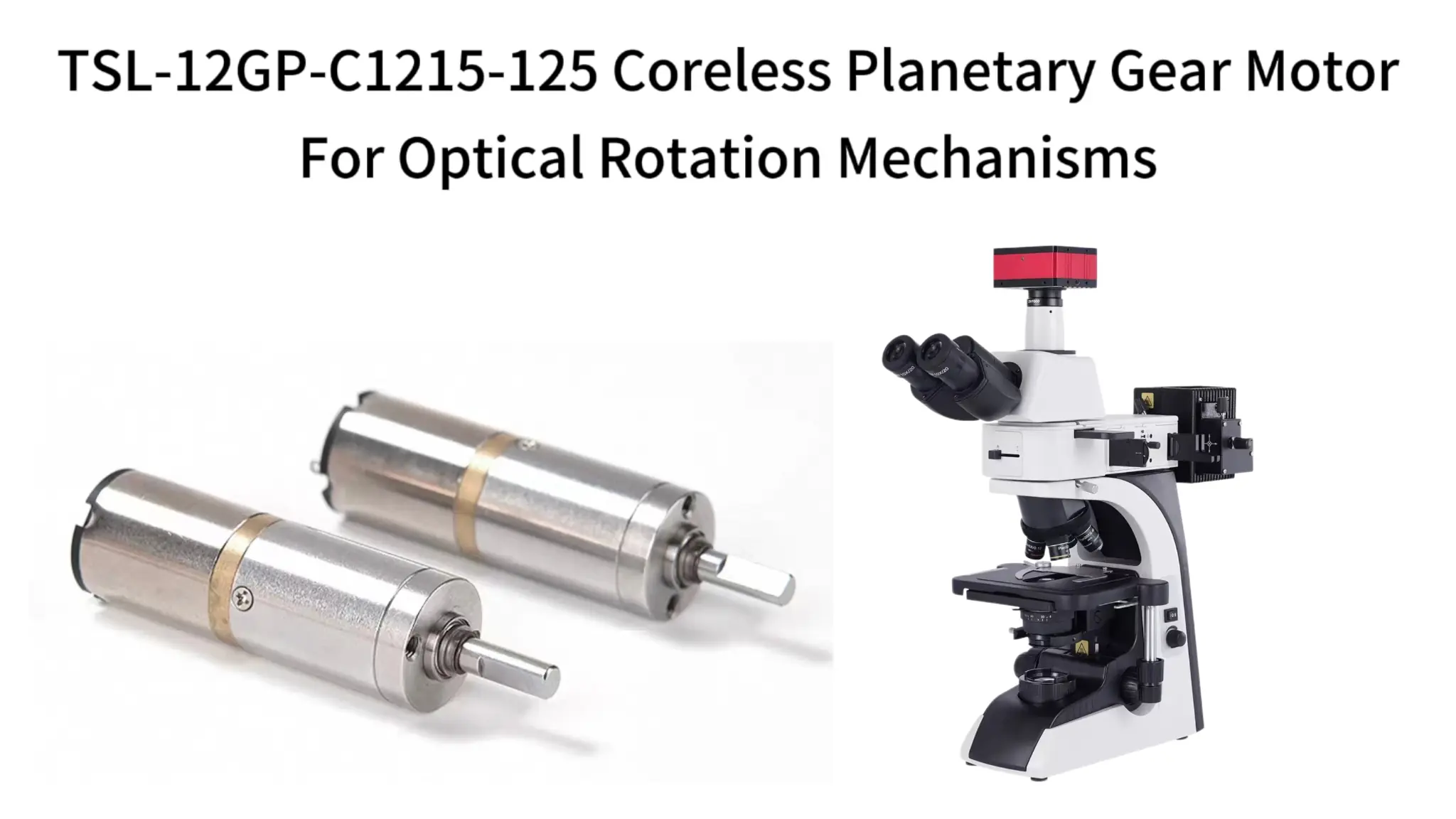
TSL-12GP-C1215-125 is a 12mm brushed coreless gear motor optimized for precision optical equipment. It is specially designed for optical rotation scenarios in structure, material and performance, with outstanding adaptability and reliability.
All-stainless Steel Precision Planetary Gearbox
Adopting an all-stainless steel precision planetary gearbox, it delivers better comprehensive performance than conventional plastic or zinc alloy gear structures. The stainless steel material features high strength and excellent wear resistance, capable of withstanding large torque impact, resisting wear and deformation after long-term operation with stable backlash.
It also has outstanding corrosion resistance, adapting to humid, dusty and temperature-fluctuating working environments. With a low thermal expansion coefficient, it maintains transmission accuracy under complex conditions. High-precision processing further reduces transmission vibration and noise, improving overall operation smoothness.
Torque Performance Precisely Matched with Optical Load
The rated torque at the maximum efficiency point reaches 375g·cm, and the stall torque is up to 2058g·cm. The parameters are highly consistent with the load characteristics of optical rotating mechanisms.
Under normal working conditions, the motor operates in the high-efficiency range with high energy utilization and low heat generation, supporting long-term continuous operation of equipment.
The 2058g·cm stall torque provides sufficient overload margin, maintaining stable output during startup, load fluctuation or slight jamming, avoiding mechanism stall, step loss or positioning deviation.
Excellent Dynamic Performance and Low-vibration Operation Quality
The coreless structure endows the motor with extremely low moment of inertia, featuring fast response and smooth start-stop. It supports rapid forward-reverse switching to meet the frequent attitude adjustment demands of optical mechanisms.
The cogging-free effect ensures smoother motor operation with vibration and noise controlled at an extremely low level, causing no interference to optical imaging.
Adopting high-precision automated production with strictly controlled component tolerances, it enjoys good batch consistency and effectively reduces customers’ assembly and debugging costs.
Overview of TSL-12GP-C1215-125 Coreless Gear Motor
TSL-12GP-C1215-125 is a 12mm brushed coreless gear motor equipped with an all-stainless steel precision planetary gearbox, with core performance fully fitting the working conditions of optical rotating mechanisms.
Customization Service and Technical Support
We provide flexible and diversified customization solutions according to the structural and performance demands of different optical devices, accurately meeting customers’ diverse development requirements. The gear ratio can be adjusted based on actual application scenarios to adapt to different speed and torque output.
It supports multiple rated voltages such as 3V, 5V, 6V and 12V, compatible with various power supply systems. Customization is available for output shaft form and length, wiring mode and connector type, greatly simplifying equipment assembly process.
Built-in driver and serial communication protocol are also optional to lower the difficulty of system integration. For scenarios with higher service life requirements, it can be upgraded to a coreless brushless motor solution on the same size platform.
Meanwhile, we offer all-round technical support covering motor selection guidance, transmission structure matching suggestions and drive scheme optimization, assisting customers in solving various problems during development efficiently, shortening product development cycles and improving product launch efficiency.
Industry Development Trend and Future Prospect
At present, optical devices are continuously developing towards miniaturization, integration, high resolution and low power consumption, putting forward higher requirements on the volume, torque density, vibration control and service life of driving components.
In the future, optical rotating mechanisms will pay more attention to lightweight design, low vibration and intelligent collaboration. Motors need to achieve stronger power and better operation quality in a smaller size. The popularity of portable and wearable optical devices will further raise the demand for high-efficiency, low-power and long-life power solutions.
With structural and performance advantages, cup-type gear motors will continue to play an important role in lens attitude rotation, filter switching, miniature gimbal, endoscopic orientation and other scenarios. We will continuously optimize product performance and launch power solutions more suitable for next-generation optical devices.
Conclusion
TSL-12GP-C1215-125 12mm coreless gear motor precisely meets the engineering demands of optical rotating mechanisms by virtue of compact size, reasonable torque configuration, low-vibration operation characteristics and high durability brought by the stainless steel gearbox.
It effectively makes up for the application limitations of stepper motors and voice coil motors in scenarios such as overall lens rotation, filter wheel drive, reflector scanning and protection mechanism actuation, delivering stable, reliable and smooth power output.
Combined with flexible customization services and professional technical support, this motor provides a mature and practical power solution for precision optical equipment, helping improve overall product performance and market competitiveness.
FAQ
Q1: Why is a coreless motor better than a stepper motor for high-resolution imaging?
A: While stepper motors offer high positioning accuracy, they are prone to low-speed jitter and vibration. Coreless motors eliminate cogging torque, ensuring ultra-smooth rotation and minimal vibration, which is critical for maintaining image clarity in high-resolution systems.
Q2: How does the stainless steel planetary gearbox improve the reliability of optical devices?
A: Unlike plastic or zinc alloy gears, the full stainless steel structure provides superior strength, wear resistance, and a lower thermal expansion coefficient. This ensures stable return clearance (backlash) and transmission precision even in humid or temperature-volatile environments.
Q3: Can this 12mm motor handle sudden load fluctuations during rotation?
A: Yes. The TSL-12GP-C1215003 has a rated torque of 375g·cm at its most efficient point and a stall torque of 2058g·cm. This high stall torque provides an ample overload margin to prevent stalling or positioning shifts during load spikes or slight mechanical jams.