
With the rapid global growth of precision optical testing, spectral analysis, laser processing, biomedical equipment, and other industries, motorized four-blade slits have become key functional parts for optical path control. They help high-end optical equipment achieve precise beam adjustment. They also improve detection and processing accuracy.
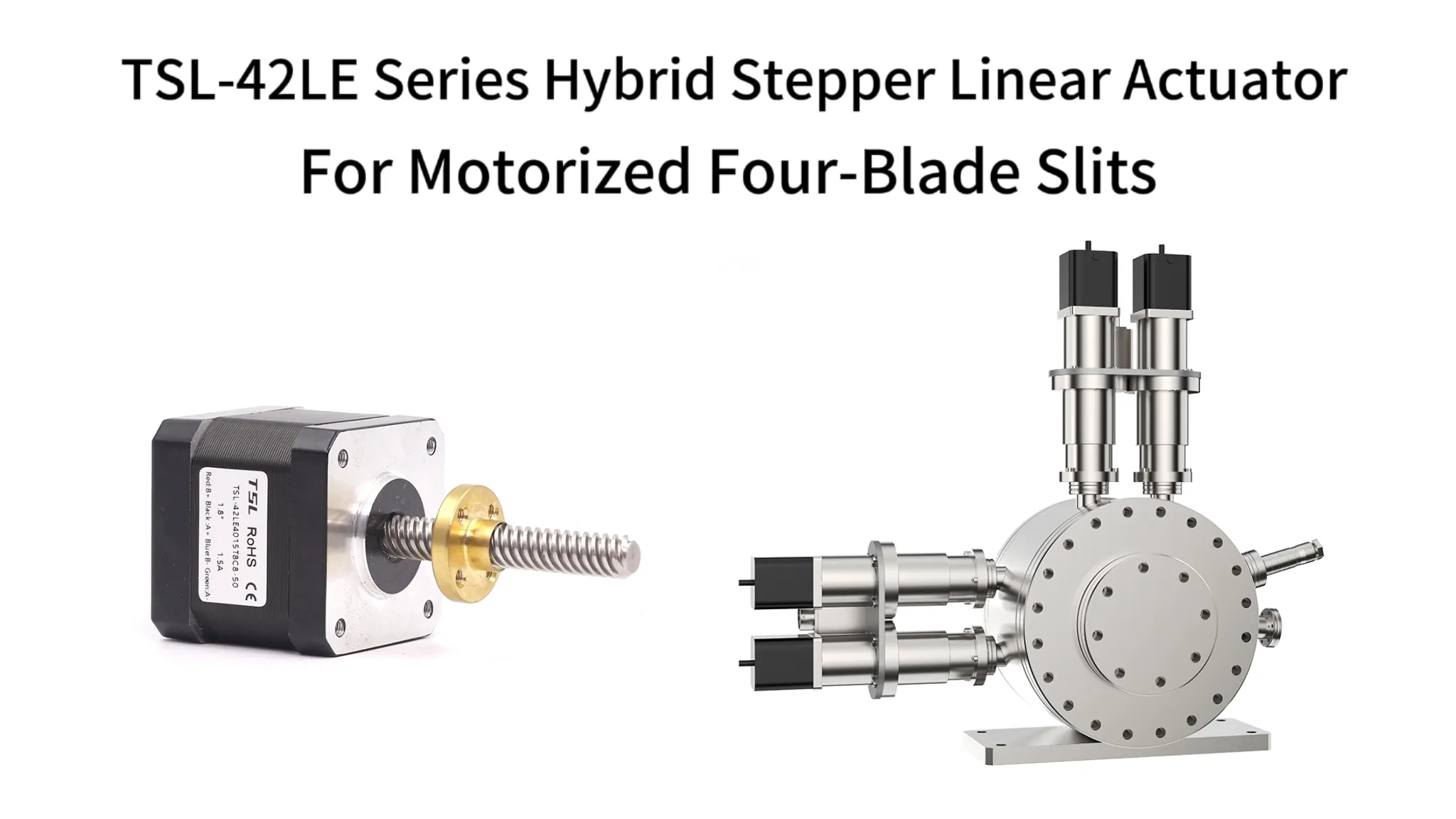
The TSL-42LE series nema 17 lead screw hybrid stepper motor offers integrated linear drive capability. It provides micron-level control accuracy. It also features a highly adaptable structure. It has become a preferred standard drive solution for motorized four-blade slits.
The motorized four-blade slits motor provides a cost-effective, fully integrated, and easy-to-deploy solution for global optical equipment upgrades and mass production.
Key Takeaways
- The TSL-42LE motor integrates a hybrid stepper body with a high-precision lead screw.
- Motorized four-blade slits utilize four-axis linkage for micron-level beam adjustment.
- The integrated architecture reduces equipment volume while enhancing overall transmission efficiency.
- Hybrid stepping technology guarantees smooth blade motion without vibration during micro-feeding.
- Standardized mounting interfaces shorten the development cycle from prototyping to mass production.
- The fully enclosed design protects internal components from dust to extend service life.
- Customization services provide specialized solutions for vacuum or cleanroom optical environments.
Working Principle of Motorized Four-Blade Slits
A motorized four-blade slit is a core actuator in precision optical systems. It is used to control the light-passing size, shape, and center position of a beam. It is widely used in spectrometers, monochromators, laser tuning systems, optical imaging equipment, biomedical testing instruments, and other applications.
Its core design is based on two pairs of precision blades. The two pairs are arranged orthogonally. They precisely trim the light beam. The whole structure includes four independent blades: upper, lower, left, and right. The blades work in pairs.
The left and right blades in the X direction adjust the horizontal light-passing width. The upper and lower blades in the Y direction adjust the vertical light-passing height.
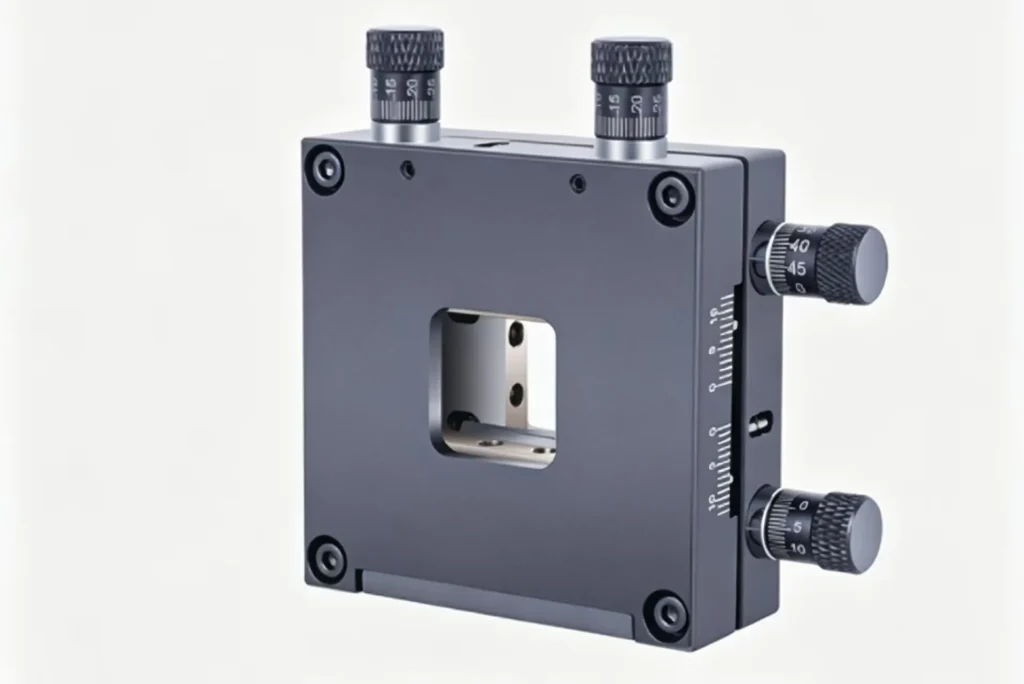
Each blade is driven by an independent drive unit. Through linear reciprocating motion, the light aperture can be continuously adjusted from several microns to tens of millimeters. The center position of the aperture can also be shifted precisely. This meets the needs of fine beam control in different optical applications.
The performance limit of a motorized four-blade slit mainly depends on the drive system. On one hand, the four blades must complete micron-level precise feeding independently. They must also move in multi-axis coordination. This ensures the aperture size accuracy and the consistency of the center position. It also avoids optical path deviation and light-throughput fluctuation.
On the other hand, most slits are installed inside compact cavities of optical equipment. The installation space is very limited. This creates strict requirements for the drive unit size, integration level, and installation convenience.
How TSL-42LE Series Lead Screw Hybrid Stepper Motor Drives Motorized Four-Blade Slits
The TSL-42LE Series lead screw hybrid stepper motor integrates a 42 series hybrid stepper motor body, a high-precision lead screw transmission pair, and a matching drive nut.
It is an integrated linear drive unit. It directly converts motor rotation into high-precision linear reciprocating motion for the blades. No extra coupling, guide rail, or transmission conversion mechanism is required. It perfectly matches the drive needs of motorized four-blade slits.
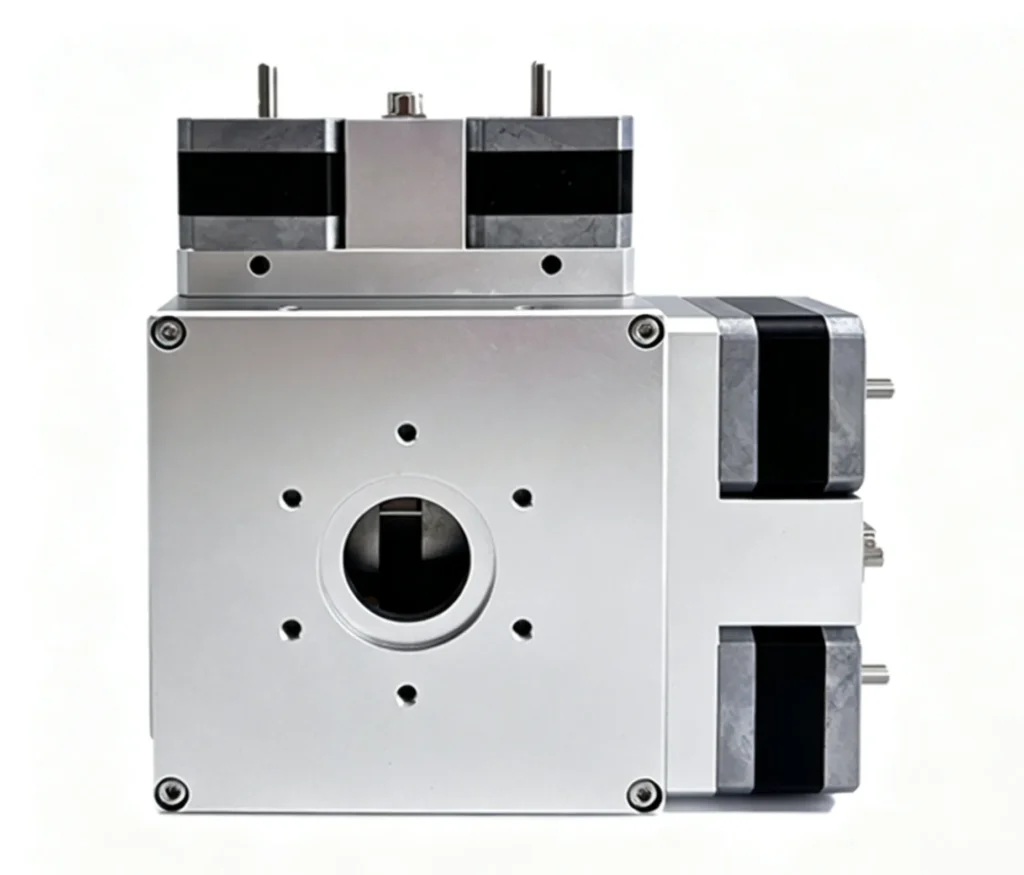
In actual motorized four-blade slit applications, one standard device uses four TSL-42LE Series 42 Lead Screw Hybrid Stepper Motors of the same model. They drive the upper, lower, left, and right blades separately. This forms a mature standardized drive solution.
The two motors in the X direction independently control the left and right blades. They precisely adjust the horizontal slit width. They control the horizontal size of the light aperture. The two motors in the Y direction independently control the upper and lower blades. They adjust the vertical slit height.
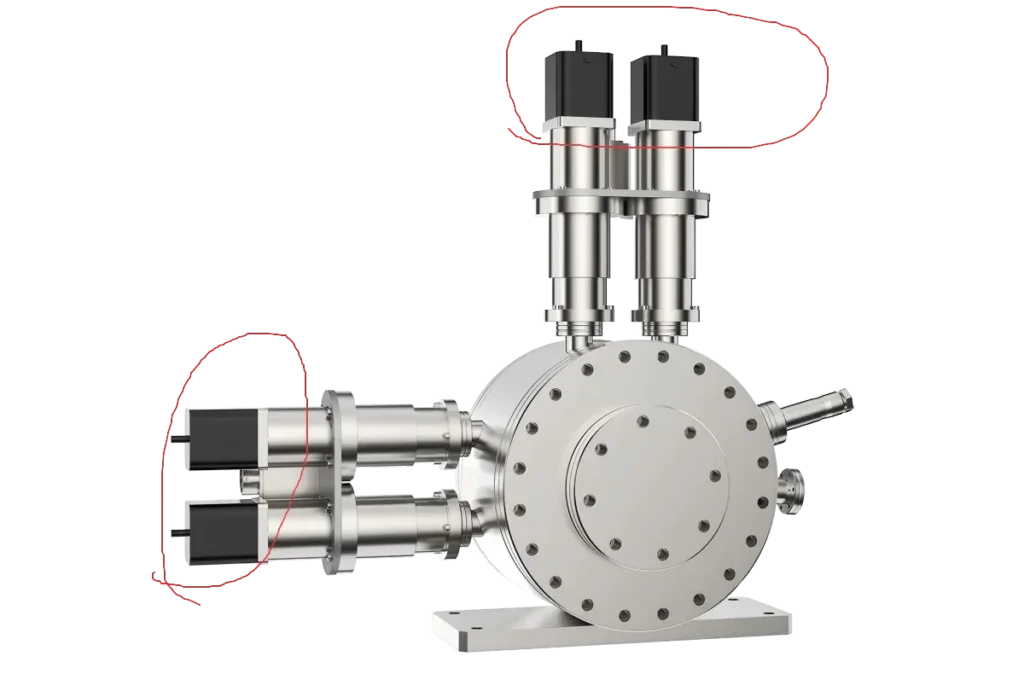
The four motors can be linked synchronously through a multi-axis controller. They can complete micron-level adjustment of a single blade. They can also realize complex actions such as four-blade aperture scaling and center position offset. This meets the optical path control needs of different optical scenarios.
At the same time, the motor uses an industry-standard mounting interface. It can be directly fixed on the slit mounting base through a flange. The lead screw output end can be directly connected to the blade. This greatly simplifies the whole slit structure. Developers only need to use a standard stepper driver. They can then control position, speed, and torque precisely. This removes complex transmission matching and debugging work. It also shortens the product development cycle.
Core Drive System Requirements of Motorized Four-Blade Slits
Based on the working principle and actual operating conditions of motorized four-blade slits, the drive system must meet strict requirements. These requirements are much higher than those of ordinary actuators. Existing industry solutions still cannot fully meet all these needs.
High-Precision Control Requirements
In high-precision spectral detection, laser micro-processing, and other scenarios, the slit size directly determines spectral resolution and processing accuracy. The blade positioning accuracy and repeat positioning accuracy must reach the micron level. Backlash must also be strictly controlled. This avoids lost steps and size deviation. It ensures consistent optical path control.
Multi-Axis Synchronous Coordination
Aperture adjustment and center position adjustment require four drive units to move synchronously and precisely. If synchronization is poor, the light-passing center may deviate from the optical path. The aperture size may also exceed the tolerance.
At the same time, the blades must move smoothly during micro-feeding and frequent forward-reverse switching. There should be no vibration or jamming. This avoids beam fluctuation and protects the stability of the optical system.
Integration
Most motorized four-blade slits are installed inside compact cavities of optical equipment. The installation space is very limited. The drive unit must be small and highly integrated. It should not require many extra transmission parts. It should be directly embedded into the slit structure. This matches the miniaturization and integration trend of optical equipment.
Long Service Life Requirements
Most optical instruments need long-term continuous operation. This is especially true in industrial online inspection and long-term laboratory testing. The drive unit must work stably under frequent start-stop and forward-reverse conditions. It should have low noise, low wear, and maintenance-free operation. It should also adapt to different working environments. This reduces later maintenance costs.
Mass Production Compatibility
Equipment manufacturers need batch production. Research institutes need customized development. Both require a standardized drive solution. The interface should be standard. It should match common drive and control systems. Complex custom development should not be needed. The supply chain should be stable. The cost should be controllable. This helps support mass production.
Comparison of Mainstream Drive Solutions and Their Key Limitations
The TSL-42LE Series 42 Lead Screw Hybrid Stepper Motor uses an innovative integrated motor and lead screw design. It solves the industry problem where small size and high precision are difficult to achieve at the same time. It perfectly matches the core application needs of motorized four-blade slits.
| Comparison Item | Traditional Separate Stepper + Lead Screw Solution | Imported High-End Linear Servo Module | Ordinary Open-Loop Lead Screw Stepper Motor | TSL-42LE Series Lead Screw Stepper Motor |
| Core Integration | Very low. Multiple separate parts are combined. | High. Drive, control, and transmission are integrated. | Medium. Only basic motor and lead screw integration. | High. Motor and lead screw are coaxially integrated. No extra transmission parts are needed. |
| Compact Space Compatibility | Poor. It takes up too much space. | Compatible. But customization is difficult and delivery is long. | Compatible. | Excellent. 42 mm standard flange. Direct installation in compact cavities. |
| Control Accuracy | Medium. Errors accumulate through many links. | Very high. Full closed-loop micron-level control. | Low. It is easy to lose steps. Backlash is large. | High. Micron-level positioning. Closed-loop upgrade is supported. No accumulated error. |
| Multi-Axis Synchronization | Poor. Precise synchronization is difficult. | Excellent. Bus synchronization is supported. | Poor. No synchronization control capability. | Excellent. Multi-axis synchronous linkage. Motion error is very small. |
| Structure and Wiring | Complex. Wiring is troublesome. There are many failure points. | Simple. Wiring is easy. | Medium. Extra wiring is required. | Very simple. Direct load connection. Wiring is convenient. |
| Development Threshold and Cycle | Very high. The cycle is 3–6 months. | Medium to high. The cycle is 1–2 months. Adaptation is difficult. | Medium. The cycle is 2–4 weeks. | Very low. Ready to install and use. The cycle is 1–2 weeks. |
| Mass Production Cost | Medium to high. Procurement and assembly costs are high. | Extremely high. | Low. | Medium. Excellent performance-to-cost ratio. Much lower than imported solutions. |
| Later Maintenance Cost | High. Many failure points. Maintenance is complex. | Extremely high. It is difficult to disassemble. After-sales cost is high. | Medium. Regular maintenance is required. | Very low. Integrated and maintenance-free. Standardized accessories are used. |
TSL-42LE Series Nema 17 Lead Screw Hybrid Stepper Motor Advantages
Based on the working principle and special operating needs of motorized four-blade slits, the TSL-42LE Series 42 Lead Screw Hybrid Stepper Motor solves the key pain points of traditional solutions.
Integrated Design
It uses an industry-leading coaxial integrated design. Within the 42 mm standard flange size, it integrates the hybrid stepper motor and high-precision lead screw transmission pair. It directly converts rotary motion into linear motion. No extra coupling or transmission conversion mechanism is required.
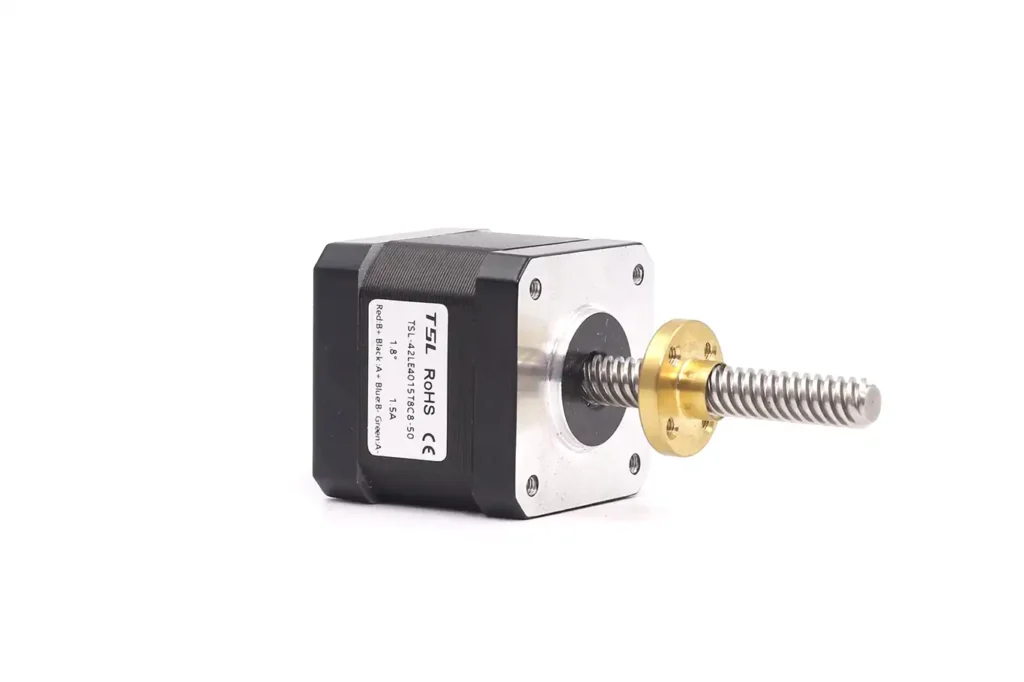
Compared with traditional separate solutions, it saves more than 60% of installation space. It can be directly embedded into the compact cavity of a motorized four-blade slit. It perfectly matches the miniaturized and integrated design needs of optical instruments.
At the same time, the integrated structure reduces accumulated transmission error. It improves transmission efficiency. It also greatly reduces the difficulty of whole-machine structure design.
High Precision
The TSL-42LE Series 42 Lead Screw Hybrid Stepper Motor uses an optimized hybrid stepper structure. It has high step angle accuracy. With a high-precision ground lead screw, it can achieve micron-level positioning accuracy and repeat positioning accuracy.
It also supports closed-loop control upgrades. With an encoder, it can realize full closed-loop control of position and speed. This completely solves the problems of ordinary open-loop stepper motors, such as lost steps, large backlash, and insufficient accuracy.
Whether it is micron-level slit fine adjustment or large-range aperture adjustment of tens of millimeters, the motor can provide precise control. It perfectly matches precision optical path control needs in high-end scenarios such as spectral analysis and laser processing.
Smooth Operation
The motor body uses an optimized magnetic circuit and tooth-slot structure. It provides stable torque during operation. It has no vibration or jamming at low speed. It also has fast start-stop response. It perfectly matches the working conditions of four-blade slit blade micro-feeding and frequent forward-reverse switching.
It can also work with a multi-axis stepper controller. This enables synchronous linkage control of four motors. The motion synchronization error can be controlled within a very small range. It supports independent fine adjustment of a single blade. It also supports four-blade aperture scaling and center offset adjustment. All actions can be smooth and precise. This ensures the stability and consistency of the optical path.
Long Service Life
The core parts of the motor use high-quality permanent magnetic materials and cold-rolled silicon steel sheets. The lead screw transmission pair uses wear-resistant high-precision materials.
The product has passed strict life tests and operating-condition verification. It can work stably for a long time under frequent start-stop and forward-reverse conditions.
The operating noise is ≤50 dB. The fully sealed structure effectively prevents dust from entering. The maintenance-free design greatly reduces later use and maintenance costs. It is ideal for continuous operation scenarios such as industrial online inspection and long-term laboratory testing.
Standardized Design
This motor uses the industry-standard 42 series mounting size. The interface is universal. It can directly match common stepper drivers and controllers on the market. Developers do not need complex custom structural design or drive development.
Only simple wiring and parameter debugging are needed. Assembly and testing can be completed quickly. The development cycle can be shortened to 1–2 weeks. This greatly lowers the development threshold.
Compared with high-end imported linear servo modules, it has a significant cost advantage. Under the same application requirements, it greatly reduces equipment production cost. With stable global delivery capability, it is very suitable for large-scale production by equipment manufacturers.
Overview of TSL-42LE Series NEMA 17 Lead Screw Hybrid Stepper Motor
The TSL-42LE Series 42 Lead Screw Hybrid Stepper Motor is an integrated drive unit designed for precision linear drive applications. It uses a hybrid stepper motor body with a 42 mm flange size.
It can be matched with a high-precision T-type lead screw or ball screw transmission pair. It comes with a standardized mounting interface.
It is compatible with common stepper drive systems. Open-loop or closed-loop control solutions can be provided according to application needs. Complete drive debugging materials and technical support are also available.
Customization Services and Technical Support System
As a professional manufacturer of micro stepper motors and precision transmission systems, we have a complete global customization service system and full-process technical support system.
Based on customer requirements for motorized four-blade slit products, we can provide one-stop services from solution design and product development to batch production. We cover the full development cycle of precision optical equipment.
Our customization services cover the following core areas:
- Motor winding parameter customization. This matches different working voltage, current, torque, and speed requirements.
- Lead screw specification customization. This includes screw type, lead, stroke, and nut form. It matches different travel and accuracy requirements.
- Open-loop and closed-loop control solution customization. An encoder can be built in. This matches different closed-loop accuracy requirements.
- Output shaft form, mounting flange size, and wiring method customization. This perfectly matches different slit structure designs.
- Special protection level and environmental adaptability design. This meets special optical working conditions such as cleanrooms and vacuum environments.
At the same time, we provide supporting driver programs, debugging materials, and upper-computer software adaptation services. Based on customer control system requirements, we can complete seamless connection at the drive layer. This further reduces customer development difficulty.
We have a technical support team made up of experienced motor engineers, transmission design engineers, and optical application engineers. We provide global customers with full technical support from solution design and product selection to debugging and maintenance.
For four-blade slit needs such as multi-axis synchronous control and precision force-position adjustment, we provide dedicated adaptation solutions. This helps customers solve development problems efficiently. It also greatly shortens the product development cycle.
Industry Development Trends and Future Outlook
The precision optical industry is now in a key stage of rapid global development. As demand continues to grow in spectral analysis, laser processing, biomedical equipment, and other fields, high-end optical equipment requires higher performance from core components.
In the next few years, drive systems for precision optical equipment will show four main trends:
First, drive integration. Integrated linear drive units that combine motor, transmission, and sensing will replace traditional separate solutions. They will become the mainstream of the industry. They will maximize space utilization, reduce system complexity, and reduce transmission error.
Second, bus-based control. Multi-axis synchronous bus control will become a standard configuration. It will realize precise coordination of multiple drive units. It will greatly simplify machine wiring. It will also improve system controllability and stability. This matches the development needs of intelligent optical equipment.
Third, standardized development. Mature drive debugging tools, standardized interfaces, and standard mounting sizes will become standard features of drive products. They will greatly reduce the industry development threshold. They will also promote fast technology adoption.
Fourth, global high cost performance. Drive solutions with strong performance, high adaptability, stable delivery, and excellent cost performance will break the price and delivery barriers of high-end imported products. They will help high-end optical equipment move from customized R&D to mass production.
We will continue to focus on hybrid stepper motors, precision lead screw transmission, and integrated drive-control technology. We will keep improving product performance. We will also improve supporting services and technical support. We will launch more drive solutions that meet the needs of the global precision optical equipment market.
We believe that through close cooperation with optical equipment manufacturers and research institutes around the world, we will jointly promote innovation and development in precision optical drive technology. We will help upgrade the global high-end optical equipment industry. We will also support its wider mass adoption.
Conclusion
The TSL-42LE Series 42 Lead Screw Hybrid Stepper Motor is designed around the core working principle and operating needs of motorized four-blade slits. It directly targets the key pain points of current precision optical equipment drive systems.
It features an integrated compact design, micron-level high-precision control, excellent smooth operation, multi-axis synchronous coordination, high reliability, and long service life. It also comes with standardized interfaces and mature drive solutions.
It provides global optical equipment manufacturers and research institutes with a low-threshold, high-performance, and cost-effective standardized drive solution for motorized four-blade slits.
With our complete global customization services and professional full-process technical support system, this product will become a preferred solution for motorized four-blade slit drive systems. It will help more high-end optical equipment products achieve fast implementation and wider adoption. It will also promote the precision optical industry into a new stage of high-quality development.
FAQ
Q1:Why does a motorized four-blade slit require four TSL-42LE motors?
A four-blade slit consists of four independent blades (upper, lower, left, and right). Each motor drives one blade, allowing the system to independently adjust the horizontal width, vertical height, and the center position of the aperture through four-axis coordination.
Q2:What level of precision can the TSL-42LE achieve in slit applications?
Equipped with high-precision lead screws, these motors achieve micron-level ($\mu m$) positioning and repetition accuracy. This meets the stringent light-path control requirements for spectral analysis and laser micro-processing.
Q3:Is this motor suitable for devices with extremely limited installation space?
Yes. The TSL-42LE features an integrated design that eliminates the need for couplings and external brackets. It saves over 60% of installation space compared to traditional setups, making it ideal for compact optical cavities.