
An insulin pump is a core medical device for precise blood glucose management in diabetic patients. The dosing accuracy, operating stability, and long-term reliability of its infusion system are directly related to medication safety and quality of life.
Traditional brushed motors have problems such as brush wear, short service life, and insufficient precision. Stepper motors have shortcomings such as low-speed vibration and complex driving. They are difficult to meet the strict requirements of insulin pumps.
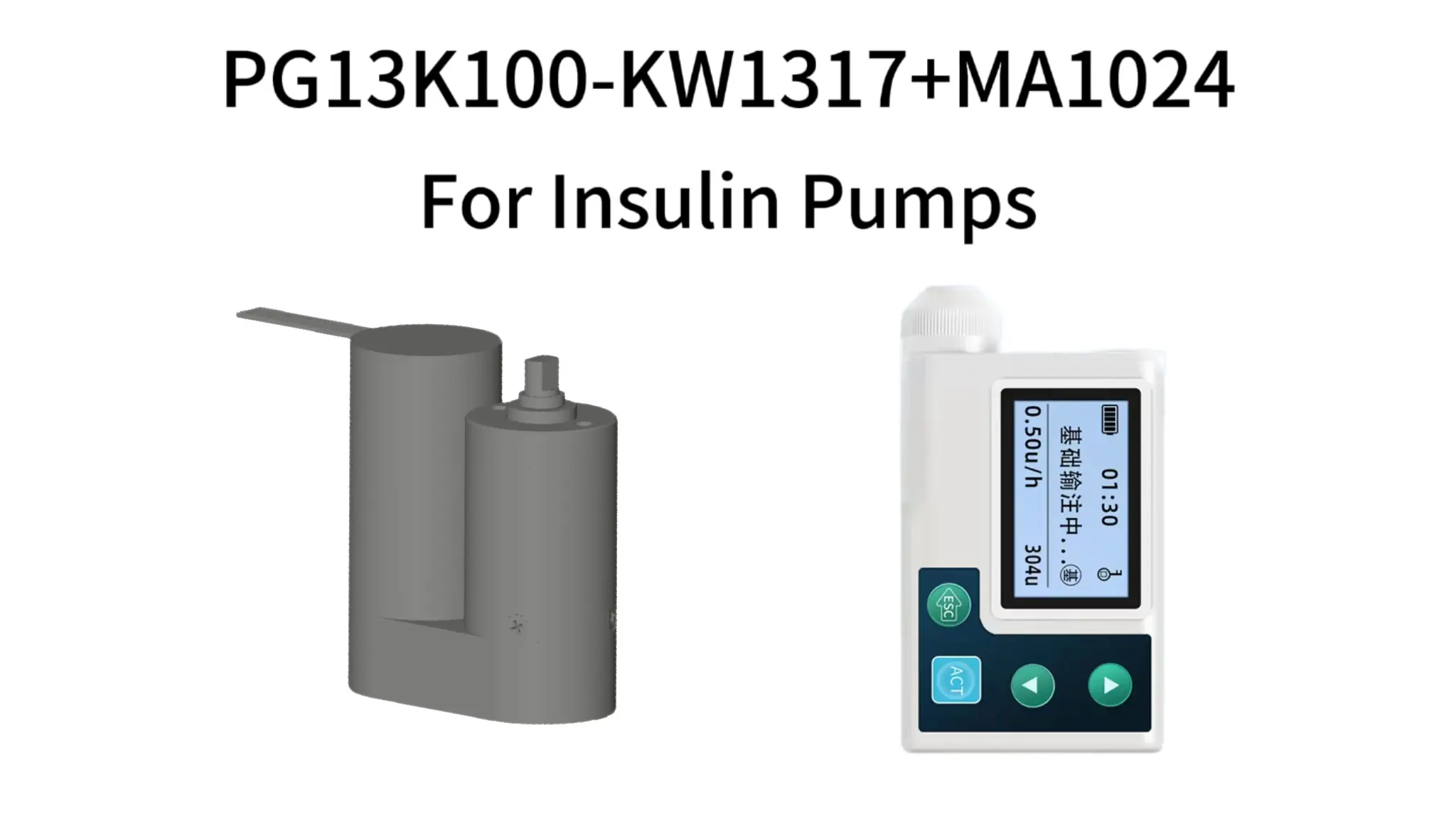
The PG13K100-KW1317+MA1024 13mm coreless brushless geared inverted module has a unique structural design and precise performance matching. It has become an ideal choice for insulin pump drive systems.
Key Takeaways
- The PG13K100-KW1317+MA1024 motor utilizes a coreless brushless design to eliminate cogging torque and mechanical vibration.
- Infusion actuator systems rely on this motor to convert rotary torque into precise linear motion for the reservoir piston.
- The 1024PPR magnetic encoder provides the real-time position feedback necessary for micro-infusion accuracy.
- All-steel planetary gearboxes deliver high torque and wear resistance, outperforming plastic or zinc alloy alternatives.
- Low-power consumption designs allow insulin pumps to operate continuously for 24 hours on battery power.
- Inverted structural designs help reduce pump thickness, making devices more portable and discreet.
- Customization services offer flexible options for voltage, gear ratios, and output shaft forms to match specific medical designs.
Working Principle of the Insulin Pump Infusion System
The core function of an insulin pump is to simulate the insulin secretion pattern of the human pancreas through controllable micro-infusion. It enables continuous basal infusion and pre-meal bolus delivery.
A complete insulin pump infusion actuator system consists of five coordinated parts:
- Drug delivery components: reservoir, infusion tubing, push rod, and screw mechanism.
- Mechanical support structure: precision screw, guide components, limit mechanism, and anti-backflow mechanism.
- Power drive unit: the drive motor that provides rotary torque and speed output.
- Reduction transmission unit: it converts the motor’s high-speed, low-torque output into low-speed, high-torque output.
- Control and feedback unit: it consists of a drive circuit and position sensor. It realizes start-stop control, direction control, speed control, and closed-loop position control.
The main control system sends an infusion command. The drive circuit converts the command into a motor drive signal. The motor output is transmitted through the gearbox. The gearbox increases torque and reduces speed. Then it drives the screw push rod to make linear motion.
The push rod pushes the reservoir piston to complete insulin infusion. The encoder provides real-time feedback on motor position and speed. This forms closed-loop control. It ensures infusion dose accuracy and consistency.
Core Role of the Motor in the Insulin Pump Infusion System
Insulin pumps commonly use a “high-speed motor + gearbox” solution. This is determined by the characteristics of the motor and the load requirements. The no-load speed of a coreless motor is usually thousands or even tens of thousands of revolutions per minute. But insulin pump infusion requires extremely low speed and stable torque output.
Through the gearbox, speed is reduced and torque is increased. This precisely matches the speed requirement of micro-infusion. It also greatly improves output torque. This is the best solution for stable power output in a small size.
This power architecture meets the drive needs of several core infusion functions in insulin pumps:
- Continuous basal infusion: the motor runs stably at an extremely low speed. It ensures uniform drug delivery for 24 hours. Dose fluctuation is controlled within a very small range.
- Pre-meal bolus delivery: the motor responds quickly. It completes the specified dose delivery in a short time. The delivery speed is controllable.
- Stall detection and safety protection: with real-time encoder feedback, the system can accurately detect abnormal conditions. These include tubing blockage and piston jamming. It can trigger alarms and stop protection in time.
- Reservoir emptying and reset: the motor provides enough torque to complete reservoir emptying and mechanism reset. This ensures normal repeated use of the device.
Core Requirements of Insulin Pumps for Motors
The motor is the power core of the insulin pump infusion system. Its performance parameters directly determine the performance ceiling and safety baseline of the whole system. Based on insulin pump operating characteristics and actual working conditions, the core motor requirements are mainly reflected in the following aspects:
First, infusion accuracy must be extremely high. Insulin is a high-risk drug. Dose errors may cause severe blood glucose fluctuation. They may even lead to serious consequences such as hypoglycemic coma. The motor must have stable speed and uniform torque. With high-precision position feedback, it can achieve microgram-level dose control.
Second, low power consumption and long battery life are required. Insulin pumps are portable battery-powered devices. They must work continuously for 24 hours. The motor needs very low no-load and working current. It also needs high energy conversion efficiency. This maximizes battery life. It reduces the frequency of charging or battery replacement.
Third, quiet operation and low vibration are required. Insulin pumps are worn close to the body for long periods. Motor noise and vibration must be strictly controlled. This avoids interference with daily life. It also improves wearing comfort.
Finally, long-term reliability and wide-temperature adaptability are required. Insulin pumps must operate stably under different ambient temperatures. Their service life must meet several years of use. The motor needs wear-free operation, anti-aging performance, and wide-temperature capability. This ensures long-term stability and consistency.
Why Choose a 13mm Coreless Brushless Geared Motor
In miniature medical devices such as insulin pumps, the 13mm coreless brushless geared motor has clear advantages. It can overcome the shortcomings of traditional motors.
| Performance Indicator | Ordinary Iron-Core DC Motor | Brushed Coreless Motor | Stepper Motor | 13mm Coreless Brushless Geared Motor |
| Infusion Accuracy | Poor. It has cogging effect and large dose fluctuation. | Good, but brush wear affects long-term accuracy. | Average. Low-speed vibration can cause dose errors. | Excellent. No cogging effect. With an encoder, it enables precise closed-loop control. |
| Service Life | Average. Brushes and bearings wear easily. | Short. Brush life is limited. | Average. Step loss may occur during long-term operation. | Long. No brush wear. The all-steel gearbox is durable. |
| Operating Noise / Vibration | High. Vibration is obvious. | Low. | Medium. Low-speed vibration is obvious. | Extremely low. Operation is smooth and almost not felt. |
| Power Consumption | Relatively high. | Average. | Relatively high. | Low. Motor efficiency reaches 75%. Suitable for battery power. |
| Cleanliness | Average. Wear dust may be generated. | Poor. Brush dust may cause contamination. | Average. | Excellent. No wear dust. It meets medical cleanliness requirements. |
| Drive Complexity | Simple. | Simple. | Complex. A special drive circuit is required. | Simple. Standard interface is easy to integrate. |
| Compatibility with Insulin Pumps | Not suitable. | Average. Service life and cleanliness are insufficient. | Average. Power consumption and vibration are problems. | Highly suitable. It meets all core working condition requirements. |
Ordinary iron-core motors have cogging effect. They run less smoothly and vibrate clearly. They cannot meet the precision requirements of micro-infusion. Brushed coreless motors run smoothly. But they have brush wear problems. Their service life is short. They may also generate dust. This does not meet the long-term use and cleanliness requirements of medical devices.
Stepper motors have relatively high positioning accuracy. But they easily vibrate at low speed. Their drive system is complex. Their power consumption is also high. This is not suitable for miniaturized and long-battery-life device design.
The ironless coreless brushless structure eliminates cogging torque in principle. It has no brush wear. It has small rotational inertia, smooth operation, and high torque density. It can provide stable power output in a small size. It also offers low vibration, low noise, and long service life. It matches the needs of insulin pumps very well.
The 13mm specification balances size and performance. It can be easily embedded into the compact structure of an insulin pump. It is an ideal power solution for this type of device
Advantages of the PG13K100-KW1317+MA1024 Coreless Brushless Geared Motor
The PG13K100-KW1317+MA1024 is a 13mm coreless brushless geared inverted module optimized for portable medical devices. It integrates a 1:100 all-steel planetary gearbox and a 1024PPR magnetic encoder. Its structure, materials, and performance are specially designed for insulin pump applications. It offers excellent adaptability and reliability.
Inverted Integrated Structure
This product adopts an inverted design. The motor and gearbox are installed in reverse. The motor body is placed behind the gearbox. The output shaft extends from the front end of the gearbox. This greatly shortens the axial installation length.
This structure perfectly matches the “thin and flat” design trend of insulin pumps. It can be flexibly arranged on the side or bottom of the pump body. It avoids the core areas of the reservoir, battery, and circuit board. This makes the internal layout more reasonable. It effectively reduces pump thickness. It also improves wearing concealment and comfort.
At the same time, the inverted module is delivered as an integrated pre-assembled unit. The motor, gearbox, and encoder are precisely calibrated and assembled before delivery. Customers do not need to assemble or debug them by themselves. They can directly connect the module to the screw push rod mechanism. This greatly simplifies production. It also reduces precision loss caused by assembly errors.
All-Steel Machined Planetary Gearbox
The product uses an all-steel machined planetary gearbox. Compared with common plastic or zinc alloy reduction structures, it has stronger overall performance. The all-steel material has high strength and good wear resistance. It can withstand large torque impact. It is not easy to wear or deform during long-term use. Its backlash remains stable.
It also has excellent corrosion resistance and a low thermal expansion coefficient. It can maintain transmission accuracy in a wide temperature range from -40°C to 80°C. High-precision machining further reduces transmission vibration and noise. It improves overall operating smoothness.
Precise Matching
The motor has a rated torque of ≥0.08 N·m. Its stall torque is ≥0.5 N·m. Its rated speed is 180±10% RPM. These parameters closely match the load characteristics of insulin pumps.
Under normal basal infusion conditions, the motor runs in a high-efficiency range. Energy utilization is high and heat generation is low. It can support 24-hour continuous operation. The 0.5 N·m stall torque provides sufficient overload margin. It can still output stable torque during startup, slight tubing blockage, or mechanism jamming. With the encoder, it can realize accurate stall detection and abnormal protection.
High-Precision Closed-Loop Control
The product has a built-in 1024PPR three-channel magnetic encoder. It has digital output. Position and speed feedback are precise. With the smooth operating characteristics of the brushless motor, it can achieve microgram-level dose control. It effectively reduces infusion errors. The encoder’s real-time feedback can also support safety functions. These include infusion volume statistics and abnormal status monitoring. This fully improves insulin pump safety.
Low Power Consumption
The motor has a working voltage of 12V. Its no-load current is ≤0.3A. Its rated current is ≤1A. Maximum efficiency reaches 75%. The low-power design significantly reduces overall device energy consumption. It greatly extends battery life. It reduces the frequency of charging or battery replacement. This improves user convenience.
Compact and Lightweight Design
The product has a compact overall size. Its weight is ≤30g. It can easily fit into the limited internal space of an insulin pump. The standardized wire sequence and interface design greatly simplify customer assembly and integration.
Overview of the PG13K100-KW1317+MA1024 Coreless Brushless Geared Motor
The PG13K100-KW1317+MA1024 is a 13mm ironless coreless brushless geared inverted module. It is equipped with an all-steel machined planetary gearbox and a 1024PPR magnetic encoder. Its core performance matches insulin pump working conditions.
Customization Services and Technical Support
For the structural and performance needs of different insulin pumps, we provide flexible customization solutions. We precisely match different customer development needs. The reduction ratio can be adjusted according to actual infusion requirements. This adapts the motor to different speed and torque outputs.
The motor supports multiple rated voltages, such as 3V, 5V, 6V, and 12V. It is compatible with various portable device power systems. The output shaft form and length can be customized. The wiring method and connector type can also be customized. This greatly simplifies device assembly.
A built-in driver and serial communication protocol can also be provided. This reduces system integration difficulty for customers. For applications that require longer service life or higher precision, encoder resolution and motor performance can be optimized on the same size platform. The inverted structure can also be customized according to customer installation space. This supports different whole-machine layout designs.
At the same time, we provide full technical support. This includes motor selection guidance, transmission structure matching suggestions, and drive solution optimization. We help customers solve development problems efficiently. This shortens the product development cycle and improves product launch efficiency.
Industry Trends and Future Outlook
Insulin pumps are moving toward smaller size, lighter weight, intelligence, and longer battery life. This places higher requirements on the size, precision, power consumption, and service life of drive components.
In the future, insulin pumps will pay more attention to wearing concealment and comfort. They will also integrate more intelligent monitoring and safety protection functions. Motors will need to deliver stronger power output and better operating quality in a smaller size. The popularity of wearable insulin pumps and closed-loop artificial pancreas systems will further increase demand for efficient, low-power, highly reliable, and high-precision power solutions.
With its structural and performance advantages, the coreless brushless geared motor will continue to play an important role in insulin pumps, micro-infusion pumps, portable analyzers, and other medical devices.
We will continue to optimize product performance. We will launch more inverted, side-mounted, and other special-structure power modules for different installation spaces. These products will provide more flexible and reliable power solutions for next-generation medical devices.
Conclusion
The PG13K100-KW1317+MA1024 13mm ironless coreless brushless geared inverted module precisely matches the engineering requirements of insulin pumps. It features a unique inverted integrated structure, compact size, high-precision closed-loop control, low power consumption, long battery life, low-vibration operation, and high durability from the all-steel gearbox.
In core scenarios such as continuous basal infusion, pre-meal bolus delivery, stall detection, and safety protection, it can effectively overcome the limitations of traditional motors. It provides stable, reliable, and safe power output.
With flexible customization services and professional technical support, this motor can provide a mature and practical power solution for insulin pump devices. It helps improve overall device performance and market competitiveness. It also provides diabetic patients with a safer, more comfortable, and longer-lasting blood glucose management experience.
FAQ
Q1:Why is a coreless brushless motor better than a brushed motor for insulin pumps?
Brushed motors suffer from brush wear and have a limited service life. Coreless brushless motors eliminate brush wear, providing a longer lifespan and ensuring no wear dust is generated, which meets strict medical cleanliness requirements.
Q2:How does this motor ensure precise insulin dosing?
The motor uses an ironless coreless structure that eliminates cogging torque, ensuring smooth operation. Combined with a built-in 1024PPR magnetic encoder, it enables microgram-level dose control through high-precision closed-loop feedback.
Q3:What is the benefit of the “inverted” integrated structure?
The inverted design places the motor body behind the gearbox, significantly shortening the axial installation length. This allows the insulin pump to be “thin and flat,” improving wearing comfort and concealment.