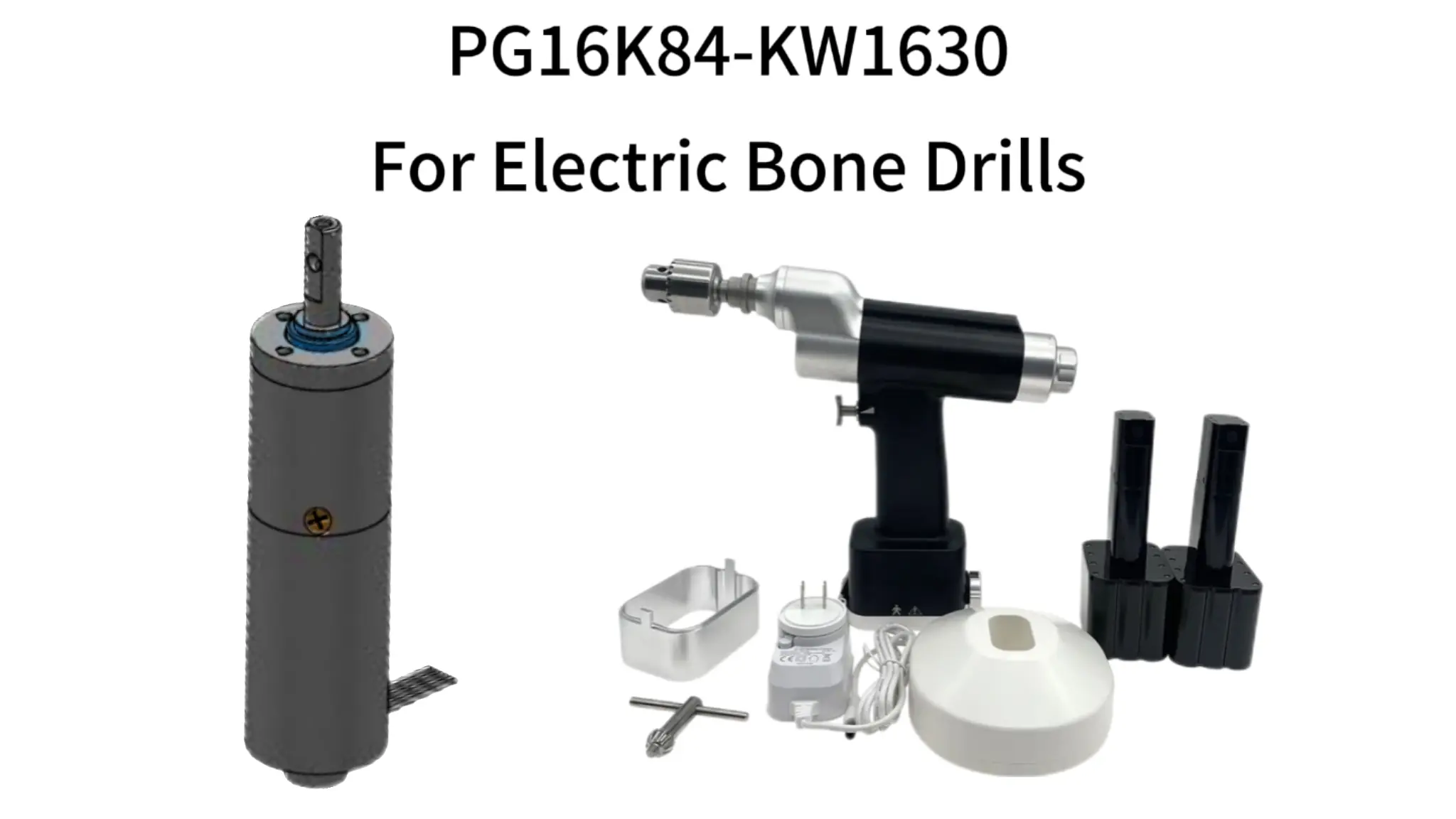

As orthopedic instruments continue to develop toward smaller size, lighter weight, higher reliability, lower noise, and longer battery life, electric bone drills have become key clinical power tools. Their requirements for drive systems are becoming more demanding.
Traditional brushed motors and ordinary geared motors have many shortcomings. These include short service life, high noise, insufficient torque, and unstable transmission. They are difficult to meet the mass production and clinical standards of high-end electric bone drills.
The 16mm coreless brushless geared motor has high power density, precise control, stable performance, and strong durability. It has become a preferred drive solution for electric bone drills.
Key Takeaways
- The PG16K84-KW1630 motor integrates a high-power-density coreless brushless motor with an all-steel planetary gearbox.
- The 16mm outer diameter allows the motor to be directly embedded into the handles of pen-type handheld bone drills.
- High torque density effectively reduces the surgical risk of drill jamming or breakage during procedures.
- The coreless rotor structure provides low inertia and high efficiency, significantly extending battery life for portable devices.
- Integrated Hall sensors enable precise closed-loop speed control and real-time status monitoring.
- Operating temperature durability spans from -40°C to 80°C to ensure reliability in various clinical environments.
- The standardized 8PIN interface simplifies wiring and assembly for medical device manufacturers.
Working Principle of Electric Bone Drills
An electric bone drill is a Class II active medical device. It consists of an operating handle, a working drill bit, and a status detection component. It is mainly used for bone drilling in various surgical procedures. It provides stable mechanical power for surgery. It is an indispensable core instrument in orthopedic trauma, joint replacement, spinal surgery, and other procedures.
Common clinical drill heads include bone drill bits, oscillating saw heads, and cannulated drill bits. They can be flexibly replaced according to surgical scenarios and procedural needs. They adapt to cutting work on different body parts and different bone types.
The detection component of the device can monitor the tissue type contacted by the drill bit in real time. This is done through a built-in current acquisition component. It enables real-time feedback of the cutting status.
The distal outer wall of the drill bit has a spiral cutting edge. The proximal end can be directly connected to an external drive component. This allows stable transmission of rotary power. The cutting speed and feed rate of the bone drill are key parameters that affect drilling results. Properly increasing both parameters can effectively reduce bone thermal injury during surgery. It also improves surgical quality.
At present, mainstream multifunctional improved electric bone drills are equipped with stepless speed control and forward/reverse rotation. They use a through-shaft chuck structure to improve the stability of Kirschner wire fixation.
This greatly reduces drill bit runout during operation. It ensures that the drilled hole diameter highly matches the nominal size of the drill bit and Kirschner wire. It improves surgical precision.
Core Role of the Motor in Electric Bone Drills
The motor is the core power unit of an electric bone drill. It is the basis for all device functions. Its performance directly determines clinical use effect and safety.
The motor is the starting point of all mechanical motion in the bone drill. Its high-speed rotary power is reduced and torque is increased through the matching planetary reduction mechanism. Then the power is transmitted through the main drive shaft and chuck connection structure. It is directly delivered to the proximal interface of the drill bit, oscillating saw head, or cannulated drill. This drives the drill bit to rotate stably around the central axis.
Through the spiral cutting edge at the distal end of the drill bit, the device generates continuous and uniform circumferential cutting force on cortical bone, cancellous bone, and other bone tissues. It completes core orthopedic operations such as drilling, reaming, and tapping.
For osteotomy and bone trimming applications, the motor can drive an eccentric wheel or oscillation conversion mechanism. This converts rotary motion into high-frequency reciprocating motion of the oscillating saw head. It enables precise bone cutting.
The motor is also the core anchor point of the safety system and status monitoring system of the bone drill. Its operating current and speed changes are directly related to the real-time load of the drill bit and the contacted medium.
When the drill bit contacts soft tissue or becomes stuck in bone, the motor load current changes linearly at the same time. The detection component collects the real-time operating data of the motor. It can accurately identify the cutting status of the drill bit and the type of contacted tissue.
Based on this, the main control system can realize safety functions. These include overload protection, emergency stop for drill jamming, and soft tissue identification warning.
At the same time, the motor’s built-in stall protection and overcurrent protection can quickly cut off power output under abnormal conditions. This prevents instrument damage and secondary surgical injury at the source.
Why Choose a 16mm Coreless Brushless Geared Motor
For electric bone drill drive solution selection, the 16mm coreless brushless geared motor has irreplaceable overall advantages. It performs better than ordinary brushed DC motors, stepper motors, ordinary geared motors, and other traditional solutions in key requirement dimensions.
Pain Points of Ordinary Brushed DC Geared Motors
Ordinary brushed DC geared motors are a mainstream choice for low-cost electric bone drill development. But their core structural defects cannot meet the clinical working conditions and compliance requirements of high-end medical-grade electric bone drills.
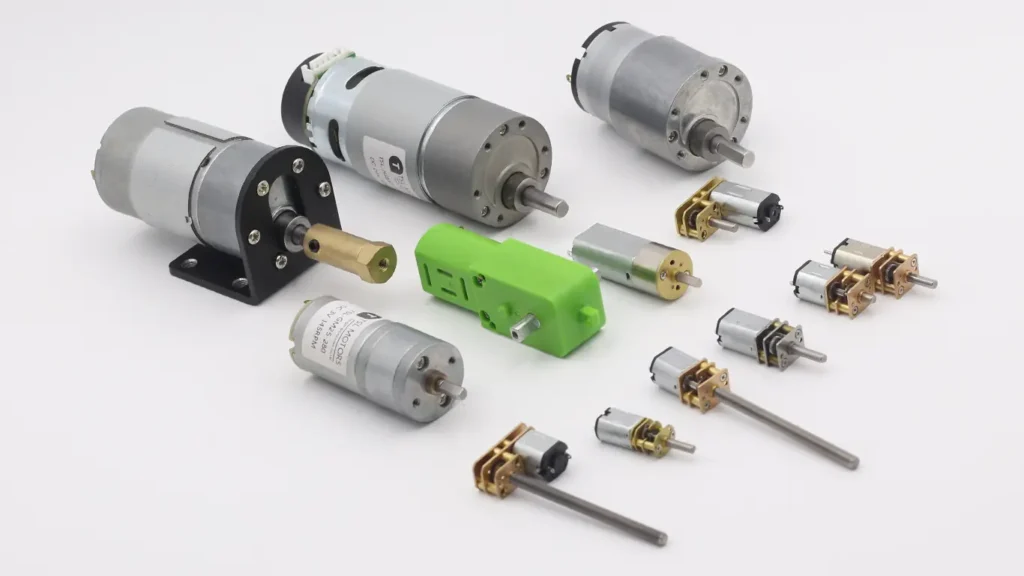
Ordinary brushed motors rely on mechanical contact between carbon brushes and commutators to achieve commutation. During mechanical commutation, continuous electric sparks are generated. This causes serious electromagnetic interference.
Electric bone drills have built-in high-precision detection components. These include current acquisition, load monitoring, and tissue identification components. Electromagnetic interference may cause signal distortion and feedback failure.
This can directly disable key safety functions, such as overload protection and soft tissue identification. It creates serious clinical safety risks. It also makes it difficult to pass electromagnetic compatibility requirements for medical devices.
Pain Points of Stepper Motors
Stepper motors are an optional solution for some high-torque desktop bone drills. But their structure and performance are not suitable for handheld portable electric bone drills in clinical use and mass production.
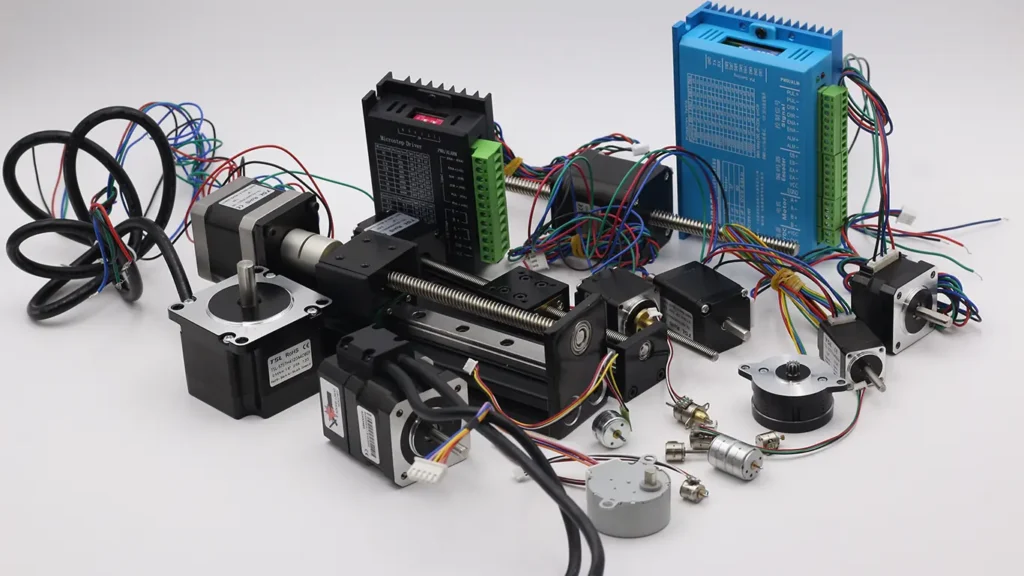
Stepper motors rely on multiple stator windings and rotor tooth-slot structures for step positioning. Under the same torque output, their size and weight are much larger than those of coreless motors with the same specification. They cannot be embedded into a 16mm pen-type handheld body.
Excessive device weight greatly increases hand fatigue during long procedures. It does not meet the design requirements of portable and lightweight orthopedic instruments.
Pain Points of Ordinary Brushless Geared Motors
Ordinary brushless geared motors solve the brush wear problem of brushed motors. But their structural design defects still cannot meet the overall performance requirements of high-end medical-grade electric bone drills.
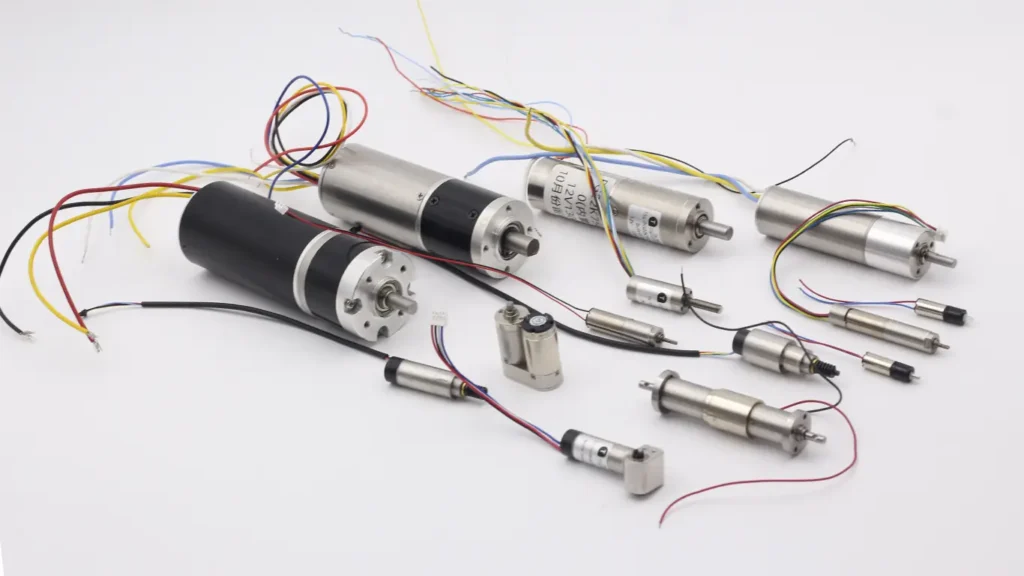
Ordinary brushless motors still use an iron-core winding structure. The rotor has large iron-core inertia. Under the very small 16mm outer diameter limit, the effective winding space is insufficient. Its torque output is much lower than that of a coreless brushless motor of the same size. It cannot achieve high torque output in a small size. It is difficult to meet the high-load cutting requirements of cortical bone.
Pain Points of Brushed Coreless Geared Motors
Brushed coreless geared motors remove the iron-core structure. This solves the problem of large rotor inertia. But they still keep the mechanical commutation structure. This creates key defects for medical-grade electric bone drills.
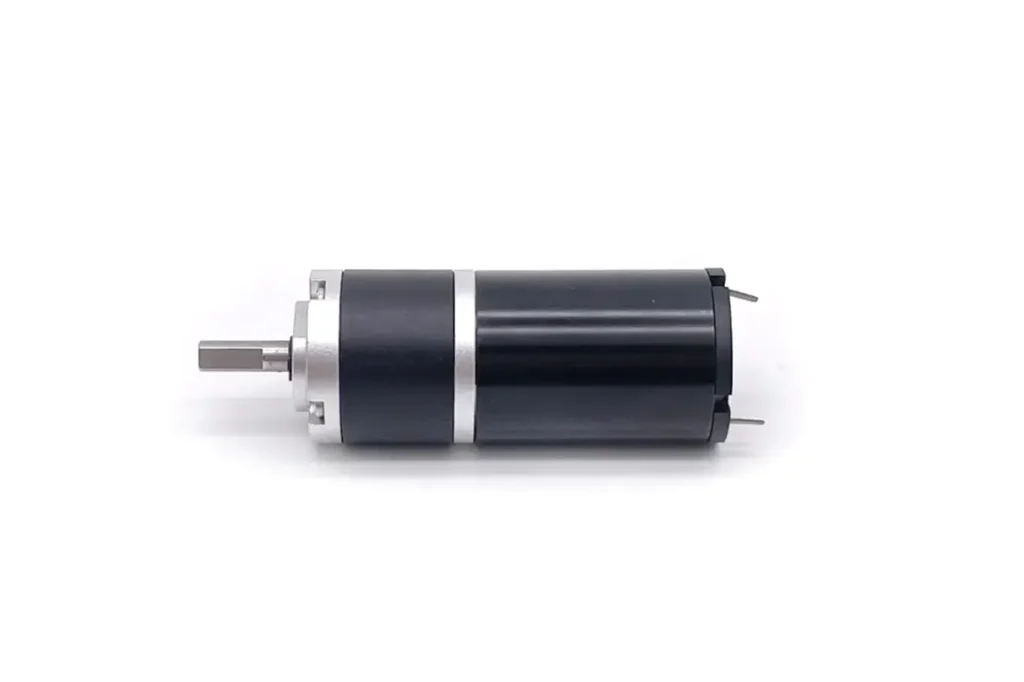
Brushed coreless motors remove the iron core. But they still retain carbon brushes and mechanical commutators. Their wear speed is only slower than that of ordinary brushed motors.
Under clinical conditions such as frequent start-stop operation, forward/reverse switching, and high load, the carbon brushes still wear continuously. They require regular disassembly and replacement. They cannot provide maintenance-free long-term operation. This greatly increases the later maintenance cost of mass-produced products. It does not meet the long-cycle and high-reliability requirements of medical devices.
| Comparison Dimension | Ordinary Brushed DC Motor | Stepper Motor | Ordinary Geared Motor | 16mm Coreless Brushless Geared Motor |
| Structural Integration | Low. External reduction transmission components are required. | Medium. Special drive and external transmission are required. | Medium. Extra speed feedback adaptation is required. | Extremely high. The motor and gearbox are integrated. |
| Size and Weight | Relatively large. It is difficult to fit handheld miniaturized designs. | Large and heavy. It is not suitable for pen-type devices. | Relatively large. It requires more assembly space. | 16mm ultra-small outer diameter. Lightweight. Easy to embed into handheld bodies. |
| Torque and Load Capacity | Low. It easily loses rotation and heats up under high load. | High low-speed torque. But torque decays quickly at high speed. | Large torque fluctuation. Gear backlash affects stability. | High torque density. All-steel transmission. Stable output under load. |
| Speed Control Accuracy | Poor. Brushed commutation causes large speed fluctuation. | Open-loop control may lose steps. Low-speed vibration and whistling may occur. | Large backlash. Low precision. Narrow speed control range. | Hall closed-loop control. Stepless wide-range speed control. Smooth forward/reverse rotation. High precision. |
| Noise and Vibration | High. Carbon brush friction causes high noise and vibration. | High. Low-speed vibration is obvious. | Medium. Large backlash may cause abnormal noise. | ≤45 dB low noise. No carbon brush friction. Very low vibration. |
| Service Life and Reliability | Short. Carbon brushes wear easily. Frequent maintenance is required. | Medium. Frequent start-stop operation may cause heating. Service life is limited. | Short. Plastic gears are easy to wear and slip. | Long. Brushless and no easy-wear parts. All-steel gears. Stable for tens of thousands of start-stop cycles. |
| Power Consumption and Battery Life | High power consumption. Low efficiency. Short battery life. | High power consumption. Fast battery drain. Not suitable for portable devices. | Medium. Efficiency is relatively low. Battery life is average. | Up to 75% conversion efficiency. Low power consumption and energy saving. Battery life is greatly improved. |
| Integration and Control Difficulty | Medium. Matching transmission and protection circuits are required. | High. Special drive and complex control are required. | Medium. Modification is needed for closed-loop control. | Low. Standardized interface. Integrated Hall feedback. Easy to adapt to medical systems. |
In summary, the 16mm coreless brushless geared motor is better than traditional drive solutions in key dimensions. These include size, torque, precision, noise, service life, power consumption, and integration. It is the most suitable and mass-production-ready core drive option for a new generation of high-end electric bone drills.
Advantages of the PG16K84-KW1630 16mm Coreless Brushless Geared Motor
The PG16K84-KW1630 is a 16mm integrated coreless brushless geared motor. It is developed for high-end handheld medical power tools. It precisely matches all clinical working conditions of electric bone drills.
High Torque Density
The product uses a 1:84 all-steel precision planetary gearbox. It works with the high power density design of the coreless brushless motor. It can output a rated torque of ≥0.8 N·m. When handling high-load conditions such as cortical bone cutting, speed fluctuation is small.
It does not lose rotation or jam. This effectively reduces the surgical risk of drill jamming and drill breakage. It also perfectly supports stepless speed control and forward/reverse rotation. It meets the needs of drilling, reaming, tapping, and other procedures.
Low Noise and Low Vibration
The brushless structure has no carbon brush friction noise. It works with precision-machined solid steel gears. Transmission clearance is small and operation is smooth. The operating noise of the whole unit is ≤45 dB. Vibration is extremely low. It meets the quiet environment requirements of operating rooms. It greatly improves comfort during long surgical operation. It also reduces hand fatigue.
High Efficiency and Low Power Consumption
The maximum conversion efficiency of the motor can reach 75%. The no-load current is ≤0.4 A. The rated current is ≤2 A. Under 12V battery power, energy consumption is excellent. It can greatly extend the use time of an electric bone drill after one charge. It meets the needs of multiple consecutive surgeries. It perfectly fits the design requirements of portable handheld devices.
Wide-Temperature Durability
The product operating temperature covers -40°C to 80°C. It can adapt to different clinical environments. The core transmission parts are made of machined solid steel. They are wear-resistant and impact-resistant.
Under long-term and high-frequency use, torque does not decline clearly. The motor supports tens of thousands of frequent start-stop cycles and forward/reverse switching. It meets the long-life and high-reliability requirements of medical devices.
Compact Integration
The integrated compact design has a 16mm outer diameter. It can be directly embedded into the handle body of pen-type and handheld electric bone drills. It optimizes the weight balance and grip feel of the whole device. The standard 8PIN Hall interface integrates U/V/W three-phase power wires and Hall signal wires. This simplifies wiring and assembly. It reduces device development and mass production difficulty.
Closed-Loop Control
The built-in Hall sensor component enables real-time closed-loop feedback of speed and position. It supports precise speed control, soft start, overload protection, and accurate stop. It can seamlessly connect with the detection component and main control system of the electric bone drill. Through current acquisition, it supports drill bit tissue identification and abnormal load protection. This fully improves surgical safety and controllability.
Overview of the PG16K84-KW1630 16mm Coreless Brushless Geared Motor
The PG16K84-KW1630 is a 16mm coreless brushless geared motor designed for electric bone drills. It integrates a 16mm coreless brushless motor, an all-steel precision planetary gearbox, and a Hall position sensor component. It provides stable power output, high control precision, and excellent integration. It can quickly adapt to various electric bone drill control systems. Its performance fully covers all orthopedic drilling working conditions.
Customization Services and Technical Support System
For global orthopedic medical device manufacturers, we provide one-stop customization services and full-cycle technical support. Our service covers solution selection, prototype development, mass production, and after-sales maintenance for electric bone drill products.
Core parameter customization: working voltage, output torque, speed, reduction ratio, and other core parameters can be adjusted according to device requirements. This supports electric bone drill products with different specifications and market positions.
Structural customization: shaft-end form, mounting position size, lead-wire length, interface type, and overall length can be customized. This perfectly matches the body structure and assembly needs of customer devices.
Transmission and performance optimization: for bone drill cutting conditions, gear ratio, material combination, and low-noise design can be optimized. This improves device stability when cutting different bone types.
Control solution adaptation: we can provide technical support for drive solution matching, closed-loop control logic development, host system connection, and detection component linkage adaptation. This simplifies customer development of electronic control systems.
Environmental and reliability reinforcement: for medical device needs such as disinfection, sterilization, wide-temperature storage, moisture resistance, and mildew resistance, we can strengthen product environmental adaptability. This helps meet medical compliance requirements in different regions worldwide.
Full-process technical support: we provide one-to-one full-cycle technical support. This covers early solution selection, structural adaptation design, prototype debugging and testing, mass production implementation, and after-sales maintenance. It helps customers accelerate product launch.
Industry Trends and Future Outlook
Global orthopedic surgical instruments are developing rapidly toward miniaturization, intelligence, portability, and high reliability. As a core power tool for orthopedic surgery, the electric bone drill drive system shows four major development trends.
Integrated drive and control: motor, reduction transmission, sensor feedback, and drive control are highly integrated. This further reduces the whole device size. It optimizes handheld device structure and lowers assembly difficulty.
Closed-loop control: closed-loop solutions with built-in position, torque, and current feedback are becoming mainstream. They enable higher cutting precision and surgical status monitoring. They improve device safety and intelligence.
Standardized design: 16mm miniature coreless brushless geared motors are becoming the mainstream drive solution for high-end electric bone drills. Standardized product design can greatly lower the development threshold for device manufacturers. It also speeds up mass production.
Global adoption: more cost-effective miniature motor solutions are appearing. They are gradually replacing high-end products. This promotes the global adoption of high-end electric bone drills, especially in emerging medical markets.
In the future, we will continue to optimize the performance and integration of miniature coreless brushless geared motors. We will carry out deep customization based on the clinical needs of orthopedic surgical instruments. We will provide global medical device manufacturers with more precise, reliable, and cost-effective drive solutions. This will support the technical upgrade of orthopedic surgical instruments and the global development of accessible precision medicine.
Conclusion
The PG16K84-KW1630 16mm coreless brushless geared motor precisely matches the core needs of electric bone drills. These include small size, high torque, low noise, high reliability, long battery life, and easy control. It effectively solves the pain points of traditional drive solutions in size, precision, service life, and stability.
As a medical-grade miniature drive solution for the global market, this product has a mature standardized design and flexible customization capability. It can help orthopedic medical device manufacturers improve product performance, reduce development cost, and shorten time to market.
It is an ideal core drive unit for a new generation of high-end electric bone drills. It will continue to support the technical upgrade of global orthopedic surgical instruments and the wider development of precision medicine.
FAQ
Q1:Why is a coreless brushless motor better for bone drills than a brushed motor?
Brushed motors generate electric sparks that cause electromagnetic interference, which can distort high-precision tissue-identification signals. Coreless brushless motors eliminate these sparks and provide higher torque in a smaller 16mm frame.
Q2:How does the motor help prevent thermal injury to the bone during surgery?
Increasing the cutting speed and feed rate effectively reduces bone thermal injury. This motor supports stepless speed control and high torque, allowing for the optimal cutting parameters needed to improve surgical quality.
Q3:How does the motor improve surgical safety and tissue identification?
The built-in Hall sensor provides real-time closed-loop feedback. By monitoring changes in motor current, the system can identify the type of tissue the drill bit is contacting and trigger overload protection or emergency stops if necessary.