
In modern laboratory analysis, pharmaceutical quality control, environmental monitoring, food testing, and material testing, UV-Vis spectrophotometers are core precision optical instruments. They are used for qualitative identification and quantitative analysis. The positioning accuracy and operating stability of the optical path system directly determine the accuracy, repeatability, and reliability of test data.
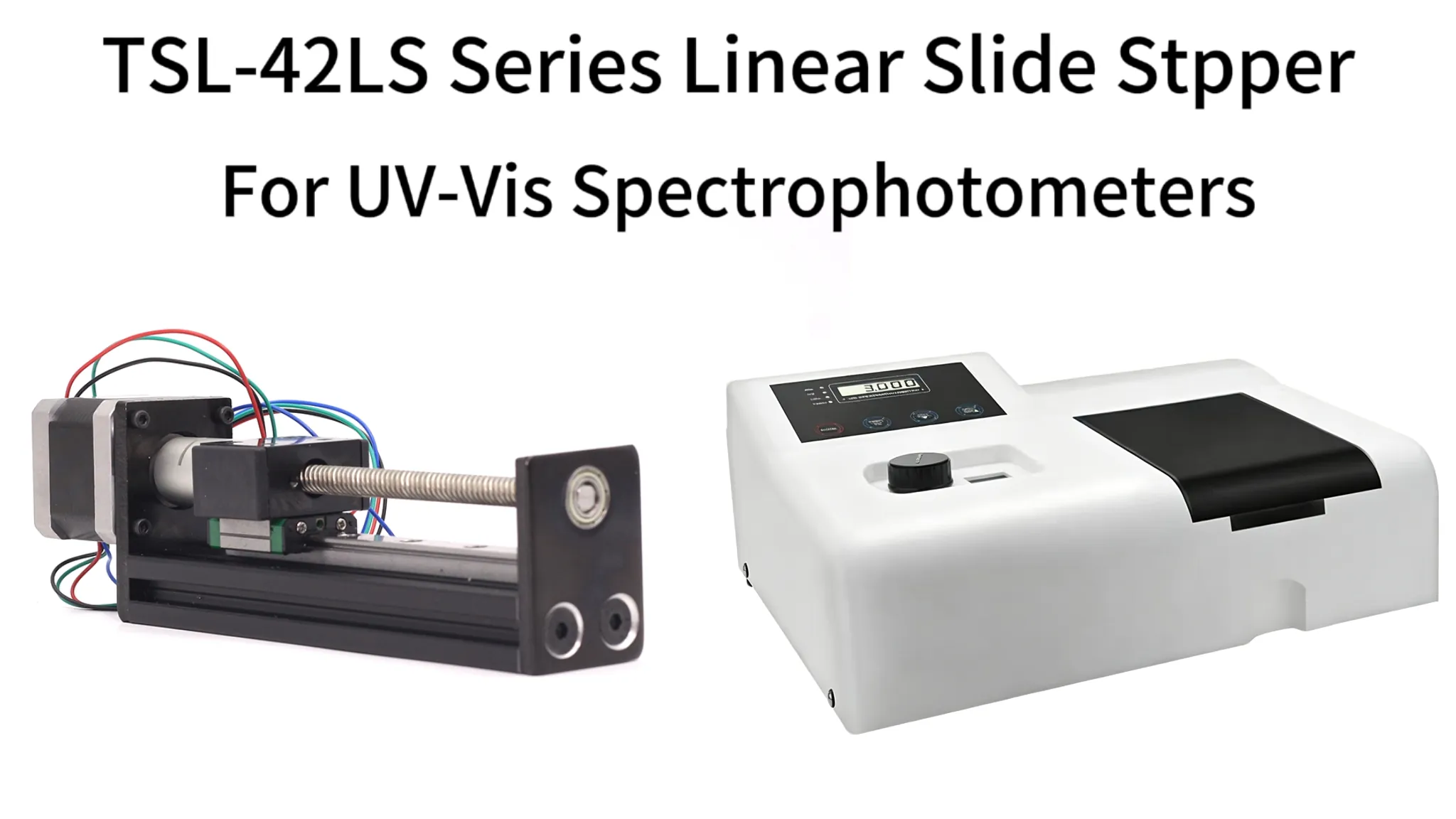
The TSL-42LS Series 42 hybrid stepper motor linear drive solution offers two optional forms. One is an integrated linear slide stepper motor. The other is a split solution, which includes a stepper motor, coupling, and precision linear module.
With micron-level positioning accuracy, closed-loop controllability, smooth operation, and flexible adaptability, it provides a stable and efficient precision drive solution for UV-Vis spectrophotometers. It fully meets the strict requirements of laboratory analytical instruments for accuracy, stability, low interference, long service life, and easy integration.
Key Takeaways
- The TSL-42LS Series offers both integrated linear slide and flexible split drive configurations.
- Closed-loop control prevents wavelength deviation by providing real-time feedback on rotor position.
- Low-vibration operation eliminates baseline drift and optical path resonance during testing.
- The beam splitter drive ensures consistent light intensity between sample and reference beams.
- High-rigidity self-locking maintains stable mirror angles without thermal drift or creep.
- Automatic sample switching enables high-throughput testing with accurate cuvette alignment.
- Customization services allow for tailored electrical interfaces and specialized environmental protections.
What Is a UV-Vis Spectrophotometer?
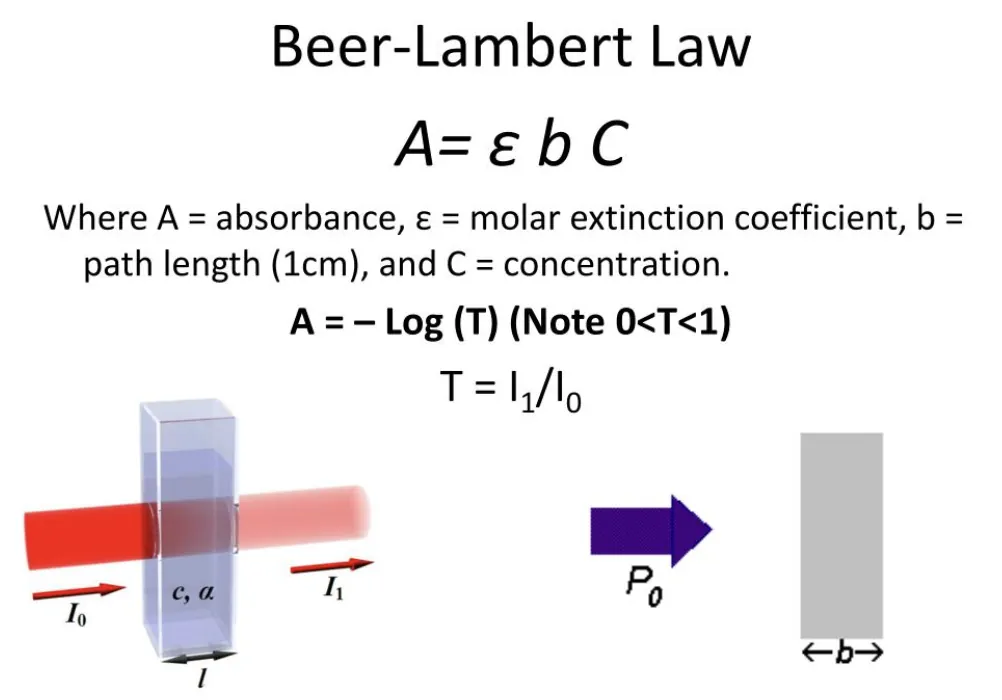
A UV-Vis spectrophotometer is based on the Lambert-Beer law. It uses the selective absorption of ultraviolet and visible light by substances at different wavelengths. It is used for qualitative identification, purity testing, structural analysis, and quantitative measurement.
The UV-Vis spectrophotometer is a basic precision optical analysis instrument in laboratories. It is also an essential testing device in pharmaceuticals, environmental protection, food, chemical engineering, life science, and clinical testing.
When a beam of parallel monochromatic light passes vertically through a sample, the absorbance is proportional to the concentration of the absorbing substance and the optical path length.
By detecting the intensity change between incident light and transmitted light, the instrument calculates key parameters such as absorbance and transmittance. It then achieves qualitative and quantitative analysis of the substance.
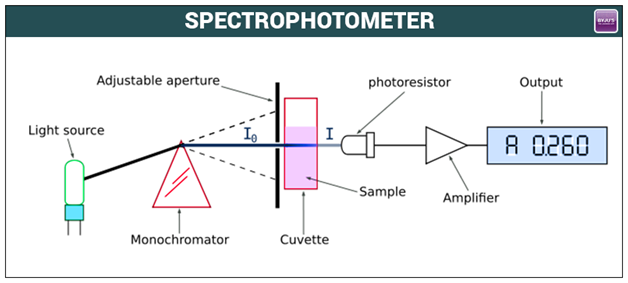
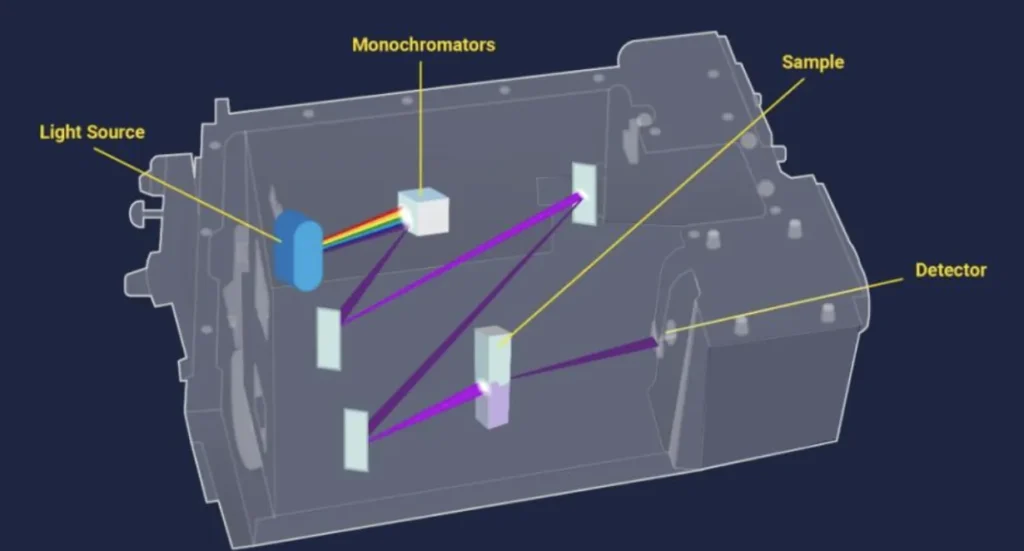
The light source emits composite light. A tungsten lamp or tungsten-halogen lamp provides visible light. A hydrogen lamp or deuterium lamp provides ultraviolet light. The composite light is dispersed by a monochromator, such as a prism or grating, into monochromatic light at different wavelengths.
After the monochromatic light passes through the sample in the cuvette, part of the light is absorbed by the sample. The unabsorbed transmitted light reaches the detector. The detector converts the optical signal into an electrical signal. After amplification and data processing, the instrument outputs the absorption spectrum and quantitative test data of the sample.
Role of TSL-42LS Linear Slide Hybrid Stepper Motor in UV-Vis Spectrophotometers
In spectrophotometers, the TSL-42LS Series motor acts as the mechanical power source for core beam quality adjustment and sample switching.
Beam Quality Adjustment
The detection stability, data signal-to-noise ratio, and stray light suppression of a spectrophotometer depend heavily on synchronous control and precise switching of the optical path system. This process is key to eliminating system errors and improving detection reliability.
It is also a key application scenario for the TSL-42LS Series motor. It mainly covers the drive of optical components such as beam splitters and plane mirrors.
Synchronous Drive of the Beam Splitter in a Double-Beam System
In a double-beam spectrophotometer, the beam splitter is a core component. It helps eliminate system errors caused by light source intensity fluctuation and amplifier gain drift. It needs to drive the mirror to swing or rotate at high speed and in sync. This divides the monochromatic light into two beams: the sample beam and the reference beam.
The TSL-42LS Series linear slide hybrid stepper motor offers excellent low-speed smoothness and synchronous control performance. It can accurately match the synchronous rotation frequency of the beam splitter. It has no phase drift and no motion jitter.
It ensures consistent light intensity and timing between the sample beam and the reference beam. This eliminates detection errors caused by light source fluctuation at the source. It greatly improves the long-term detection stability of the instrument.
Optical Path Calibration of Plane Mirrors
Plane mirrors handle optical path redirection, range switching, and automatic optical path calibration. They require precise angular deflection control and long-term stable position locking.
The TSL-42LS linear slide hybrid stepper motor has high-rigidity self-locking capability. It can keep the mirror angle stable for a long time. It has no creep and no thermal drift. It can quickly complete automatic optical path calibration at startup. It can also accurately position the mirror for range switching. Repeated manual calibration is not required. This greatly reduces instrument operation and maintenance costs.
Automatic Sample Switching
High-throughput automated testing and ultra-micro sample analysis are key development directions for modern UV-Vis spectrophotometers. The mechanical motion accuracy of the sample chamber directly determines the reliability of test results.
This is a basic application scenario for the TSL-42LS Series motor. It can be flexibly matched with either the integrated linear slide solution or the split module solution.
Automated 8-cell or 16-cell sample holders need to move under motor drive through a guide rail and slider structure. They complete fast switching between the reference cell and sample cells. Each cuvette must be accurately aligned with the center of the optical path.
The TSL-42LS Series motor supports a horizontal load of up to 56 kg. It can easily drive heavy thermostatic cell holders with constant-temperature water jackets. Its ultra-high repeat positioning accuracy of ±0.05 mm ensures that the detection beam always passes through the geometric center of the cuvette.
This completely avoids absorbance data fluctuation caused by cup wall scattering and optical path deviation. It meets the needs of high-throughput batch sample testing in pharmaceutical quality control and environmental monitoring.
Why Beam Splitters, Plane Mirrors, and Other Optical Components Prefer the TSL-42LS Series Hybrid Stepper Motor
For the drive of core optical components in UV-Vis spectrophotometers, the Series 42 hybrid stepper motor has irreplaceable advantages in adaptability, stability, and overall cost. Compared with other drive solutions, it better matches the core needs of optical applications.
| Motor Type | Positioning Accuracy | Closed-Loop Feedback | Position Holding | Operating Noise | Service Life | Overall Cost |
| Voice coil / direct-drive motor | High for micro-stroke, low for large-angle or long-stroke motion | Yes | Poor. Continuous power is needed for locking. | Medium | Medium | High |
| DC brushed motor | Low | No | Poor | High | Short | Low |
| Standard open-loop stepper motor | Medium | No | Medium | Medium | Long | Medium |
| Precision servo motor | High | Yes | Medium | Low | Long | High |
| Series 42 hybrid stepper motor | High | Yes | Excellent | Low | Long | Moderate |
Core Product Advantages of TSL-42LS Series 42 Hybrid Stepper Motor
The TSL-42LS Series is a 42 mm standard hybrid stepper motor drive solution designed for precision optical instruments. It offers both integrated and split configurations. It can fully meet the drive requirements of various core optical components in UV-Vis spectrophotometers.
Closed-Loop Control
A 1000-2500 line high-precision encoder can be built in. It provides real-time feedback on rotor position and motion travel. It forms full closed-loop control. Positioning accuracy can reach the micron level. Angular control accuracy can reach 0.001°.
This completely prevents wavelength deviation and optical path misalignment caused by step loss. It ensures the accuracy of test data.
Low Vibration
Through optimized internal electromagnetic design and a precision transmission structure, the motor runs smoothly at low speed. There is no jitter and no crawling. No vibration is transferred to optical components. This avoids optical path resonance and baseline drift. It is ideal for quiet laboratory environments and strict precision optical applications.
Long-Term Stability
The motor uses high-quality rare-earth permanent magnets, precision silent bearings, and wear-resistant transmission parts. It has passed strict working condition tests. It can support millions of reciprocating cycles without performance degradation.
It meets the needs of 24/7 continuous operation and high-throughput batch sample testing. It greatly reduces maintenance costs throughout the equipment life cycle.
Strong Expandability
It can be flexibly matched with dedicated drivers, gearboxes, and transmission mechanisms. It can meet different torque, speed, and travel requirements. It can perfectly match the optical path design of single-beam, double-beam, diode-array, and other spectrophotometer models.
Dedicated Advantages of the Two Solutions
The integrated linear slide solution combines the Series 42 hybrid stepper motor with a high-precision ball screw linear slide. The structure is compact. It greatly reduces installation space. It is ideal for the compact layout of small benchtop instruments.
It also eliminates coaxiality errors and transmission backlash caused by split assembly. This further improves positioning accuracy and operating smoothness. It uses a standardized mounting interface. It is ready to install and use. It greatly lowers the technical threshold and defect rate of full-machine assembly.
The split solution includes a motor, high-rigidity coupling, and precision linear module. It uses a Series 42 hybrid stepper motor with a high-rigidity elastic coupling or diaphragm coupling and a precision linear module.
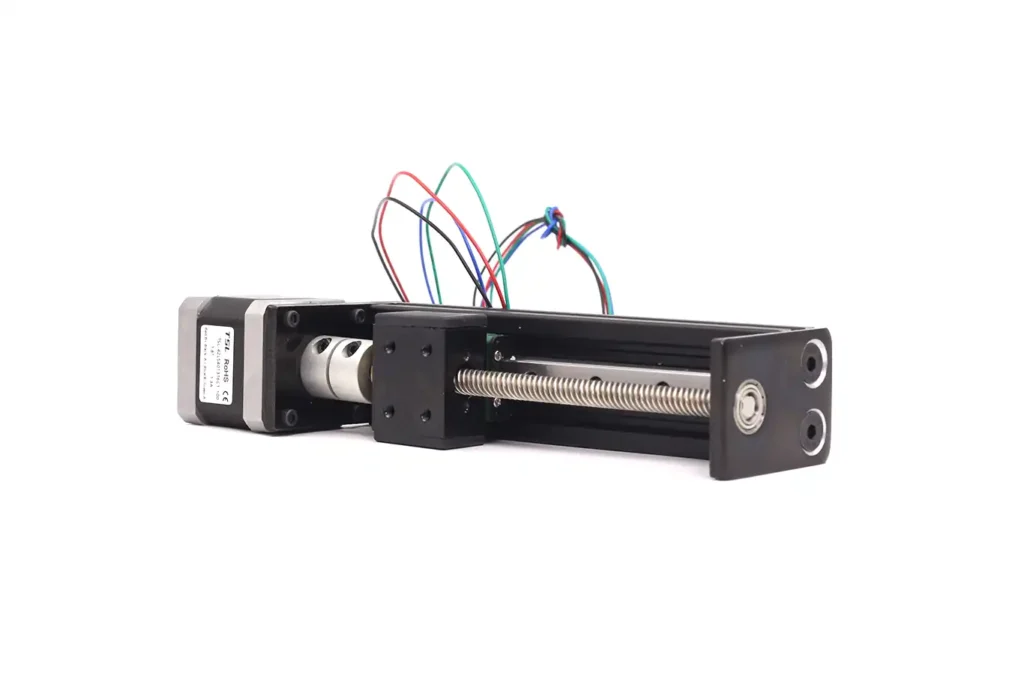
The motor installation direction, effective module travel, and screw lead can be freely adjusted according to the overall layout, installation space, and transmission needs of the instrument. It has very strong adaptability. It is ideal for non-standard customized high-end instrument designs.
The high-precision coupling can effectively compensate for coaxiality deviation between the motor and module. It can isolate the influence of motor axial vibration on the optical system. This further improves optical path stability. At the same time, the standardized interface supports quick assembly and disassembly. This makes later maintenance and part replacement easier.
Customization Services and Technical Support
To meet the diverse full-machine design needs of global analytical instrument manufacturers, we provide full-dimensional customization services and full-process technical support for the TSL-42LS Series 42 hybrid stepper motor. Both the integrated and split solutions support deep customization.
Customers can customize encoder accuracy level, rated current, and holding torque according to instrument accuracy, travel, and torque requirements. They can customize the effective travel and screw lead of the integrated linear slide. They can also customize the travel, screw specification, and coupling type of the split module.
A dedicated driver can also be selected. This forms a complete “motor + drive + transmission” solution. It simplifies system debugging and integration for customers.
For mechanical structure, we support customization of the motor output shaft, mounting holes, connecting flange, limit structure, and other details. This allows perfect matching with the customer’s full-machine design drawings.
For electrical performance, we can customize wire length, wiring method, and connector type. This meets internal wiring standards and electrical interface requirements inside the instrument. For laboratory instrument environments, we can also upgrade the product with dust resistance, moisture resistance, and electromagnetic interference resistance. This improves operating stability in complex environments.
From early-stage selection, solution evaluation, and prototype testing, to mid-stage installation, debugging, and adaptation optimization, and then to later mass production and after-sales maintenance, we provide one-on-one technical support throughout the whole process. This helps customers shorten the R&D cycle and speed up product launch.
Industry Trends and Future Outlook
With the rapid development of precision testing, life science, and green pharmaceuticals, UV-Vis spectrophotometers are moving toward higher accuracy, smaller size, greater intelligence, and higher throughput. Functions such as full-wavelength fast scanning, automatic sample handling, and IoT remote calibration are gradually becoming standard in the industry. Instruments now place higher requirements on drive systems for positioning accuracy, smooth operation, thermal stability, and integration.
In the future, high-precision closed-loop control, modular integration, low heat generation, strong position holding, and flexible customization will become the main development directions of spectrophotometer drive systems.
We will continue to focus on technological upgrades in the field of precision optical instrument drives. We will keep optimizing the integrated and split solutions in integrated design, transmission accuracy, and closed-loop control performance.
We will launch drive solutions that better meet the needs of next-generation UV-Vis spectrophotometers. This will provide continuous drive support for the technological development of the global analytical testing industry.
Conclusion
The TSL-42LS Series 42 hybrid stepper motor covers two options. One is the integrated linear slide solution. The other is the split solution with a motor, high-rigidity coupling, and precision linear module.
With micron-level high-precision positioning, stable closed-loop control, low-vibration and low-noise operation, excellent position holding, and strong cost performance, it perfectly meets the drive requirements of core optical components in UV-Vis spectrophotometers. These include beam splitters, plane mirrors, and sample cell translation stages.
The solution can accurately match both standardized compact instruments and non-standard customized high-end instruments. It ensures instrument detection accuracy and long-term stability. It also effectively reduces R&D, assembly, and maintenance costs. It is an ideal drive choice for UV-Vis spectrophotometers.
As precision analytical testing technology continues to spread and upgrade worldwide, we will continue to focus on precision motion control. With a mature product system, flexible customization services, and professional full-process technical support, we will work with global analytical instrument manufacturers to drive innovation. Together, we will provide stable and reliable drive support for more accurate, efficient, and intelligent analytical testing technology.
FAQ
Q1:Which components in a UV-Vis spectrophotometer use the TSL-42LS motor?
The motor is primarily used to drive core optical components such as beam splitters and plane mirrors for optical path adjustment, as well as translation stages for automatic sample switching.
Q2:How does the TSL-42LS improve the accuracy of test data?
By utilizing built-in high-precision encoders for full closed-loop control, the motor achieves micron-level positioning and an angular accuracy of 0.001°, which prevents wavelength deviation and optical path misalignment.
Q3:Is the motor quiet enough for a laboratory environment?
Yes, the motor features an optimized electromagnetic design and precision transmission that ensures smooth operation at low speeds with no jitter or resonance, making it ideal for quiet lab settings.
Q4:Can the TSL-42LS handle heavy sample holders with temperature control?
Yes, the motor supports a horizontal load of up to 56 kg, allowing it to easily drive heavy thermostatic cell holders while maintaining a repeat positioning accuracy of ±0.05mm.