
The global drone and FPV racing industry is rapidly developing toward higher speed, greater maneuverability, and multi‑scene applications. Rocket racing drones—featuring a low‑drag, streamlined rocket‑shaped fuselage—have become core flight equipment for FPV racing competitions, high‑speed cinematic filming, low‑altitude emergency inspection, and security reconnaissance.
The flight performance, control precision, and operational reliability of rocket racing drones depend critically on the powertrain. As the core drive component of the powertrain, high‑performance brushless motors directly determine the aircraft’s power output, dynamic response, and stability across all operating conditions.
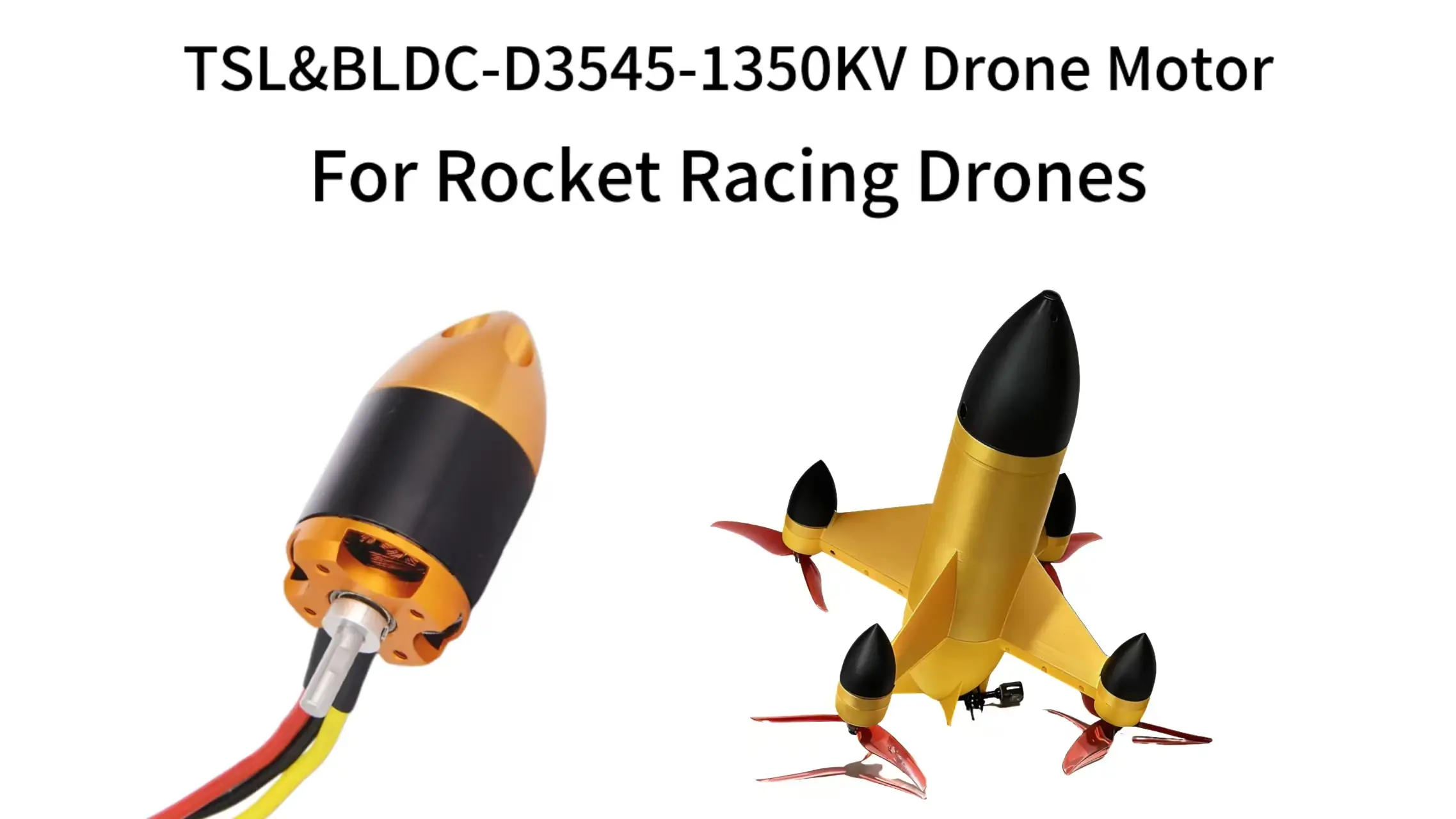
The TSL‑BLDC‑D3545‑1350KV outrunner brushless DC motor features an integrated rocket‑nose shape and optimized front‑end vent design. It provides a mature, reliable, and mass‑producible dedicated power solution for global rocket racing drone manufacturers, racing teams, and industrial users.
Key Takeaways
- The TSL-BLDC-D3545-1350KV motor utilizes an integrated streamlined rocket-nose to maximize aerodynamic efficiency.
- Rocket racing drones solve the industry pain point of short endurance by drastically reducing high-speed air resistance.
- Outrunner brushless DC motors have become the industry standard due to their superior power density and torque output.
- The optimized vented cooling structure ensures thermal stability and consistent power output under full-load conditions.
- Aerospace-grade aluminum alloy housing enhances structural reliability against high-speed impacts and intense vibrations.
- The 1350KV power configuration enables rocket drones to perform instantaneous bursts of speed and complex aerial maneuvers.
- Comprehensive customization services provide global manufacturers with technical support ranging from KV adjustments to environmental reinforcement.
Overview of Rocket Racing Drones
A rocket racing drone (also called a high‑speed rocket‑style FPV drone) is a specialized unmanned aerial vehicle (UAV) with a low‑drag, streamlined rocket‑shaped fuselage. It combines the high maneuverability of FPV drones with the aerodynamic efficiency of high‑speed aircraft, representing a key high‑speed segment in the current FPV drone market.
Unlike traditional open‑frame multi‑rotor FPV drones, rocket racing drones use an integrated streamlined fuselage to drastically reduce aerodynamic drag and losses while optimizing overall weight distribution and flight stability. They achieve significantly higher speed, acceleration, and maximum range than conventional FPV drones.
With core advantages such as a high thrust‑to‑weight ratio, strong maneuverability, low drag, and excellent environmental adaptability, rocket‑racing drones have gained wide global adoption.
They are used in professional FPV racing, high‑speed dynamic cinematography, public‑security emergency reconnaissance, low‑altitude inspection of power and oil‑gas pipelines, military target‑drone simulation, and environmental monitoring.
As one of the fastest‑growing segments in the UAV industry, rocket racing drones impose far stricter technical requirements on their core drive motors than ordinary FPV drones.
Why Rocket Racing Drones Adopt an Integrated Rocket‑Nose Design
The streamlined rocket‑nose design used in both the drone fuselage and core drive motor is not merely for visual consistency. It is a key solution that synergistically optimizes aerodynamic efficiency, power performance, and structural reliability around the core positioning of high speed, high maneuverability, and long endurance—making it the core competitive edge over traditional open‑frame FPV drones.
For the Complete Aircraft
The core value of the rocket‑nose streamlined fuselage is to minimize drag losses during high‑speed flight.
Traditional open‑frame FPV drones have large frontal areas and protruding structures. Pressure drag and turbulence increase exponentially with speed, wasting large amounts of power and severely limiting top speed and flight time.
A rocket‑nose streamlined fuselage designed for subsonic aerodynamics reduces overall drag coefficient by more than 40%. With the same power, it greatly boosts flight speed and significantly lowers energy consumption, fundamentally solving the industry pain point of short endurance in high‑speed FPV drones.
Meanwhile, the integrated rocket‑nose fuselage offers superior structural strength, effectively dispersing impact forces from collisions and protecting internal core components. It also reduces flight noise, expanding use in noise‑sensitive scenarios such as cinematic aerial filming and security reconnaissance.
Rocket‑Nose Design for the Motor
Applying an integrated rocket‑nose design to the drive motor is a critical detail for maximizing overall aerodynamic performance and ensuring stable powertrain operation.
If the aircraft uses a low‑drag streamlined design but the motor has a conventional flat end‑cap, it creates a disruptive drag point on the frontal surface, generating extra drag and turbulence that directly negate the aircraft’s low‑drag advantages.
The integrated rocket‑nose shape at the motor front forms a smooth, continuous aerodynamic surface with the fuselage, fully unleashing the drone’s low‑drag aerodynamic benefits.
In addition, vents on the rocket nose create internal cooling ducts. Oncoming airflow at high speed directly cools the motor’s heat‑generating core components, greatly improving heat dissipation and avoiding thermal degradation under full load. This preserves stable power output and extends motor life.
The one‑piece structure also enhances impact resistance, perfectly suiting the harsh high‑speed, high‑maneuver operating conditions of rocket racing drones.
The Preferred Power for Rocket Racing Drones: Outrunner Brushless DC Motors
Outrunner brushless DC motors have become the mainstream power solution in the global rocket racing drone industry due to their structural and performance advantages. They offer irreplaceable compatibility compared to coreless motors, conventional inrunner brushless motors, and brushed DC motors.
Comparison with Coreless Motors
Although coreless motors are lightweight, their winding structure lacks strength and cannot withstand the sustained high current and heavy loads required by rocket racing drones, making them prone to overheating and burnout.
They also deliver insufficient torque for sustained high‑speed power and have poor shock and vibration resistance. Vibration and impacts during flight easily damage the motor. They are only suitable for micro, low‑load small aircraft and cannot meet the high‑speed, high‑load demands of rocket racing drones.
Conventional Inrunner Brushless Motors
Conventional inrunner brushless motors have an internal rotor design with low torque density. While capable of high RPM, they deliver weak low‑speed high torque, poorly matching rocket racing drone load characteristics and causing lag under full‑throttle acceleration.
They are larger and heavier at equal power, harming the aircraft’s thrust‑to‑weight ratio. Their shape is hard to adapt to the streamlined aerodynamic layout of rocket racing drones, raising integration difficulty and failing to meet core power needs.
Brushed DC Motors
Brushed DC motors rely on mechanical commutation with carbon brushes, leading to inherent wear and short service life. Carbon brushes wear out quickly under high‑RPM, high‑current conditions.
Commutation sparks and strong electromagnetic interference severely disrupt flight controllers and video transmission.
They also have low energy conversion efficiency, severe heat generation, and obvious thermal degradation under heavy load, making them unsuitable for long‑duration, high‑stability rocket racing drone flight. They are only used in low‑end toy‑grade aircraft.
| Comparison Item | Coreless Motor | Conventional Inrunner Brushless Motor | Brushed DC Motor | Outrunner Brushless DC Motor |
| Power Density | Low | Medium | Low | High |
| High Torque Output | Weak | Average | Weak | Strong |
| Dynamic Response | Average | Average | Poor | Excellent |
| High‑RPM Stability | Poor | Medium | Poor | Excellent |
| High Current Tolerance | Low | Medium | Low | High |
| Aerodynamic Compatibility | Poor | Average | Poor | Excellent |
| Shock & Vibration Resistance | Poor | Medium | Poor | Excellent |
| Service Life | Medium | Medium | Short | Extra Long |
| Airframe Integration | Poor | Average | Poor | Best |
| Overall Cost‑Effectiveness | Medium | Medium | Low | High |
Advantages of the TSL‑BLDC‑D3545‑1350KV Drone Motor
The TSL‑BLDC‑D3545‑1350KV is a high‑performance outrunner brushless DC motor developed specifically for rocket racing drones. Fully optimized for rocket racing drone operating conditions, it features an integrated rocket‑nose shape and front‑end vented structure to fully meet the power‑drive requirements of professional rocket racing drones.
Integrated Aerodynamic Design
The TSL‑BLDC‑D3545‑1350KV uses an integrated streamlined rocket‑nose shape that seamlessly matches the fuselage’s streamlined layout. It greatly reduces extra drag and turbulence caused by the motor, optimizes overall aerodynamic efficiency, and further improves flight speed and endurance.
Optimized Front‑End Vents
Dual improvement in heat dissipation and weight reduction
The motor front has multiple sets of vents. On one hand, they create through internal ducts to accelerate airflow and quickly remove heat from windings and cores under heavy load, drastically improving cooling efficiency.
On the other hand, they effectively reduce weight without sacrificing structural strength, further boosting the motor’s thrust‑to‑weight ratio and optimizing overall aircraft weight balance.
Ultra‑High Power Density
Industry‑leading thrust‑to‑weight ratio
The motor uses an optimized 12‑slot, 14‑pole magnetic circuit with permanent magnets and low‑loss silicon steel. With a lightweight body of only 170g, it delivers a maximum continuous power output of 1150W and stably withstands 65A continuous current.
At a working voltage of 22.2V, it provides a stable thrust of 1800g, with a thrust‑to‑weight ratio far exceeding peer products. It perfectly supports extreme acceleration, high‑speed cruising, and difficult aerobatic maneuvers, solving the industry pain point of insufficient power in compact traditional motors.
Ultra‑Fast Dynamic Response
Using an outrunner direct‑drive design, torque is delivered directly without loss. The moment of inertia is precisely matched to rocket racing drone loads. Paired with a rated KV value of 1350rpm/V, the motor has extremely strong RPM tracking, responding to flight controller and throttle commands in microseconds with no lag or power fluctuation.
It remains smooth even at high RPM, ensuring consistent power and precise control during frequent attitude changes, high‑speed turns, and aerobatic maneuver switching.
High Conversion Efficiency
With high‑precision, low‑internal‑resistance winding design, the motor has a no‑load current of only 2.8A at 15V. Its energy conversion efficiency is well above the industry average, greatly reducing power loss and effectively extending flight time.
Combined with the vented cooling structure, it further cuts extra losses from high temperatures, maintaining high efficiency across all operating conditions.
High Structural Strength
The motor body is precision‑machined from aerospace‑grade aluminum alloy, with the rocket nose and body integrated for higher strength.
Core components undergo strict dynamic balancing, resulting in low vibration and noise during operation. It also offers exceptional shock and vibration resistance, withstanding aerodynamic forces, continuous vibration, and accidental impacts during high‑speed flight. It maintains structural integrity and stable performance in complex environments, greatly lowering the risk of flight failures.
Wide Operating Condition Compatibility
The motor supports a wide voltage input of 3–6S LiPo batteries, compatible with mainstream global rocket racing drone power systems. Its brushless commutation structure eliminates mechanical wear and spark interference, not affecting flight controller or video transmission performance.
It operates stably in a wide temperature range of −20°C to 60°C, adapting to high‑altitude, high‑temperature, low‑temperature, and other complex outdoor environments. It has a long fault‑free service life to meet high‑frequency, high‑intensity competition and operational demands.
Standardized Design
It uses industry‑standard mounting holes, a φ5mm standard shaft diameter, and a standardized three‑wire output connector. It quickly fits mainstream ESCs, flight controllers, and rocket racing drone frames without custom modifications, greatly shortening manufacturers’ product development cycles and lowering mass‑production integration costs.
TSL‑BLDC‑D3545‑1350KV Drone Motor Summary
The TSL‑BLDC‑D3545‑1350KV is an outrunner brushless DC motor dedicated to rocket racing drones. It features an optimized 12‑slot, 14‑pole magnetic circuit, an integrated rocket‑nose front end, and a vented cooling structure, enabling fast compatibility with various rocket racing drone flight control and power systems.
Customization Services & Technical Support
We provide one‑stop customized solutions and full‑cycle technical support for global rocket racing drone manufacturers, professional racing teams, and industrial users. Covering product design, prototype development, testing and validation, and mass production, we fully meet personalized needs.
Core Parameter Customization
KV value, rated torque, RPM range, operating voltage, power output, and other core parameters can be customized according to aircraft load, speed, thrust, and power supply specifications.
Structural Design Customization
Shaft diameter, mounting holes, wire outlet, connector type, waterproof and dustproof rating, housing material, and other structural customizations are supported.
Rocket‑nose shape, vent specifications, and layout can also be tailored to the user’s aerodynamic layout.
Special Environment Reinforcement
Material upgrades, structural reinforcement, and protective treatments are available for harsh environments such as high altitude, high humidity, salt fog, and heavy impact, meeting military, industrial, marine, and other specialized industry needs.
We provide full‑cycle technical support: from early power system selection, structural adaptation design, and prototype performance testing to mass‑production delivery and after‑sales maintenance. Our dedicated one‑on‑one professional support helps customers quickly launch high‑performance rocket racing drones and seize global market opportunities.
Conclusion
The TSL‑BLDC‑D3545‑1350KV outrunner brushless DC motor for rocket racing drones perfectly meets the stringent all‑operating‑condition demands of rocket racing drones through its core advantages: integrated rocket‑nose aerodynamic design and vented cooling‑and‑weight‑reduction structure.
This product effectively resolves industry pain points of traditional coreless, conventional inrunner brushless, and brushed DC motors in power output, dynamic response, aerodynamic compatibility, and reliability. It provides a mature, reliable, and scalable dedicated power solution for global rocket racing drone manufacturers, professional racing teams, and industrial users.
Going forward, we will continue to focus on core brushless DC motor technologies, refine product performance, improve our global service system, and empower customers worldwide to enhance their core competitiveness with high‑quality products and professional customization services. We will drive the deep application and popularization of rocket racing drones across global industries.
FAQ
Q1:Why must rocket racing drones use an “integrated nose” motor design?
A1:Standard flat-capped motors create significant pressure drag and turbulence at high speeds. The TSL-BLDC-D3545-1350KV’s integrated rocket-nose design forms a continuous aerodynamic surface with the fuselage, reducing drag by over 40% to boost top speed and flight endurance.
Q2:What does the 1350KV rating mean for rocket drone performance?
A2:The 1350KV rating provides an ideal balance between high RPM and high torque. When powered by a 6S LiPo (22.2V), it delivers explosive acceleration and microsecond-level dynamic response, ensuring immediate power delivery during high-speed turns or acrobatic maneuvers.
Q3:How do the front-end vents function during flight?
A3:At high speeds, the vents act as forced-air cooling ducts. Oncoming airflow is driven directly through the motor’s internal coils and core, preventing thermal degradation during sustained full-throttle operation and extending the motor’s overall lifespan.