
In optical imaging devices, the aperture, or iris, is the core component that controls the amount of incoming light. It directly determines exposure accuracy, depth of field, and dynamic range.
With the popularity of large-aperture lenses and variable aperture technology, video shooting now requires quieter operation and faster response. As a result, the performance of the iris drive motor has become an important factor that distinguishes lens grades.
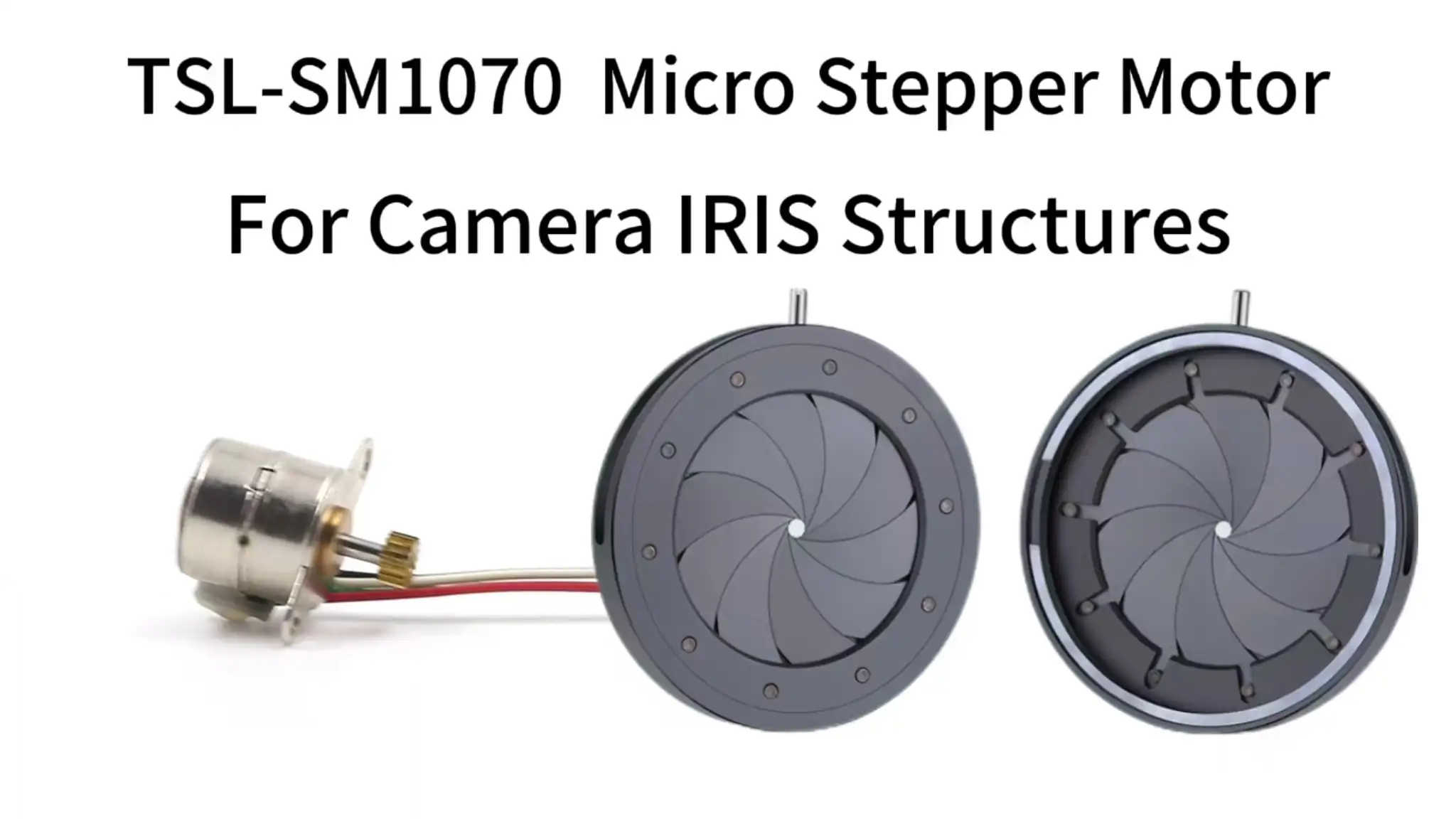
The TSL-SM1070 geared miniature permanent magnet stepper motor is designed for camera iris drive applications. It features a compact rotary output structure, precise angle control, and stable operation. It is now a mainstream solution that combines cost efficiency and reliability.
Key Takeaways
- The TSL-SM1070 motor features an ultra-compact 10mm diameter for space-constrained lenses.
- Integrated metal gears amplify torque to drive multi-blade iris structures smoothly.
- Precise step control guarantees millisecond-level response for automatic exposure systems.
- The low-noise design prevents mechanical sounds from interfering with video audio tracks.
- Permanent magnet technology ensures long-term stability and high position-holding capability.
- Sealed metal housings protect the motor from dust and moisture in outdoor security environments.
- Customizable output gears allow for seamless mechanical integration with various lens designs.
Working Principle of a Camera Iris Structure
In an optical imaging system, the iris works in the same way as the pupil of the human eye. It is the main “gate” that controls light entering the camera. Its adjustment accuracy directly determines exposure accuracy, dynamic range, and depth of field. It is one of the key factors that affect lens image quality.
Modern camera irises use a multi-blade overlapping structure. They usually consist of 6 to 12 curved thin metal blades, a central drive dial, and an outer fixed ring. One end of each blade is fixed to the outer ring. The other end is inserted into the guide slot of the central drive dial.
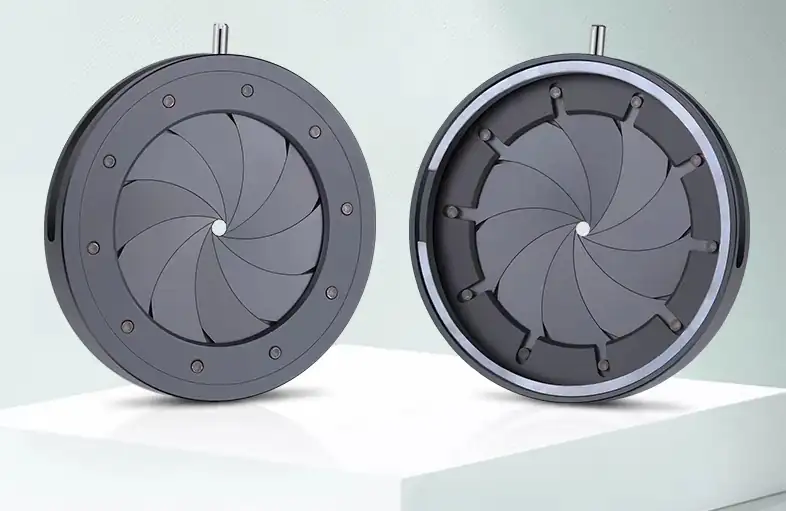
When the drive motor rotates the central dial, the guide slots push all blades at the same time. The blades move inward toward the center or outward. This forms a circular light opening with an adjustable size. A larger opening allows more light to enter the camera in a given time. A smaller opening allows less light to enter.
This synchronized opening and closing design keeps the light opening nearly circular. It prevents image distortion and irregular light spots caused by a non-circular aperture. The more blades the iris has, the closer the opening is to a perfect circle. Image quality also improves. However, this also requires higher output torque from the drive motor.
Two Core Functions of the Camera Iris
Controlling the Amount of Incoming Light
This is the most basic and most important function of the iris.
Under different lighting conditions, the camera needs to adjust the iris opening. This keeps the light intensity reaching the image sensor within the ideal range.
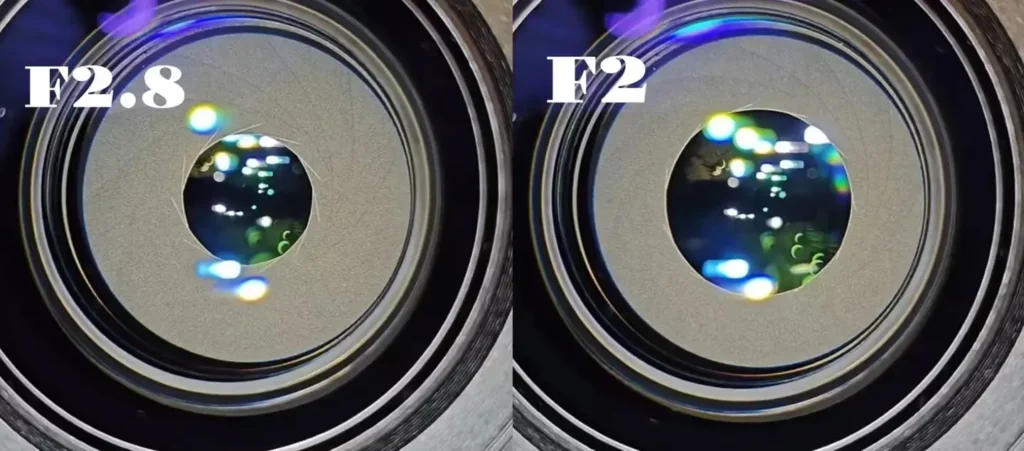
- Strong sunlight: reduce the aperture size. This prevents overexposure and loss of highlight details.
- Cloudy days or low light at night: enlarge the aperture. This increases incoming light, lowers ISO, and reduces image noise.
For cameras that support automatic exposure, the iris must adjust in real time according to ambient light. This ensures accurate exposure for every photo.
Adjusting Image Depth of Field
In addition to controlling incoming light, the iris can also control depth of field by changing the aperture size.

- Large aperture: shallow depth of field. The background blur is strong. It is suitable for portraits, still life, and scenes that need to highlight the subject.
- Small aperture: deep depth of field. The image stays clear from near to far. It is suitable for landscapes, architecture, and scenes that require full-scene clarity.
Because of the adjustable aperture, photographers can create images with different styles according to different shooting needs.
Core Technical Requirements for Iris Drive
Unlike zoom and focus systems, which require long-stroke linear motion, iris drive has a unique motion form and performance requirements. This also determines the motor selection standards.
Small-angle, high-precision rotation: the full working stroke of the iris is only a 0 to 90° rotation. But the angle control accuracy must be very high. The light opening area is proportional to the square of the radius. Even a 0.1° angle error can cause a clear deviation in incoming light. This may lead to inaccurate exposure or image brightness flicker.
Millisecond-level fast response: during dynamic shooting and video recording, ambient light may change sharply in an instant. The motor must switch from the minimum aperture to the maximum aperture within tens of milliseconds. This allows the automatic exposure system to keep up with changes in light in real time.
Extremely low-noise operation: during video shooting and live streaming, the camera microphone records surrounding sounds. If the motor produces obvious mechanical noise or electromagnetic noise, it will be recorded in the video. This seriously affects audio quality and viewing experience.
Ultra-compact design: modern lenses are becoming more compact and thinner. This is especially true for large-aperture lenses. Most internal space is occupied by optical elements. The space left for the iris drive motor is very limited.
High reliability and long service life: the camera aperture needs to open and close frequently throughout the product life cycle. The total number of cycles can reach millions. Cameras must also work under harsh conditions, such as wide temperature ranges, humidity, and dust. This places very high demands on motor reliability and durability.
Core Role of the Motor in the Iris System
In the iris system, the drive motor is the only power source. Its core function is to output precise small-angle rotary torque. It drives the dial and blade group to open and close in sync. It is the key link between the electronic control system and the optical actuator. Its performance directly determines aperture adjustment accuracy, speed, and smoothness.
A high-performance iris drive motor enables seamless aperture switching. Users will not notice any mechanical movement during shooting.
In contrast, poor motor accuracy can cause inaccurate exposure and image brightness flicker. Slow response can miss the best shooting moment. Excessive noise can seriously damage video audio quality. Therefore, the quality of the iris drive motor directly affects the overall imaging experience and market competitiveness of the lens.
Why Choose a Miniature Permanent Magnet Stepper Motor
There are many motor types available for iris drive. But in terms of overall performance, cost, and reliability, the miniature permanent magnet stepper motor is currently the best solution.
| Item | Brushed DC motor | Voice coil motor | Brushless DC motor | Permanent magnet stepper motor with geared output shaft |
| Rotation Accuracy | Low | High | Medium | Extremely high |
| Response Speed | Medium | Extremely fast | Fast | Fast |
| Output Torque | Medium | Low | Medium | High |
| Operating Noise | High | Low | Medium | Extremely low |
| Service Life | Short, due to brush wear | Medium | Long | Very long |
| Overall Cost | Low | High | High | Medium |
| Main Application | Low-end toy-grade devices. It has basically been eliminated. | Small-aperture drive in high-end flagship phones. Fast aperture adjustment in high-end professional cameras. | High-torque drive for large professional lenses. | Iris drive for most cameras and surveillance lenses. |
Core Application Advantages of TSL-VSM1070 in Iris Drive
The TSL-SM1070 is a miniature permanent magnet stepper motor optimized for camera iris drive applications. It has a diameter of only 10 mm and a length of 9.2 mm. Its output shaft integrates a high-precision metal transmission gear. It delivers high performance in a very small size.
Miniaturization
To solve the problem of limited internal lens space, the TSL-VSM1070 uses a miniature structural design. The motor body and output gear are highly integrated. With a 10 mm diameter and 9.2 mm motor length, it can easily fit into iris modules of large-aperture lenses and compact lenses. This leaves more space for optical design.
Low Noise
We have fully optimized the TSL-SM1070 for low-noise operation. It uses high-precision bearings and special grease to reduce mechanical friction noise. The motor drive current waveform is also optimized to suppress electromagnetic noise.
High Torque Output
With the popularity of large-aperture lenses, the number of iris blades is increasing. This requires higher motor output torque. The TSL-SM1070 uses a small gear to drive a larger gear. This amplifies torque. It can output enough torque at low current. It can easily drive large-aperture irises with 6 to 12 blades. It also ensures smooth and fast aperture opening and closing.
Long Service Life
The TSL-VSM1070 uses high-grade permanent magnetic materials and wear-resistant metal parts. Every production step follows strict process control and reliability testing. Its output gear and bearings receive special wear-resistant treatment. They can withstand millions of repeated rotations. The motor also uses a sealed design. It can operate stably for a long time in harsh environments, including high and low temperatures, humidity, and dust.
TSL-VSM1070 Miniature Permanent Magnet Stepper Motor Product Overview
The TSL-SM1070 is a two-phase, four-wire miniature permanent magnet stepper motor. Its output shaft has a metal transmission gear. It uses a standard lead-wire interface. This makes it easy to connect to the device mainboard. The motor uses a metal housing. It offers good heat dissipation and mechanical strength.
We can also customize output gears with different modules and tooth numbers according to customer needs. We can also customize lead-wire lengths and connector types.
Wide Range of Practical Application Scenarios
With its excellent overall performance, the TSL-SM1070 miniature permanent magnet stepper motor has become a preferred iris drive solution for many optical imaging devices. It is widely used in the following fields.
Consumer electronics: aperture drive for consumer digital cameras, compact cameras, DSLR cameras, and mirrorless cameras. It enables precise exposure control and depth-of-field adjustment.
Security monitoring: automatic iris drive for HD network cameras, bullet cameras, and dome cameras. It ensures clear monitoring under different lighting conditions throughout the day.
Industrial field: aperture drive for machine vision cameras and industrial inspection equipment. It enables precise exposure control and improves inspection accuracy.
Medical field: aperture drive for medical endoscopes, surgical microscopes, and pathology slide scanners. It helps doctors obtain clear and stable medical images.
Customization Services and Technical Support
As a professional DC motor and stepper motor manufacturer, we have rich experience in drive solutions for optical imaging applications. In addition to standard TSL-SM1070 products, we can also provide full customization services based on customer needs.
We can adjust key parameters according to customer requirements. These include step angle, output torque, and rated voltage. We can also customize output gears with different modules and tooth numbers. We can provide connecting wires with different lengths and interfaces.
For customers with special structural requirements, we can provide one-stop service. This includes product design, mold development, and manufacturing. We also have an experienced technical support team. We can provide full technical guidance from model selection to debugging. This helps customers bring products to market faster.
Industry Trends and Future Outlook
As optical imaging technology continues to develop, camera iris technology is also improving. In the future, multi-blade large apertures, stepless variable apertures, and intelligent aperture adjustment will become industry trends. These trends will place higher requirements on motor accuracy, torque, response speed, and quiet operation.
As a leading company in the industry, we always follow the forefront of technological development. We continue to increase R&D investment. We are committed to launching more high-performance, compact, and low-noise iris drive motor products.
We believe that our strong technical accumulation and deep understanding of customer needs will help us provide better drive solutions for global optical imaging equipment manufacturers. Together, we can promote the continuous progress of imaging technology.
Conclusion
Aperture adjustment is the foundation of optical imaging. The drive motor is the heart of the aperture system. The TSL-SM1070 miniature permanent magnet stepper motor with geared output shaft meets the drive needs of camera iris structures. It offers an extremely compact design, precise angle control, low-noise operation, and high reliability.
In the future, we will continue to focus on drive technology for optical imaging. We will keep innovating and pursuing excellence. We look forward to working with more partners. With high-quality motor products, we aim to bring users a clearer and better visual experience.
FAQ
Q1:Why is the TSL-SM1070 specifically suited for camera iris drive?
The iris requires precise, small-angle rotation (0–90°) within a very tight space. The TSL-VSM1070’s 10mm miniature diameter and integrated gear output provide the high torque and angular precision needed to move multiple iris blades synchronously.
Q2:How does this motor ensure accurate exposure in photos?
Even a 0.1° angle error can cause exposure deviation. The TSL-VSM1070 permanent magnet stepper motor offers extremely high rotation accuracy, ensuring the aperture opening area matches the electronic system’s commands perfectly to prevent brightness flicker.
Q3:Does the motor noise affect video recording?
No. The TSL-VSM1070 is optimized with high-precision bearings, specialized grease, and suppressed electromagnetic noise. This ensures the mechanical movement is nearly silent and won’t be picked up by the camera’s microphone during 4K/8K recording.